Nomura: The "Blue Wave" impacts American data centers, while Chinese AI benefits instead
The Democratic Party in the United States swept both houses of Congress in the midterm elections, raising concerns in the market about the prospects for data center construction in the U.S. However, Nomura Securities believes that the net impact of this political shift on China's AI economy may actually be positive.
According to news from the Wind Trading Desk, economists Ting Lu and Jing Wang at Nomura pointed out in a report released on November 6 that the **Democratic Party's "blue wave" will slow down the expansion of U.S. data centers through strengthened regulation and protection of electricity prices, which will trigger a decline in global AI chip prices and alleviate the pressure on Chinese companies in acquiring high-end chips. "We expect the overall Chinese AI economy to benefit significantly from the blue wave in the U.S.," the report stated.**
Market reactions have already indicated the issue. Within two trading days after the election results were announced, the Nasdaq Composite Index fell 5.5% on the second trading day, marking the largest single-day drop in 18 months; the Philadelphia Semiconductor Index (SOX) dropped nearly 15% over two days. Nvidia fell about 12% over two days, Micron Technology dropped about 24%, and SK Hynix and Samsung Electronics fell 9.5% and 7.5% respectively in the Korean KOSPI market, triggering automatic circuit breaker mechanisms.
Morgan Stanley, in a report during the same period, noted that Democratic control of Congress does not mean a substantive easing of U.S.-China relations, but it does enhance policy predictability. In terms of AI investment strategy, the firm is more optimistic about China's "self-sufficient" direction rather than relying on global AI capital expenditure export chain targets.
### U.S. Data Center Construction: Stricter Regulation, Expansion Hindered
The direct impact of this election result is that U.S. data center construction will face stricter policy constraints.
According to the Nomura report, the Democratic Party won governorships in several key states for data center construction, **with the new leadership emphasizing consumer electricity burdens, energy affordability, and corporate accountability during the campaign.** This means that data center developers will no longer be able to pass on the capital costs of upgrading the power grid, expanding transmission, and adding generation to residential users; the financial burden will fall directly on the developers themselves.
The firm pointed out that stricter municipal regulations, prohibiting confidentiality agreements during the early site selection phase, and mandatory clean energy procurement requirements will replace the previous rapid industrial development model. "The time required for a newly built hyperscale data center from site selection to grid connection will be significantly extended," the report stated.
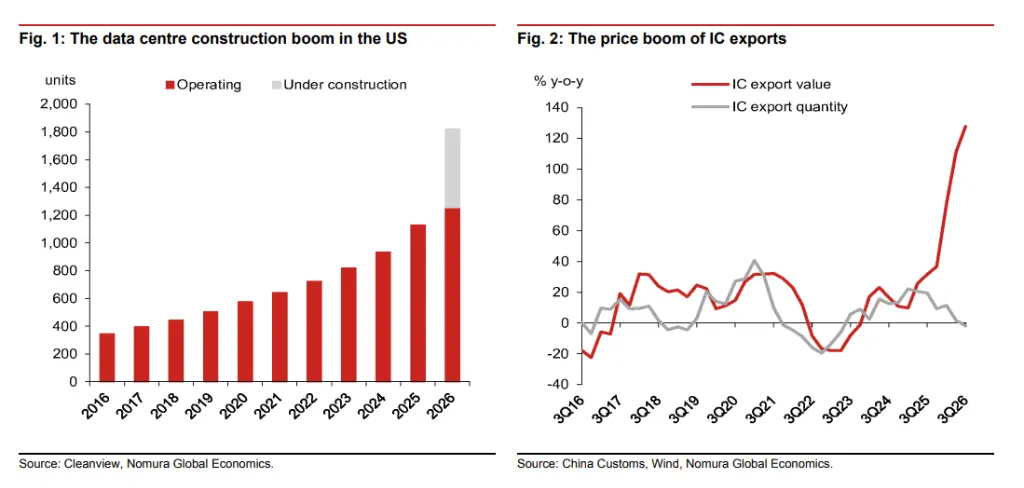
Currently, the scale of data center construction in the U.S. is enormous. According to Cleanview tracking data, there are over 4,500 data centers distributed across more than 1,500 parks in the U.S., with about 1,418 operational, 564 under construction, and another 2,555 in the planning stage. Data from commercial real estate firm Cushman & Wakefield shows that the current construction capacity has reached a record 37.7 gigawatts, with planned pipelines as high as 285 gigawatts.
### Chip Price Decline: An Unexpected Dividend for Chinese Data Centers?
For China, the most direct benefit from the slowdown in U.S. data center construction is the reduced difficulty and price pressure in acquiring AI chips.
The firm noted, **"When U.S. cloud giants aggressively expanded data centers, they hoarded global GPU, HBM, and advanced logic chip capacity, tightening global supply and driving up the premiums of constrained hardware in black markets and secondary channels."**
Once U.S. data center capital expenditure slows, this situation will ease. **The firm believes that Chinese AI companies, cloud service providers, and research institutions will be able to obtain relevant GPUs, HBM modules, and advanced packaging materials more conveniently and at lower costs through intermediary trade hubs.**
Analysts pointed out that during the peak of U.S. data center construction, the premiums for advanced GPUs and HBM modules in Asian logistics hubs often reached 200% to 300% of the listed price. As Western demand cools, "these speculative premiums may collapse significantly, allowing Chinese buyers to acquire computing hardware at more reasonable prices."
At the infrastructure level, China is promoting a nationally led network construction of AI data centers, with the 15th Five-Year Plan planning to invest about 2 trillion yuan (approximately 295 billion USD), aiming to integrate dispersed regional computing power facilities into a unified interconnected network by 2028, mainly operated by state-owned telecom giants like China Mobile and China Telecom. Unlike the local resistance faced by U.S. grid construction, China relies on the "East Data West Computing" project, coordinated by the State Grid, allowing computing power hubs in western regions such as Guizhou, Inner Mongolia, Gansu, and Ningxia to directly access low-cost renewable energy without dealing with residential electricity price disputes or grid connection queues.
### Morgan Stanley: Favoring Localization and "Self-Sufficiency" Themes in China
Morgan Stanley provided a supplementary perspective on the above logic in its report, but with a more cautious tone.
Strategists Laura Wang and Vicky Wu pointed out that Democratic control of Congress should not be interpreted as a substantive easing of U.S.-China relations. "We believe that strategic competition and geopolitical uncertainty will continue to exist."
The strategists believe that the potential positive impact of this election lies in the increased predictability brought about by policy constraints. Congressional checks and balances will make large-scale unilateral policies more difficult, reducing the likelihood of tariffs being repeatedly upgraded as a primary bilateral policy tool.
The firm suggested distinguishing between two types of Chinese AI trades: **beta exposure to the global AI supply chain (such as optical transceivers, which mainly follow global AI capital expenditure and U.S. policy reviews) and the localization and self-sufficiency theme in China.**
**"We prefer self-sufficiency trades—these enjoy both supply and demand support within the framework of China's national policy priorities."** Analysts believe that the ongoing bipartisan technological competition with China will only reinforce domestic policy commitments to technological self-reliance, covering semiconductors, computing power, power equipment, and domestic AI infrastructure.
Additionally, the firm pointed out that compared to the market's excessive focus on AI trades in the first half of 2026, current investment opportunities in the Chinese stock market are more balanced, covering consumer and industrial exporters, oil price-sensitive downstream industries, healthcare/biotechnology, and green energy sectors. The report also noted that the current valuation of the Chinese stock market is near historical absolute lows, approximately within a 10% range, and various funds have recently significantly increased their buying power in A-shares.
### Rising Risk of U.S. Data Centers Relocating
Moreover, there is a popular view that as domestic regulations tighten in the U.S., there may be risks of data centers relocating abroad.
Recently, All-In Podcast co-hosts Jason Calacanis, David Sacks, and David Friedberg also warned in their program that if states continue to set approval barriers, giga-level data center projects worth over $50 billion will be forced to relocate to Canada, Mexico, Malaysia, or even the Middle East, turning the U.S. from a "global computing power exporter" into an expensive "token importer," with significant strategic impacts on technological competitiveness and employment.
Analysis indicates that the "blue wave" has instead made orders in the Asian computing power industry more certain and performance more predictable.