After five consecutive quarters of losses and a nearly 90% drop in stock price since the IPO: How much longer can Gemini's cash last?
*Author: [Olga Kharif](https://www.bloomberg.com/news/articles/2026-11-12/winklevosses-gemini-exchange-posts-narrower-than-expected-loss?srnd=phx-crypto), Bloomberg*
*Original text compiled by: Deep Tide TechFlow*
Gemini Space Station Inc. has recorded losses for five consecutive quarters since its IPO, with a loss of $58.6 million in the third quarter, equating to a loss of 46 cents per share. The company's revenue fell 19% to $40.9 million, with spot trading volume plummeting 73% year-over-year; total operating expenses decreased by 30% year-over-year to $119.9 million.
As of the end of this quarter, Gemini held $194.1 million in cash, down from $252.2 million at the end of last year. Analysts are closely monitoring its cash burn rate to assess how long the company can continue to operate.
Founded by billionaire brothers Tyler Winklevoss and Cameron Winklevoss, this digital asset platform went public last year, shortly before the cryptocurrency market retreated from its historical highs; now, it faces its fifth consecutive quarter of losses since going public.
The company reported a loss of $58.6 million in the third quarter, with a loss of 46 cents per share, better than the Bloomberg analyst consensus forecast of a loss of 67 cents per share; in the same period last year, Gemini lost $159.5 million. Revenue decreased by 19% year-over-year to $40.9 million, also better than market expectations.
The New York-based company's stock price rose over 5% in after-hours trading. However, compared to its IPO price in September 2025, the stock has cumulatively dropped nearly 90%.

*Image: In October, Tyler Winklevoss and Cameron Winklevoss attended the Token2049 conference in Singapore, Photographer: Ore Huiying / Bloomberg*
Although Gemini is much smaller than exchanges like Coinbase, OKX, and Binance, the Winklevoss twins are among the most prominent supporters in the cryptocurrency industry. In the recently concluded midterm elections in the United States, they were major donors in the industry, helping to push for favorable regulatory rules.
As Gemini released its financial report, digital asset prices weakened again due to U.S. inflation data exceeding expectations, leading to a cooling of market risk appetite, while concerns grew that the Democratic control of Congress would result in unfavorable policies for the industry. A significant portion of cryptocurrency exchange revenue comes from trading fees, and low coin prices typically suppress trading activity.
Gemini stated in its announcement on Thursday that spot trading volume fell 73% year-over-year. Meanwhile, total operating expenses decreased by 30% year-over-year to $119.9 million, primarily due to reductions in payroll costs and marketing expenditures.
CEO Tyler Winklevoss stated, "Operating expenses have decreased for three consecutive quarters. While we invest resources to expand our business, we will continue to prudently manage our capital allocation. We are aware of the challenges ahead and are determined to do things right."
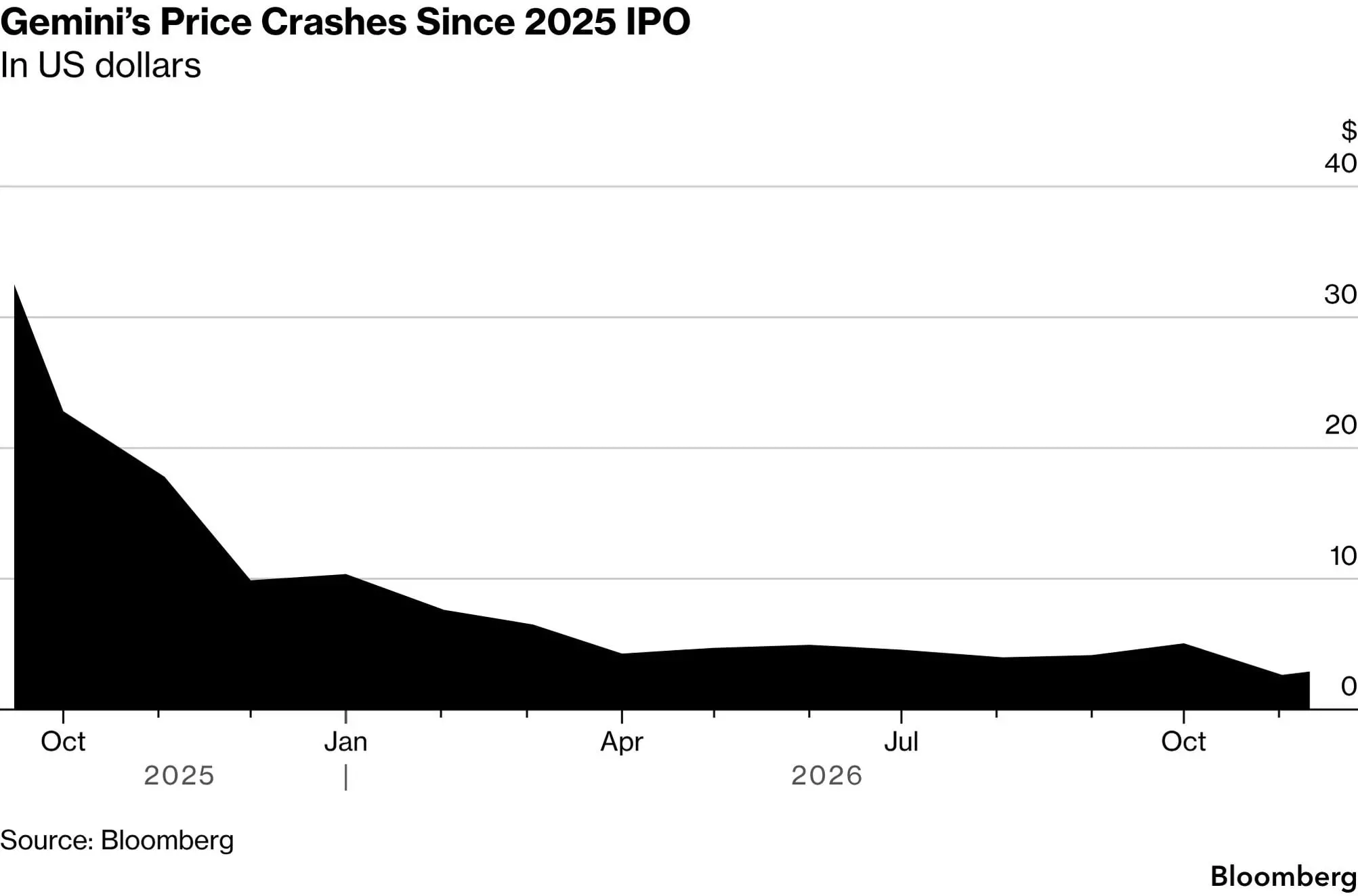
*Image: Gemini's stock price has plummeted significantly since its IPO in October 2025, oscillating at low levels for an extended period.*
To reduce reliance on trading fee revenue, Gemini is exploring new businesses such as prediction markets. This segment generated $800,000 in revenue for the quarter, a 52% increase quarter-over-quarter.
As of the end of the quarter, the company had $194.1 million in cash, down from $252.2 million at the end of last year. Analysts continue to track its cash burn rate to determine how long the company can sustain operations without additional funding from the Winklevoss brothers.
Matthew Coad, a stock analyst at Truist Securities, stated before the earnings report, "I believe the brothers will continue to act as a last line of funding to sustain operations until the next cryptocurrency bull market arrives. Our model does not account for any subsequent capital increases from them, but the company's outlook remains highly uncertain."
Earlier this year, the company laid off about one-third of its workforce, and several executives left. In May, the brothers invested $100 million into the continuously loss-making exchange. Additionally, the platform faced a high incidence of credit card fraud this year, with Gemini stating that the scale of credit card write-offs increased in the third quarter due to previously reported fraud incidents.
Just a week before Gemini's earnings report, larger competitor Coinbase released its earnings, returning to profitability after a year, but also reported a decline in quarterly revenue.