What is the AI of the payment company doing with one trillion tokens a year?
Adyen's CTO said that the company has about 1,400 developers who consume approximately one trillion tokens each year. In the past three months, this number has quadrupled, and Adyen has begun preparing for an annual consumption of one hundred trillion tokens.
Where is their token spending going? What are they doing?
Adyen's one trillion tokens are primarily burned by the engineering team. Looking at other payment companies, tokens are also spent on merchant reviews, customer service responses, handling chargebacks, reading emails, and investigating anomalies.
Money flows like water, and tokens do too.
People sit there without moving, while tokens keep running.
In the past 90 days, AI at Adyen has edited about one million documents and participated in 20,000 Git commits. The company's average merge request has increased by 48%, and engineers estimate that AI has saved them about 15% of their time. Adyen believes that the money spent on tokens has likely yielded a twofold return.
They shared an example where Adyen has a backend payment system responsible for invoicing, reconciliation, and card organization reporting, which contains about 2,000 production tasks involving over forty card organizations. The original system was all crammed into a large deployment image, and Adyen wanted to break it apart so that each card organization would have its own independent image.
Following previous practices, this project would require multiple teams and take 6 to 12 months. In the end, two engineers worked with AI and completed it in two months without any incidents.
This is roughly how the Coding Agent consumes tokens. It doesn't just help you fill in a couple of lines of code; it first reads the code, reads the documentation, finds dependencies, and runs tests. If the tests fail, it reads the error messages, modifies the code, and runs it again. When a person opens several agents simultaneously, they continuously repeat these processes in the background. People sit there without moving, while tokens keep running.
Stripe has also mentioned that 91% of their engineers are using AI in their daily work (it's unclear why the remaining 9% haven't been laid off). The internal Coding Agent `minion` submits over 1,000 PRs to the production environment each week. In March 2026 alone, Stripe had over 57,000 PRs utilizing AI Coding Assistance, a 140% increase in three months.
Block is similar, with about 7,500 employees using AI weekly, and over 90% of code submissions involve AI participation, with the average weekly code change increasing by 30%.
Currently, it appears that a significant portion of the token bill for payment companies comes from the engineering department. The use of AI in the payment industry is not just about writing new code from scratch; a more realistic application is helping humans climb the mountain of complexity. Payment systems are vast, with a lot of legacy code, and they need to accommodate banks, card organizations, and various payment methods. Previously, this complexity mainly consumed engineers' time, but now AI is also brought in to help, consuming tokens.

Searching for documents, writing ads, reading contracts, all consume tokens.
Writing code is just one part of how companies use AI internally. A slightly larger fintech company spends a lot of time daily searching for information: Where is the reimbursement policy? Which team manages this data? Where to apply for permissions for a certain system? Who should be contacted for leave? The larger the company, the more documents there are; the more documents there are, the easier it is to get lost.
Nubank has about 9,000 employees, and different teams place their processes and documents in Confluence. When employees encounter problems, they may need to search for half an hour; if they still can't find it, they open a ticket and wait for several hours. Nubank later created an internal tool called AskNu, where employees can directly ask questions in Slack. AskNu first determines which department the question belongs to, then searches for the answer in the corresponding Confluence documents, and finally organizes a response using a large model, including the original link.
Six months after launch, AskNu had 5,000 users and handled 280,000 messages. Nubank stated that it reduced some internal tickets by 96%. Problems that previously took 30 minutes to find or required an 8-hour wait for a ticket now receive answers in an average of 9 seconds.
AskNu does not directly help customers transfer money or process payments, but it continuously reads questions, retrieves documents, and organizes answers. Every person in the company asks a few times a day, and tokens accumulate little by little.
The content team is the same. Chime named its internal content model very straightforwardly: ChimeGPT. It also created a "brand brain" that includes past brand stories, user feedback, campaign results, and community discussions. The marketing team uses it to generate different versions of content and personalized onboarding processes, which then undergo brand, legal, and compliance reviews.
Chime disclosed that the internal team's content output has increased by over 300% year-on-year, and production time has been reduced by 60%. What used to take ten hours from concept to campaign can now be completed in about four hours, with testing volume tripling. Klarna's organizational data is also interesting: 90% of employees use generative AI daily, with usage rates in communications, marketing, and legal teams reaching 93%, 88%, and 86%, respectively.
Writing code consumes tokens, and so does writing ads, translating materials, summarizing meetings, reading contracts, and answering colleagues' questions.

"Champagne-colored dress" does not mean selling alcohol.
Payment companies perform a task somewhat akin to checking identities every day: Who is this person? What exactly are they selling? Can we allow them to come in and collect money?
Merchants certainly do not honestly introduce themselves according to the payment company's forms. Clues are scattered across official websites, product pages, registration documents, and news articles, and they may be written in different languages. The previous systems lacked the patience for such complexity, and the simplest method was to check keywords.
Airwallex provided a humorous example. One merchant sells a "military-style jacket," and the system sees "military," which may lead it to suspect they are selling prohibited military goods; another merchant writes "champagne-colored dress," and the system sees "champagne," which might lead it to think they are selling alcohol.
A person can tell at a glance that a military-style jacket is not a weapon, and there is no champagne in a champagne-colored dress. But keywords do not understand colors or fashion; they only know that this word looks a bit dangerous.
This is precisely what large models excel at: not just focusing on a single word, but reading the surrounding content first and then seeing what the merchant is actually selling. Airwallex stated that after integrating generative AI into KYC, the average false positive rate in related processes decreased by 50%, and the number of clients that could complete onboarding without human intervention increased by 20%.

Stripe also began using LLM for merchant onboarding in 2023. It does not allow the large model to approve all merchants; instead, it first processes open, unstructured information and quickly passes through applications that clearly meet the requirements. Over 80% of "eligible merchants" can be automatically approved instantly. Checkout.com's policy review has been shortened from 60 minutes to 10 minutes.
Previously, employees had to open web pages, read materials, check policies, and write conclusions themselves; now, the large model reads through first and highlights the areas that need human attention. The tokens burned here translate into fewer false positives, faster account openings, and less time spent by internal personnel on materials that are not problematic at all.
A five-dollar cup of coffee also needs to go through finance.
Payment companies help others handle money, but internally they still need to reimburse, audit expenses, chase invoices, and do accounting. This may be the most inconspicuous type of fintech AI product. When an employee uses a company card to buy a cup of coffee, they may need to upload a receipt, specify the purpose, and select an expense category; managers need to confirm if it was for work, finance has to check the policy, do accounting coding, and then sync it into ERP. The amount may only be five dollars, but the labor cost to process it is often higher.
Ramp created a Policy Agent specifically to audit these types of expenses. It checks if the receipt and transaction match, whether there are duplicate reimbursements, if the purpose is clearly stated, whether it violates company policy, and if the employee has any unusual spending recently. Compliant expenses can be automatically suggested for approval, while problematic ones are referred to a human. Ramp claims that early clients reduced manual reviews by about 85%, with an accuracy rate of over 99% in expense policy enforcement, while the final approval authority remains with the reviewer.
Brex Assistant handles even more trivial tasks. It automatically finds receipts, writes memos, fills in expense categories and attendees, and proactively questions employees about non-compliant expenses. Brex provided an example: a receipt may not state "alcohol," but only "vodka." Previous keyword rules might not catch that, but the large model knows that vodka counts as alcohol.
This kind of work is well-suited for exchanging tokens for time.
AML analysts spend most of their time not catching bad guys.
Payment companies generate a large number of risk alerts daily. There may not be many truly suspicious transactions, but each alert requires someone to open it, check customer information, review historical transactions, examine related accounts, and then write a paragraph explaining why to close or escalate the investigation. Many AML analysts do not spend their time catching bad guys; instead, they spend it proving that a person does not currently look like a bad guy.
Nexo uses Unit21's AI Agent for preliminary alert reviews. The agent organizes transaction and account information, analyzes relationships between addresses, and generates investigation summaries and handling opinions. Analysts no longer start from a blank page but check the materials and conclusions provided by AI.
In the case study released by Unit21 and Nexo, it was mentioned that Nexo's false positive rate decreased by 93% compared to the previous internal system, and currently, 57% of alert reviews are completed automatically by AI, with a goal of increasing that to 80%. This set of numbers should be noted: it comes from a case jointly published by the vendor and the client, not from an independent audit; Unit21 has not disclosed how many tokens are consumed per investigation.
However, this case clearly illustrates what AI can do in AML: the machine gathers the materials, maps out the relationships, and writes the narrative; humans then judge whether it is genuinely suspicious and whether to report it to regulators.
A client simply asked, "Where is my money?"
Customer service at payment companies is sometimes not as simple as "help me change my password." When a customer asks, "Why hasn't the money arrived yet?" it may involve the acquiring bank, card organization, issuing bank, currency conversion, settlement cycle, refund status, and account restrictions. Customer service representatives have to check multiple systems and piece together the information to provide a coherent answer.
AI Agents go through the same process: first understanding the problem, querying the transaction, retrieving rules, determining the next step, and then generating a response. Each time a system is queried, the results must be sent back to the model, and Tokens are consumed round after round.
Checkout.com states that about 60% of customer service requests are simple, repetitive questions, and the company expects that by 2026, AI Agents will be able to independently handle more than half of customer service volume. Block disclosed that approximately 65% of customer service cases at Cash App are already using AI. Klarna's numbers are even more direct: its AI Assistant served over 4 million customers in the first half of 2024, and the company expects to save $40 million annually.
The calculation of Tokens used by customer service is straightforward. Previously, a certain number of people handled a certain number of tickets; now, a certain number of Tokens handle a certain number of tickets, and it can be counted whether there was a transfer to human agents or whether the customer reopened the case.
Chargebacks and dispute handling are the same. Stripe receives a large number of automated emails from financial partners, which previously required employees to read one by one and then process them in the system; now, LLMs can first read the emails, understand what the other party wants, and then convert the requests into API calls. Checkout.com also stated that the distribution of declined transactions, which used to rely on manual completion, has now achieved 100% automation.
These tasks may not sound as grand as "AI changing finance," but they are time-consuming and well-suited for consuming Tokens.
When AI starts talking while looking at your holdings
The AIs mentioned earlier are mostly invisible to customers. They work behind the scenes in code, audits, and customer service systems. Robinhood Cortex is different; it appears directly on investors' phones.
When a user opens a stock, Cortex reads real-time quotes, breaking news, analyst reports, technical indicators, and Robinhood's own data, then explains in layman's terms why the stock is rising or falling today. It also combines with the user's holdings to explain why this news is relevant to their account.
Robinhood disclosed that Cortex Digests had been used by nearly 1 million customers by the first quarter of 2026. The next step is to allow users to buy and sell stocks and cryptocurrencies, research the market, and adjust account settings directly using natural language.
At this point, it's not just company employees consuming Tokens. Every time a user asks a question, Cortex reads a piece of news or research report, and every time it reinterprets based on personal holdings, it has to process the context again.

The real trouble is that once AI starts operating on behalf of users, the cost of mistakes changes. If the news is misreported, the user may just be misled; if the stock is bought incorrectly, real money is lost. Therefore, Robinhood has also set boundaries for Cortex: what it can see, what it can say, and which actions must be confirmed by the user.
One trillion Tokens, what does that mean for AI companies?
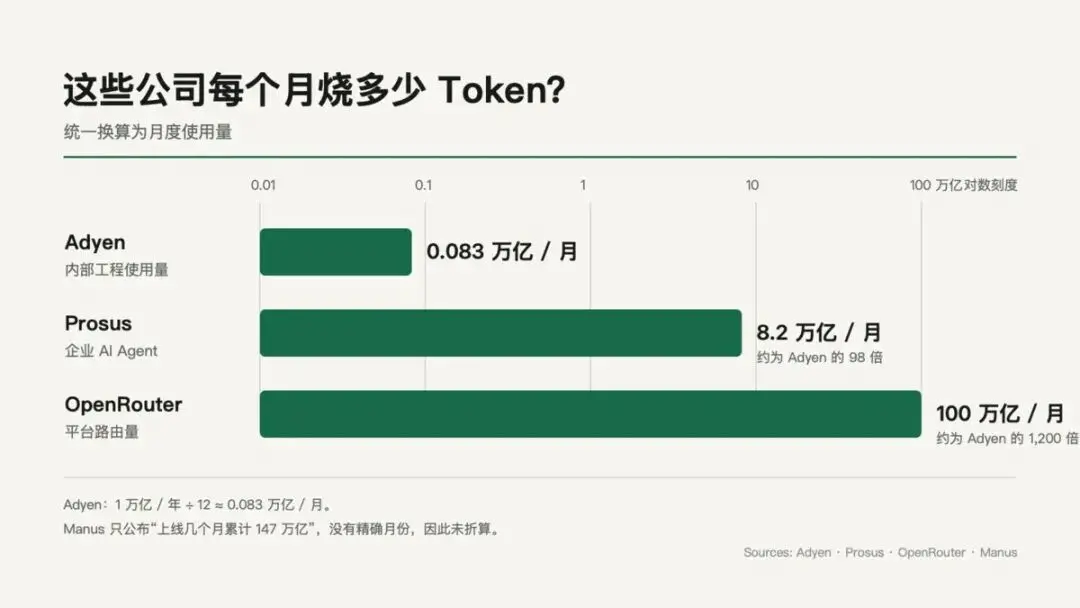
First, look at Adyen itself, with about 1,400 developers using 1 trillion Tokens in a year, averaging 710 million per person. Assuming 250 working days, that's about 2.86 million Tokens per person per day. This is no longer just occasionally letting AI fill in a few lines of code; it's having an Agent working all day.
But when this number is placed in the AI industry, the measurement unit quickly changes.
Manus's product has been online for a few months and has processed over 147 trillion Tokens, equivalent to Adyen's usage over 147 years. OpenRouter now routes 100 trillion Tokens a month, equal to the annual usage of 100 Adyen companies each month. Of course, these are platforms serving a large number of customers and cannot be directly compared to an internal engineering team of one company, but the magnitude of the difference is quite intuitive.
Looking at a company that resembles a typical business, Prosus has numerous e-commerce and internet operations, with AI Agents serving 40,000 employees, 5 million partners, and 1 billion users. It consumes 82 trillion Tokens a month, roughly finishing Adyen's annual amount every four days. Over the past year, its Token usage has grown 52 times.
OpenAI has not disclosed how many Tokens it consumes in a year, but it has revealed how much researchers can spend. By August 2026, the median daily computational cost for a researcher, based on API pricing, will exceed $600. The top 10% can spend over $7,000 a day. Assuming 250 working days a year, one person would cost $150,000, while heavy users would reach $1.75 million.
Anthropic is more direct; it measures not money but who works longer. By August 2026, the combined working hours of those Agents under employees will be six times that of humans. Most Tokens are spent on writing software, resulting in an average increase in code submission speed for each engineer to five times the original rate over six months.
Manus is similar. Co-founder Zhang Tao mentioned that there was a month when the average AI expenditure per person exceeded $10,000, with a few individuals spending $70,000 to $80,000 in a month. Not all of this is Token cost, but the meaning is clear: they are no longer just occasionally asking AI questions but are individuals managing a group of Agents simultaneously.
Thus, one trillion Tokens can be seen as both large and small. Compared to AI platforms, it is just a fraction; but for a payment company, this trillion is only happening among about 1,400 developers, not counting customer service, compliance, risk control, and customer-facing AI. Viewed this way, Adyen preparing for 100 trillion Tokens a year is not exaggerated.
Tokens can be consumed, but the accounts still need to be settled.
One trillion Tokens do not equate to a fixed amount bill; the prices of different models can vary by a hundred times. According to the standard API prices announced by OpenAI on October 28, 2026, assuming 80% of one trillion Tokens are input and 20% are output: if all are used with GPT-6 Luna, the theoretical cost would be about $180,000; if all are used with GPT-6 Astra, the theoretical cost would be about $18 million.
Adyen actually uses many different models and has its own reasoning infrastructure, semantic routing, and enterprise pricing, so the real bill is certainly not as simple as this multiplication. One trillion Tokens can be very cheap or very expensive. Spending a lot does not necessarily mean using it well.
After the Tokens are exhausted, companies must answer some very basic questions: How much code was completed without incidents? How many normal merchants were misjudged? How many customer service tickets were resolved without needing to transfer back to human agents? When handling chargebacks, were the correct materials provided to the right people?
There is one question more important than cost: How far can AI go? Helping customer service check information is not too risky; helping engineers write code can still run tests and do reviews; but if Agents are allowed to directly move funds, freeze accounts, or reject merchants, the cost of mistakes is entirely different.
At least for now, payment companies will not ask a large model about every payment. A more realistic division of labor is: the ledger continues to keep accounts, rules and dedicated models continue to judge transactions, large models are responsible for reading, writing code, checking information, and handling exceptions, while humans remain in positions where mistakes are more costly.
Money flows like water, and Tokens do too.
The end of the article

This article is based solely on personal observations and thoughts and does not constitute any investment or business advice. Readers are encouraged to consider their own understanding and information sources rationally.