Rare! Has the panic of AI in the US stock market ended?
Overnight, the U.S. stock market experienced a rare panic.
The Nasdaq fell by 5.52%, the S&P 500 dropped by 4.36%, and the Dow Jones decreased by 3.44%, with the seven major tech companies evaporating about $1 trillion in a single day; the Philadelphia Semiconductor Index fell over 12%, SanDisk dropped 22%, Micron and AMD fell around 17%, and Nvidia dropped more than 9%.
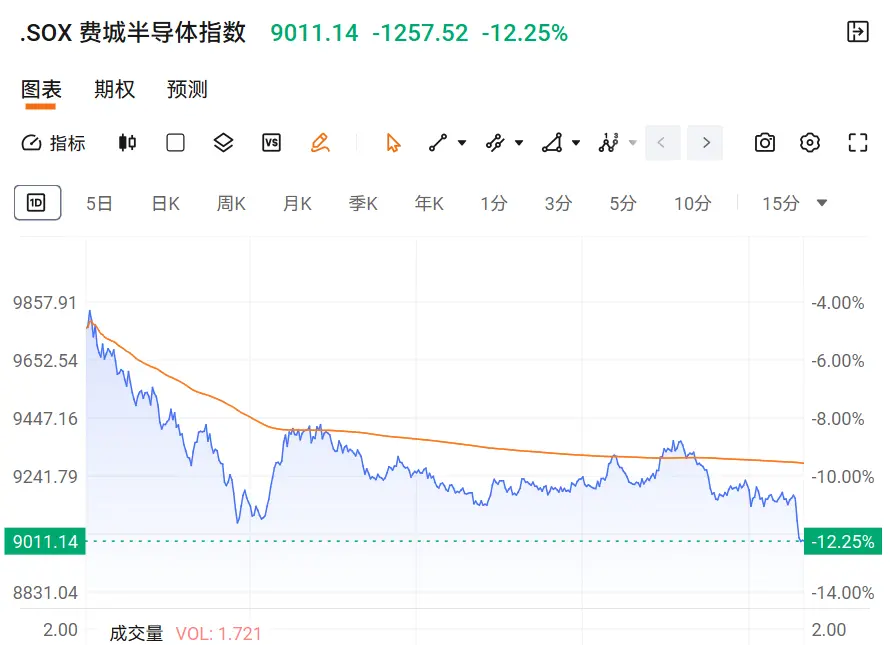
Why did it fall?
First, the "blue wave" triggered panic over AI regulation due to the midterm elections.
The Democratic Party secured both the House and Senate, making breakthroughs in data center construction in key states like Texas and Georgia.
The market is concerned that data centers may face stricter environmental, electricity, and land approval processes, or even temporary suspensions.
UBS estimates that about 30% of the planned new data center capacity in the U.S. may be affected.
This directly impacts the chain of "continuous expansion of AI computing power—ongoing growth in chip orders—cloud providers' capital expenditures increasing."
Secondly, anxiety over AI investment returns has shifted from sentiment to pressure on financial reports.
Companies like Google, Amazon, and Meta are under pressure regarding free cash flow, Intel's performance guidance is weak, and the market is starting to ask: After spending hundreds of billions, when will profits catch up?
Thirdly, the valuations of the semiconductor and computing power chains are too high, and the stakes are crowded.
Since the beginning of this year, the market's expectations for AI have been overly optimistic, especially in the AI hardware chain, which saw significant early gains and concentrated institutional holdings. Once expectations reverse, programmatic stop-losses, deleveraging, and retail sell-offs will amplify the declines.
The surge in the VIX also indicates a significant rise in panic sentiment.
Additionally, Federal Reserve officials have released hawkish signals, rising oil prices have heightened inflation concerns, and pressures from the dollar and U.S. Treasury yields are suppressing high-valuation growth stocks.
With such a drop, many people want to know if the negative impact of the Democratic Party has already been priced in.
To conclude, it cannot simply be said that it has been priced in.
More accurately, the market has only completed the first layer of pricing: the Democratic victory itself.
However, what truly affects AI valuations is the subsequent implementation of policies, which remains uncertain.
It can be understood that Wall Street sees the negative news and employs the strategy of retreating, but upon calm reflection, is everyone clear about the calculations of this negative news?
I believe it is still unclear, as quantifying these negative factors into profits, cash flow, and valuation models is not easy, or rather, there is still no specific data.
Therefore, in the short term, the pricing of policy uncertainty is insufficient.
Only after the Democratic Party truly controls both houses will AI regulation, data center approvals, grid connection costs, taxes, and antitrust investigations be re-discussed, which may provide answers.
Nvidia's financial report on the 17th of this month, or insights from management, will be worth paying attention to.
The market previously priced in "loose regulation + rapid expansion," and now needs to re-estimate the pace of capital expenditures and return cycles.
Qualitatively, AI has not been banned, but the speed of expansion may slow down.
Both parties do not want the U.S. to lose its AI advantage, but the Democratic Party emphasizes compliance, energy consumption, antitrust, and public interest more.
This means AI will still develop, but instead of being given a green light all the way, it will now have to wait at specific intersections for traffic lights.
From the perspective of the industry chain, the degree of impact also varies.
"Shovel sellers" like chips, storage, optical modules, data center operators, and power equipment are most sensitive to construction pace; the same logic applies to targets in the A-shares and Hong Kong stock markets.
Cloud giants that already have substantial computing power in production are relatively more buffered and may even enhance the value of existing assets due to supply constraints.
There is also a reverse logic.
Some institutions believe that tech companies may rush capital expenditures before policies are fully implemented; if future computing power expansion is limited, existing computing power assets may become even scarcer.
However, this can only hedge part of the risk and cannot negate the valuation discount brought about by tightened regulation.
Overall, the impact of this midterm election was indeed somewhat unexpected, but it also revealed some issues, such as the previously high expectations and high valuations.
However, I believe this is not necessarily a bad thing, as things were too crazy before, and it is time to hit the brakes. The most critical point is that the development trend of the AI industry is clear; it will not change just because the control of both houses has shifted.
For investors, it is indeed a time to dodge the flying knife; if it is uncertain whether the knife has finished falling, it is better to avoid it for now and wait until everything becomes clearer.
In terms of news, focus on the statements from Democratic officials and the views of AI companies;
In terms of fundamentals, pay close attention to corporate financial reports, especially Nvidia's report on the 17th and Micron's report next month.