One week until the midterm elections! Will Crypto change dramatically?
Written by: KarenZ, Foresight News
On November 3, American voters will decide what kind of Congress Donald Trump will face in the next two years.
The presidential term will continue, but whether the Republican Party can maintain control of both houses will be subject to the scrutiny of the ballot. For the Crypto industry, what the White House is willing to support now may not necessarily pass smoothly in Congress.
The Crypto industry has already experienced the weight of Congress. In September of this year, the highly anticipated CLARITY Act faced obstacles in advancing in the Senate. The White House has supporters, and Congress has allies, but they still cannot gather the votes needed to advance the review.
Crypto companies continue to invest in the elections, vying for who will set the rules and push the bills in the next two years, and who will demand to renegotiate the terms.
The presidential term in the United States is four years, but Congress holds elections every two years. This election, occurring in the middle of a presidential term, is referred to as the "midterm election." The voting day in 2026 is November 3, and Trump himself will not run for re-election.
The U.S. Congress is divided into the House of Representatives and the Senate, with different methods for electing the majority party.
All 435 seats in the House of Representatives are up for re-election, with a two-year term for members; seats are allocated based on population, with one representative elected from each district. To achieve a majority, a party needs to secure 218 seats.
The Senate has a total of 100 seats, with each state having two fixed seats, a six-year term for members, and staggered elections. This year, 35 seats are up for election, including 33 regular elections and two special elections to fill unexpired terms. To determine the Senate's majority, the 65 un-elected seats must also be counted. Currently, the Republican Party holds 53 seats. The coalition of Democrats and two independent senators has a total of 47 seats, needing a net gain of four seats to reach a majority of 51. The Republican Party can rely on the Vice President to break ties when there is a 50-50 split.
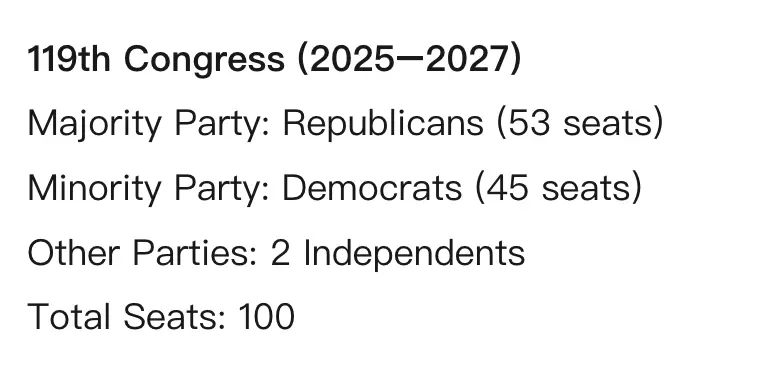
Voters cast their ballots by state or district, and the results are summarized to determine which party controls the majority in Congress.
For a crypto trading platform, a friendly regulatory attitude is certainly a good thing, but doing business still requires answering some practical questions: Is a certain token treated as a security or a commodity? Which agency does the platform register with? What regulations must be followed for custodial user assets?
Different answers lead to different products and compliance costs.
Regulatory agencies can adjust policies under existing laws, while Congress can amend laws. In October 2024, Coinbase CEO Brian Armstrong listed support for Fairshake and Stand With Crypto as one of the highest returns on investment at the policy level for the company during an earnings call. He believes clearer regulations will help institutions and funds enter the market.
However, on September 15 of this year, the Senate held a final debate vote on the motion to enter the CLARITY review process, resulting in 49 votes in favor, 50 votes against, and 1 abstention, failing to reach the 60-vote threshold. The procedural blockage prevented the bill from entering the final vote.
One of the important issues CLARITY aims to address is how the U.S. Securities and Exchange Commission (SEC) and the Commodity Futures Trading Commission (CFTC) will divide responsibilities in regulating the digital asset market. Advancing most ordinary legislation in the Senate typically requires 60 votes to end debate. This means that even if one party secures a majority, it often still needs to seek support from the other party.
The controversy is not limited to financial regulation. Republican sponsors claim the new text has absorbed a large number of Democratic amendments and includes strict ethical restrictions; however, Democratic Senator Elizabeth Warren believes these arrangements are still insufficient to constrain the President and his associated crypto business's conflicts of interest.
This also explains why "supporting the crypto industry" is not an unlimited pass. When it comes to specific provisions, lawmakers will still debate and may still vote against it.
### Who is Funding, and Supporting Whom?
Bills require votes from lawmakers, and lawmakers need to win elections. The political funding from crypto companies plays a role in this process.
Fairshake is one of the most representative super political action committees, with major contributors including Coinbase, Ripple, and entities and individuals related to a16z. Fairshake also has two affiliated organizations: Defend American Jobs primarily supports Republican candidates, while Protect Progress primarily supports Democratic candidates. All three belong to the same industry funding network and are not official organizations of either party.
These committees support or oppose candidates through independent activities such as advertising, without directly donating to candidates. According to the Federal Election Commission (FEC) regulations, independent expenditures must not be coordinated with candidates, their authorized campaign teams, or related party organizations. Therefore, "spending $1 million to support someone" typically refers to activities such as advertising around the candidate.
On October 5, Fairshake announced support for 32 current House members, including 19 Republicans and 13 Democrats. According to the Associated Press, these lawmakers share a commonality: they all supported the House version of the CLARITY Act. Among the six who received $1 million in support, French Hill is the Chairman of the House Financial Services Committee, and Bryan Steil is the Chairman of the committee's Digital Assets, Fintech, and Artificial Intelligence Subcommittee. These positions can influence the drafting, review, and amendment of bills.
Beyond Fairshake, Fellowship PAC connects another group of funders. Its disclosed donations include $10 million from Cantor Fitzgerald and $1 million from Anchorage Digital Group's parent company, Anchor Labs. Fellowship PAC announced in September 2025 that it had secured over $100 million in funding commitments.
Fellowship PAC Chairman Jesse Spiro also serves as the head of government affairs for Tether. The donors also have business ties to Tether: Anchorage Digital Bank issues its U.S. stablecoin USAT, and Cantor Fitzgerald is responsible for designated reserve custody.

According to The Intercept, early expenditures from Fellowship PAC primarily supported Republican candidates, but in the summer, it invested a total of $600,000 to support Democratic incumbents Ritchie Torres, Mark Warner, and Maggie Goodlander. This political investment is also not fixed to a single party.
The advocacy organization Stand With Crypto, supported by Coinbase, participates in elections through endorsements and voter mobilization. On September 30, it announced its first three Senate candidate endorsements: Republicans Jon Husted and Ashley Hinson, and Democrat Chris Pappas. Hinson and Pappas were both still serving as House members at the time, transitioning to the Senate. The same announcement also added endorsements for four House candidates.
The choice in Ohio is particularly stark: Stand With Crypto supports Jon Husted, while Fairshake announced in September plans to invest about $30 million against his opponent Sherrod Brown. Brown, a 73-year-old American politician, previously served as the Chairman of the Senate Banking Committee and has harshly criticized the risks and chaos of the crypto market. In 2022, he called for the government to promote comprehensive cryptocurrency regulatory legislation to address potential financial stability risks and enhance consumer protection.
Further reading: "Why has this 73-year-old American politician become a thorn in the side of crypto lobbying organizations?"
However, Ripple co-founder Chris Larsen disagrees with this move. On October 9, he called it a "terrible decision" in a Bloomberg interview, arguing that Brown is not anti-crypto. Reports indicate that Larsen personally invested $4 million to support Brown, while Ripple has contributed $48 million to Fairshake in this election cycle. A Ripple spokesperson also stated that Larsen and CEO Brad Garlinghouse are evaluating whether to continue funding Fairshake, with the final decision resting with Garlinghouse.
### What is the Current Election Situation?
Currently, the Democratic Party has a higher chance of regaining the House of Representatives, while the outcome of the Senate remains uncertain. National polls, seat-by-seat ratings, and prediction markets provide different perspectives on observing this election.
First, looking at national polls. As of October 26, the average value of congressional voting intentions compiled by RealClearPolling is: Democrats 51.1%, Republicans 42.8%, with Democrats leading by 8.3 percentage points. This average includes survey dates from October 8 to 23.
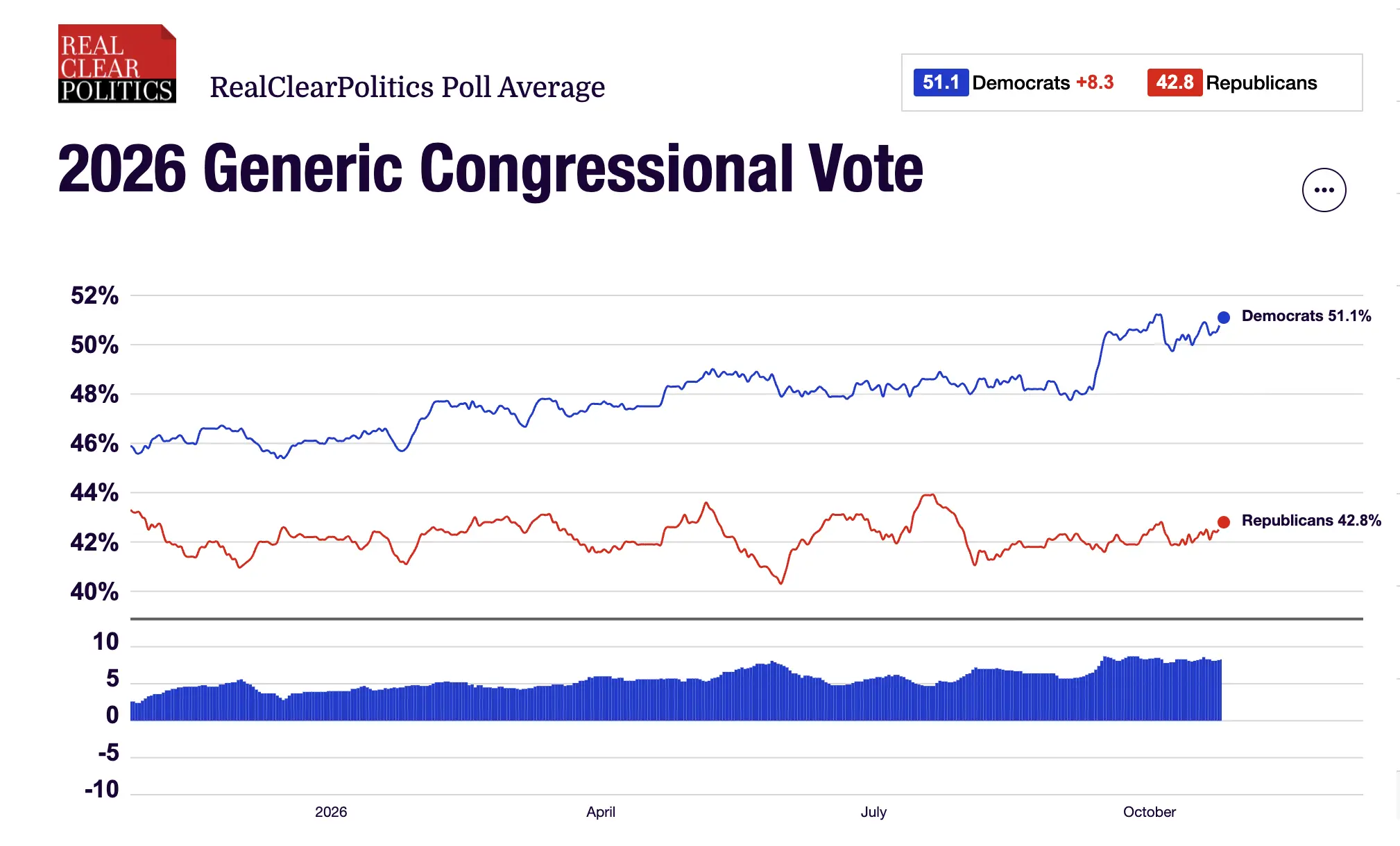
_Source: RealClearPolling_
A new CBS News/YouGov poll released on October 25 also shows Democrats leading 53% to 45%; this survey was conducted from October 21 to 23.
These "national congressional voting intention" surveys ask voters which party's congressional candidates they would prefer to support, helping to gauge the national political climate, but they cannot be directly converted into House seats. The 435 House seats must be filled in each district, and candidate performance and local election conditions are equally important.
Evaluating by district provides a clearer picture of the specific situation in the House seat competition. As of October 26, RealClearPolitics (RCP) has categorized 227 seats as leaning Democratic, 183 seats as leaning Republican, and 25 seats as difficult to determine. According to this classification, the number of seats on the Democratic side has exceeded the 218 seats needed for a House majority. However, "leaning Democratic" is still a pre-election assessment.
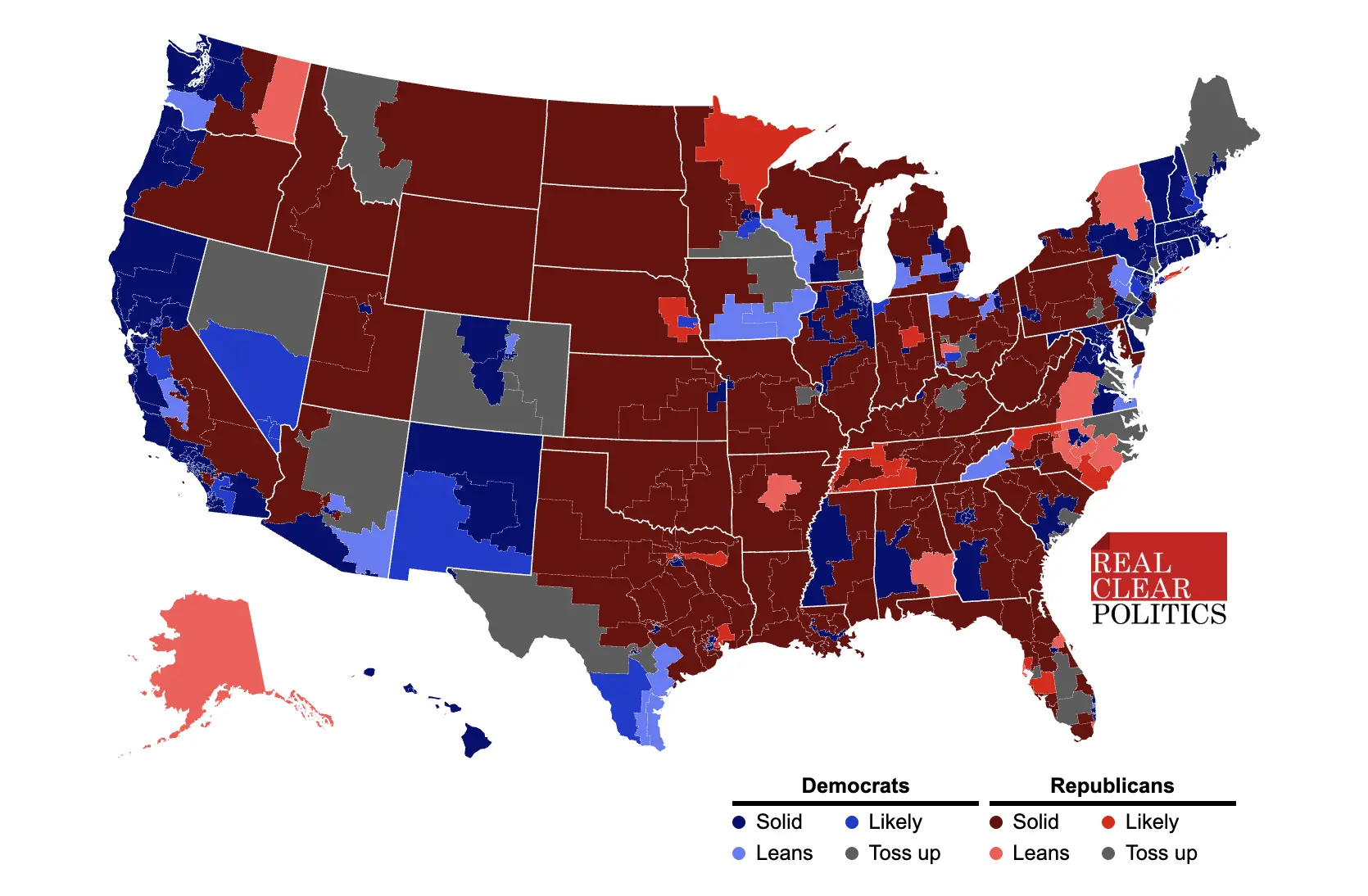
_Source: RealClearPolitics House Election Map_
The situation in the Senate is more complex. It only re-elects some seats, and even if national polls are favorable, it depends on whether these advantages can translate into the states holding elections this year. As of October 26, after combining the unfilled seats with the ratings of various elections, the RCP Senate election map shows 46 seats for the Democrats and 44 seats for the Republicans, with another 10 seats still highly competitive and uncertain. States such as Ohio, Maine, Iowa, Texas, and Michigan are particularly noteworthy.
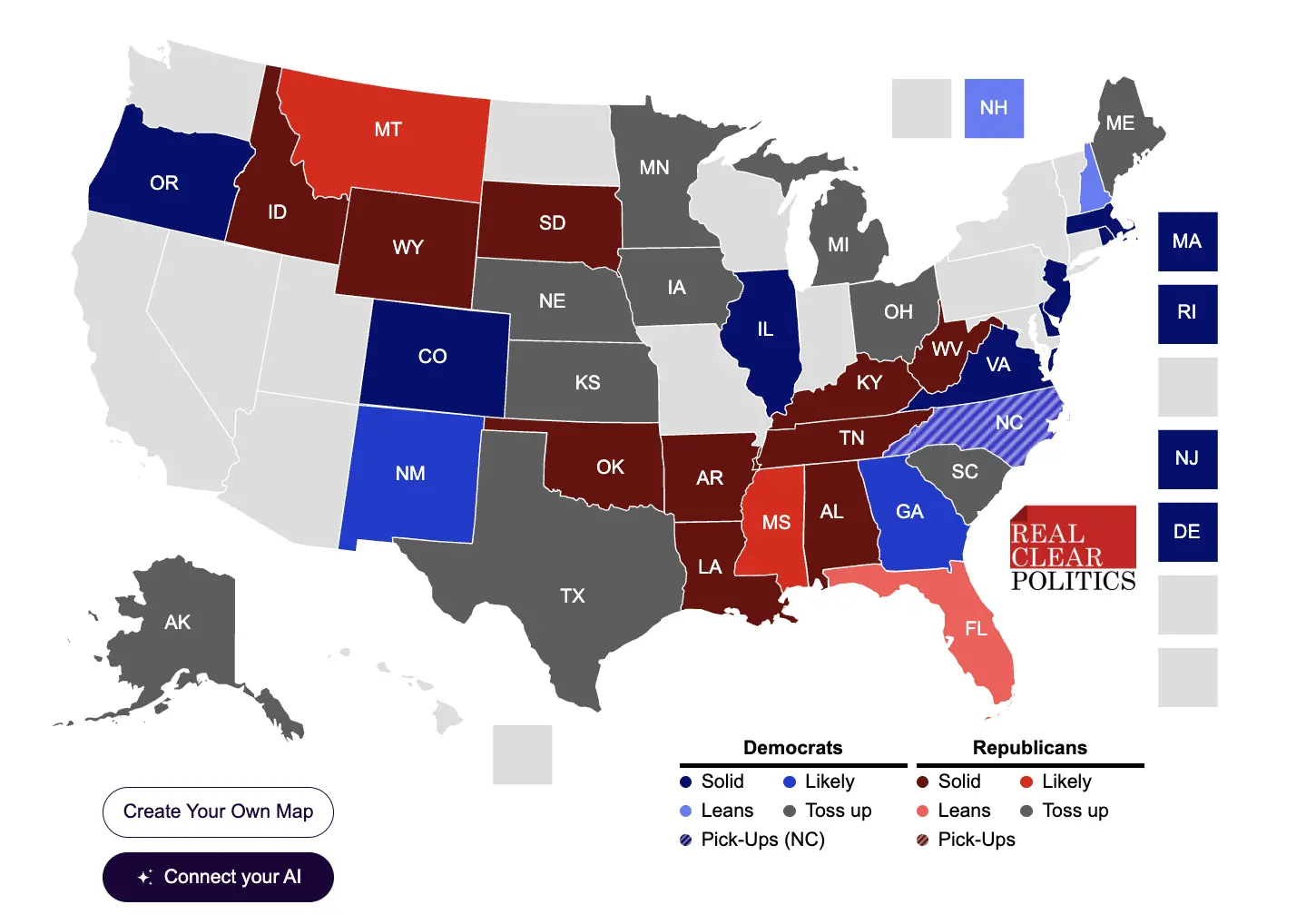
_Source: RealClearPolitics Senate Election Map_
Ohio, mentioned earlier, is a battleground worth the crypto industry’s attention. In a survey compiled by RCP from September 22 to October 22, Sherrod Brown leads Jon Husted with 48.2% to 44.9%. Sherrod Brown has an advantage, but his average support rate has not yet surpassed half. Different surveys also show discrepancies, so it cannot be concluded that he is assured of victory.
The prediction market offers another perspective. As of October 27, Kalshi shows a probability of about 90.5% for the Democrats to win the House of Representatives and about 64% for the Senate. The corresponding independent contracts on Polymarket are approximately 92% and 66%, respectively.
These numbers reflect probabilities based on market trading prices, not voter support rates. They indicate that the market has a concentrated expectation for the Democrats to regain the House, but retains greater uncertainty regarding the Senate.
For the crypto industry, this means that attention must be paid to whether Congress will change party leadership and to continue tracking the competition among specific candidates. Which party gains the majority will influence who controls the agenda; which legislators are elected will affect how much support a bill can ultimately garner. Campaign ads can buy exposure, but the votes needed for legislation will still depend on the elections and subsequent negotiations.
### How Will Crypto Regulations Change After the Congressional Transition?
First, who will preside over the relevant legislation? The focus is on the House Financial Services Committee, the Senate Banking Committee, and the agriculture committees of both chambers. The agriculture committees are important because they have jurisdiction over the CFTC; how the digital asset market delineates the regulatory scope of the SEC and CFTC will directly involve these committees.
The majority party typically holds the chair positions of the committees, giving them greater influence over scheduling hearings, organizing bill reviews, and conducting investigations. The Senate committees will also review nominations for regulatory officials, which will then be confirmed by the full chamber. Therefore, the transition could simultaneously change three things: which bills are prioritized, which regulatory decisions are scrutinized, and which individuals enter regulatory agencies. Specific chair selections will wait until the new Congress's organizational procedures are determined.
There is also a temporal premise: after the November vote, this Congress still has remaining sessions. If the CLARITY Act does not become law by the end of this Congress, it will need to be reintroduced and go through the legislative process again in the next session.
Combining the current distribution of congressional seats and the progress of digital asset legislation, we can deduce the impact of the elections on the crypto industry through four scenarios.
Scenario 1: Democrats take both chambers: Legislative conditions may be renegotiated, and oversight may be intensified.
Based on existing data, this scenario has the highest likelihood. The Democrats will be better positioned to rearrange the agendas of the relevant committees. Coupled with Elizabeth Warren's previous opposition to the CLARITY Act, conflicts of interest for officials involved in crypto businesses, investor protection, and the scope of regulatory exemptions may all become focal points for renegotiation. For trading platforms and token issuers, while striving for clear regulatory identities, they may also need to accept more restrictions.
However, Trump remains president and retains veto power; the congressional transition will not automatically replace current officials in agencies like the SEC and CFTC. The Democrats can push for rule changes, but whether they can become law still depends on reaching agreements with Republican legislators and the White House. Overriding a presidential veto requires two-thirds support in both chambers.
Scenario 2: Democrats take the House, Republicans retain the Senate: The industry needs to find consensus between the two chambers.
House Democrats may demand adjustments to ethical restrictions, customer protections, or regulatory arrangements, while Senate Republicans may wish to maintain the core elements of the existing framework. Both chambers must pass the same text to send it to the president; if they cannot agree, the time for businesses to wait for unified rules may be extended.
Scenario 3: Republicans retain both chambers: The existing agenda is easier to continue, but bipartisan negotiations are still necessary.
In this case, the Republicans are better positioned to coordinate the agenda with the White House, which is favorable for continuing to push the CLARITY Act. However, bipartisan votes in the Senate, as well as the divisions between banks, the securities industry, and crypto platforms, will not automatically disappear with the elections.
Scenario 4: Republicans retain the House, Democrats take the Senate (very low probability event).
The probability of this scenario occurring is extremely low and can be essentially ignored. As of October 26, Polymarket assigns it a probability of only 1%. If this outcome occurs, even if the House passes industry-supported texts, the Senate can still demand modifications or choose not to advance them. In the future, when nominations requiring Senate confirmation arise for the SEC or CFTC, the government will also need to seek Democratic support.
It is worth mentioning that in the 23 midterm elections from 1934 to 2022, the president's party lost seats in the House 20 times. However, a decrease in seats does not necessarily mean the ruling party will lose control of Congress, and there is no inherent connection between election results and asset price trends.
Control of Congress affects the legislative agenda and negotiation space but does not determine whether a bill will necessarily pass or be blocked. Meanwhile, banks, Wall Street, and crypto companies are also vying for digital asset regulations: stablecoin issuers hope to retain flexibility in product design and reward arrangements, banks worry about stablecoin revenues diverting deposits, and traditional financial institutions focus on access rules for custody, trading, and tokenized assets.
The interests of various parties are not entirely opposed, and there are also divisions within crypto companies. After the elections, Congress will still need to seek a balance between financial innovation, the banking system, consumer protection, and regulatory authority. Political funding can amplify the industry's influence but cannot eliminate these conflicts of interest.
### How Have the Stock Market and Bitcoin Performed After Recent Elections?
Will the market breathe a sigh of relief after the elections?
Historical data from the U.S. stock market does provide some basis. In a study released by BlackRock on October 1, it was noted that since 1970, the average total return of the S&P 500 six months after midterm elections is 14.1%, higher than the corresponding window of 5.7% in non-midterm election years.
Zooming in and adding Bitcoin, the results are not as tidy.
Looking back at the midterm elections of 2014, 2018, and 2022, in 2014, the Democrats, led by Obama, lost the Senate, allowing the Republicans to control both chambers; in 2018, the Republicans, led by Trump, lost the House but retained the Senate; in 2022, the Democrats, led by Biden, also lost the House while keeping the Senate. In all three cases, the party of the sitting president lost one chamber, but the starting points and market performances were different.
Below are the price performances of the S&P 500 and Bitcoin for 30 calendar days before and after the midterm election voting:

Note: The pre-election price changes compare the prices 30 calendar days before the voting day with the voting day; the post-election price changes compare the voting day with the following 30 calendar days. All time points are taken at 16:00 New York time, and the S&P 500's closing price is used when the market is closed.
In November 2018, the market believed that the core reason for Bitcoin's sharp decline was the "hash war" triggered by the hard fork of Bitcoin Cash (BCH), compounded by a bear market that had been ongoing for nearly a year and regulatory pressures.
In 2022, it coincided with the FTX crisis. The midterm election voting day was November 8, and FTX suspended withdrawals on the same day, subsequently filing for bankruptcy on November 11. The election and the industry crisis occurred almost simultaneously, making it difficult to isolate the election's impact from this market trend. Bitcoin had already been impacted by the crisis at the statistical boundary.
These three samples can only show performance during the same period and cannot individually identify the election's role, nor do they provide a comparison for the president's party "retaining both chambers."
The halving of Bitcoin's production also brings another layer of cyclical coincidence: midterm elections are held every four years, and Bitcoin's halving also occurs approximately every four years. The midterm election years of 2014, 2018, 2022, and 2026 occur two years later than the halving years of 2012, 2016, 2020, and 2024. However, elections are held according to the statutory calendar, while halvings occur every 210,000 blocks. Similar time intervals do not imply that prices will repeat the same trends.
For the crypto industry, the most direct consequence of the elections is changing who discusses the rules and which provisions have a chance of passing. Whether these changes can lead to clearer operating conditions, attract more market participants, and ultimately reflect in prices will depend on what happens after the ballots are cast.