Bitwise Report: Bitcoin May Be the Best Performing Mainstream Asset of the Next Decade
*Original Author: [Bitwise](https://s3.us-east-1.amazonaws.com/static.bitwiseinvestments.com/Research/Bitwise-Bitcoin-Long-Term-Capital-Market-Assumptions-2027.pdf)*
*Original Compilation: Luffy, Foresight News*
On October 28, the cryptocurrency investment firm Bitwise released this year's long-term capital market assumptions report for Bitcoin, raising the target price for Bitcoin in 2036 to $1.6 million, corresponding to an annual expected return of 34.3%. The report continues to use last year's valuation model, adjusting the target due to the expansion of the market size for value storage and institutional investment. Despite Bitcoin's decline of over 50% in the past year, institutions have increased their positions against the trend, and volatility has gradually converged, with Bitcoin's market share in value storage continuing to rise. The report also notes that this forecast is a scenario simulation, and Bitcoin still faces multiple risks including regulation and technology. Below is an edited compilation of the report's content (some content has been omitted):
Bitcoin has experienced a year of extreme volatility. From the peak in October 2025 to the low in June 2026, the maximum drawdown reached 53%. However, this performance still aligns with our expectations for Bitcoin's long-term returns; compared to an average maximum drawdown of over 80% in historical cycles, this round of decline has significantly narrowed. We believe this marks Bitcoin's maturation as an asset.
Setting aside price volatility, Bitcoin has made steady progress over the past year: the regulatory environment has continued to improve, institutions are increasingly adopting it, and the global market size for value storage assets continues to expand.
We expect the next decade to be the golden age for Bitcoin, driven by three main factors:
* Bitcoin continues to become an asset for institutional allocation, bringing stable net inflows of funds in the long term;
* In the context of high sovereign debt, institutional investors increasingly need hard assets to hedge against inflation and currency devaluation risks;
* The total supply of Bitcoin is limited, with almost zero supply elasticity.
Considering these factors, we predict that Bitcoin will become the best-performing mainstream institutional asset over the next decade, with a price reaching $1.6 million by 2036 and a ten-year compound annual growth rate of 34.3%. Compared to last year's report, which predicted $1.3 million in 2035 with an annualized return of 28.3%, this forecast has been adjusted upwards. The upward adjustment comes from the continued expansion of Bitcoin's core target market size, and our confidence in Bitcoin's long-term development path has further strengthened.
We judge that Bitcoin will maintain a low to medium correlation with other major asset classes such as stocks and bonds. It will still exhibit high volatility, but the volatility will continue the downward trend observed over the past 15 years. Although the traditional "four-year halving cycle" effect of Bitcoin will gradually weaken as the investor base expands, it remains a cyclical asset and will still experience significant drawdowns.
This report predicts that the biggest long-term risks facing Bitcoin are technological disruptions from quantum computing and AI mathematical breakthroughs, as well as regulatory and government policy risks.
### Macroeconomic Assumptions
Bitcoin is essentially a macro-driven asset, and macro conditions are crucial to its long-term capital market assumptions.
Bitcoin is often regarded as "digital gold," although it has other uses and future payment scenarios are expected to materialize, value storage remains its core investment logic.
The most important macro variables focus on debt, fiscal deficits, currency devaluation, and changes in the dollar's status as the global reserve currency, which directly determine institutional demand for hard assets like gold.
We believe the direction of macro trends is relatively clear: the debt levels of major countries, including the United States, will accelerate accumulation, and the debt burden will continue to squeeze the economy. As investment strategist Lyn Alden said, "This train cannot be stopped."
In 2026, global sovereign bond yields are expected to rise sharply, indicating that the trend may be approaching a critical point. In the absence of strong political support for tight monetary policies, many Western democracies have reached a point of no return: high debt leads to interest burdens, forming an inescapable debt spiral.
Over the next decade, faced with heavy debt pressure, governments are likely to choose to devalue their currencies. Legendary hedge fund investor Ray Dalio wrote in June 2025: "When national debt is high, policymakers tend to lower interest rates and devalue the currency that prices the debt. Betting on this trend would be a favorable choice."
In such an environment, hard assets like Bitcoin will become an important component of investment portfolios.
**Rapid Expansion of U.S. Debt**
This year marks the 250th anniversary of the founding of the United States, but the fiscal reality is not optimistic. Here are five shocking facts about U.S. debt:
* From 1776 to 1976, the United States accumulated $650 billion in debt; today, federal debt has reached $40.2 trillion.
* Half of the federal debt has been accumulated over the past decade.
* Per capita debt exceeds $127,000 when distributed among every American citizen.
* Federal debt has reached 121% of GDP.
* Annual interest payments on the debt amount to $1.1 trillion, making it the third-largest expenditure item in the U.S. federal budget. If refinanced at current market rates, annual interest would approach $1.5 trillion.
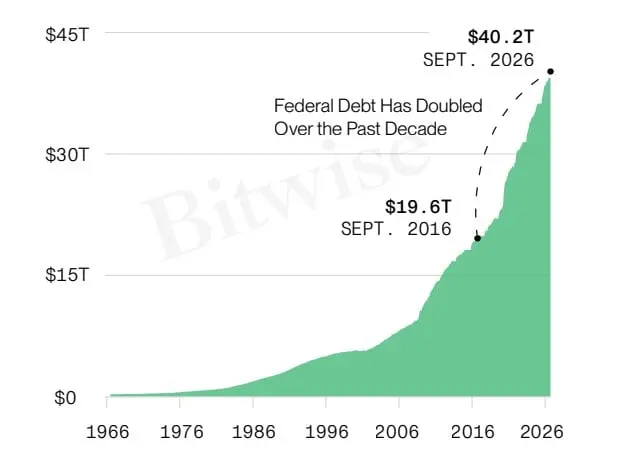
Total U.S. federal debt, 1966-2026, $19.6 trillion in 2016, $40.2 trillion in September 2026, with the debt size doubling over the past decade. Data source: U.S. Department of the Treasury, statistical period from 1966-01-01 to 2026-09-30.
**The Situation Continues to Deteriorate**
In the 2026 fiscal year (ending in September), the U.S. fiscal deficit reached $2 trillion, an increase of $218 billion year-on-year, exceeding the Congressional Budget Office's February forecast by $140 billion. This administration's campaign promises included cutting fiscal spending, but the reality has not delivered.
At the beginning of 2025, Trump established the Department of Government Efficiency (DOGE) with the goal of cutting $2 trillion in government spending, but it quietly concluded in less than a year, ultimately achieving only $215 billion in cuts, reaching just 10% of its target.
In the 2026 fiscal year, total U.S. government spending reached a record high of $7.4 trillion, with the fiscal deficit accounting for 6.2% of GDP. All of this is happening during a phase of strong economic growth; if the economy falls into recession, the scale of the deficit will be even more terrifying.
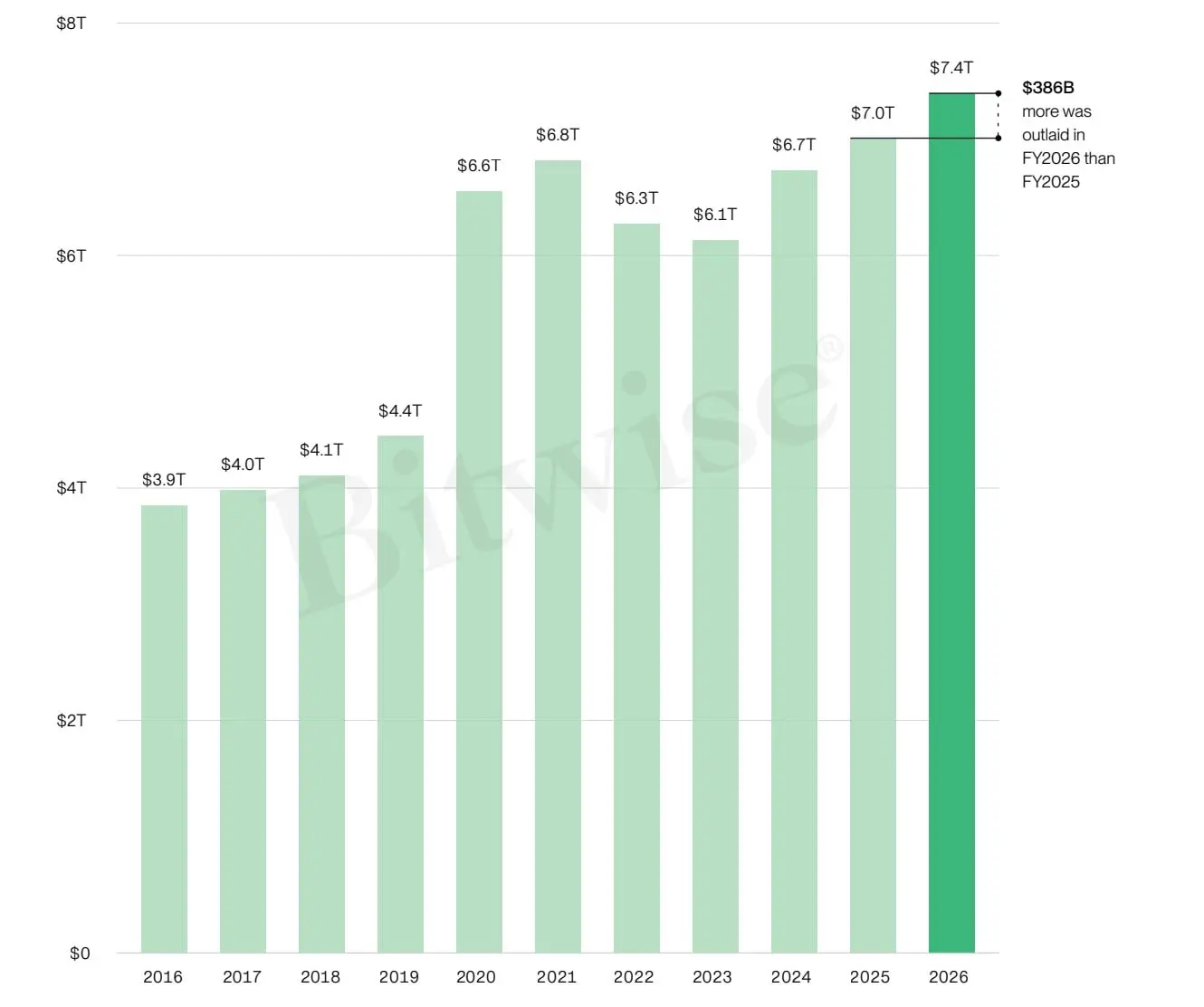
Annual total U.S. fiscal expenditure, fiscal years 2016-2026, $7.4 trillion in the 2026 fiscal year, an increase of $386 billion from the previous year. Note: The U.S. fiscal year runs from October 1 to September 30 of the following year. Data as of 2026-09-30, source: U.S. Department of the Treasury.
**Not Just the United States**
High debt burdens are a global phenomenon, with developed economies that have comprehensive social welfare systems seeing rising debt levels. The table below shows total debt, debt/GDP, annual deficits, 10-year government bond yields, and year-on-year changes for G10 countries.
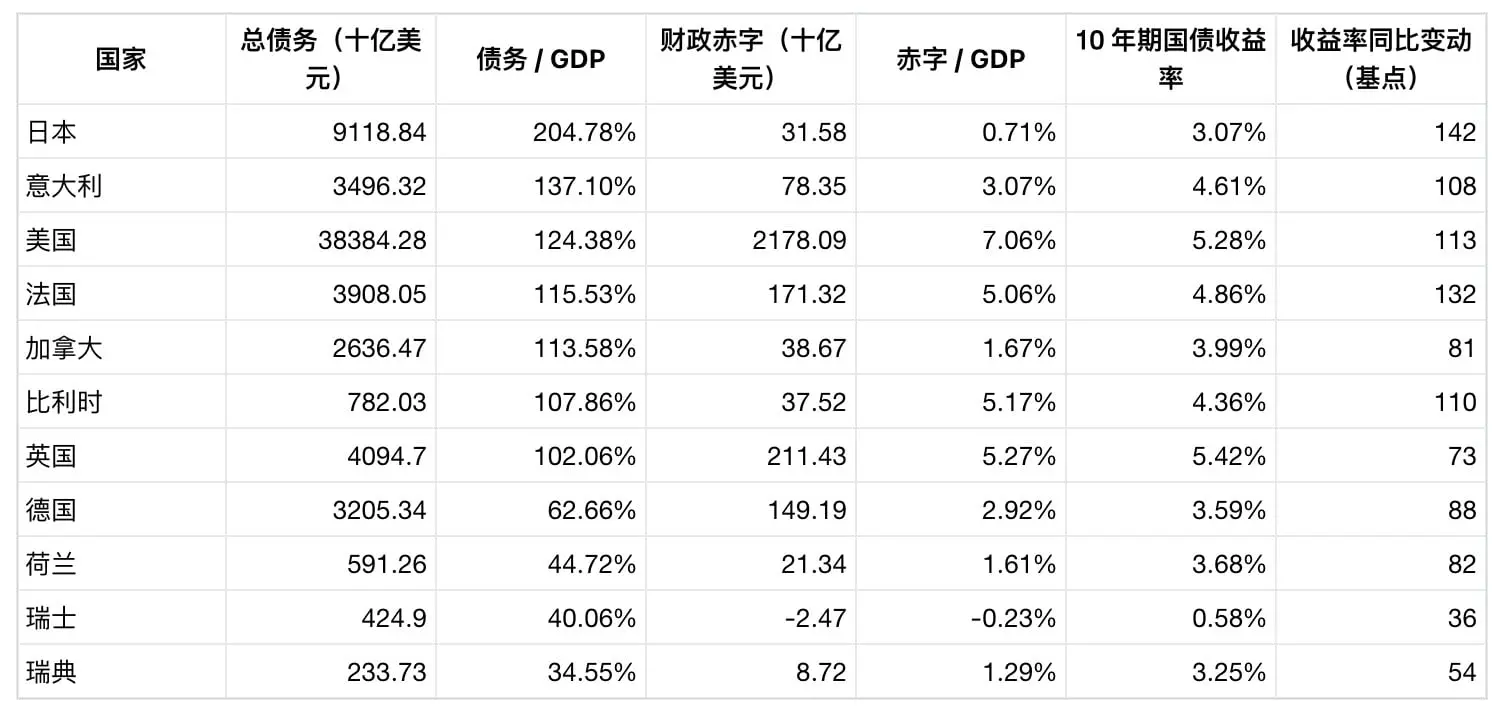
This table is based on IMF statistics as of the end of 2025, including federal, state, and local government debt, and excluding intra-governmental debt; Japan's figures are estimates by the IMF.
**Rising Demand for Hard Assets**
Investors have begun to notice macro changes and are increasingly allocating hard assets as a hedge. Since 2020, Bitcoin and gold have been the best-performing major asset classes globally.
The strength of hard assets does not require extreme scenarios like hyperinflation; merely continuing the macro environment of the post-pandemic era is sufficient. The market has actively adjusted its portfolio to increase allocations to hard assets. This report's model assumes only the continuation of existing trends without presupposing hyperinflation.
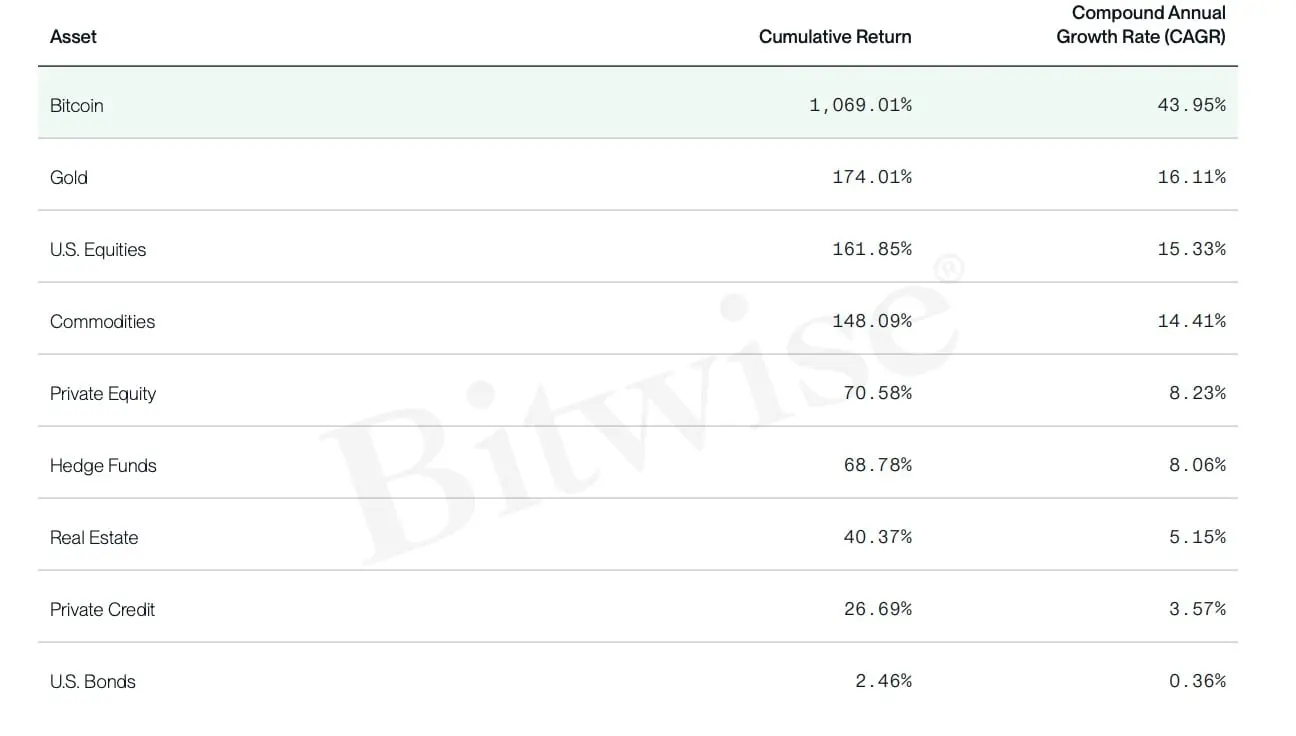
Cumulative returns and annualized returns of major asset classes from 2020-01-01 to 2026-09-30. Data source: Bloomberg, PivotalPath.
**Reserve Assets, Central Bank Gold Purchases, and Changes in Global Monetary Order**
Another key macro trend is the weakening of the dollar's status as the dominant global reserve currency. This is reflected in the declining share of the dollar in global central bank foreign exchange reserves, with many central banks increasing their gold holdings.
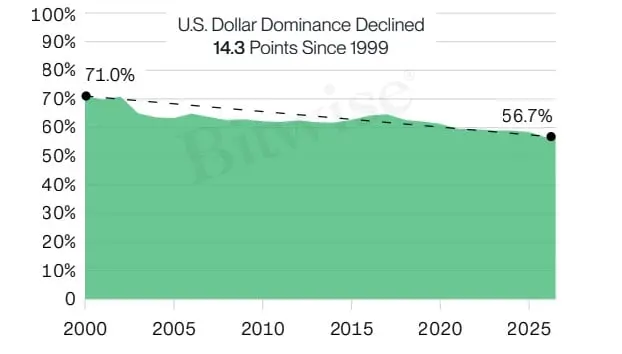
Share of the dollar in global foreign exchange reserves, 71.0% in 1999, 56.7% in June 2026, a cumulative decline of 14.3 percentage points; data source: IMF, as of 2026-06-30.
In 2025, global central bank net purchases of gold reached $96 billion, a record high, four times the scale of ten years ago, up 14% from 2024, and the pace is accelerating.
At the same time, more than a dozen countries, including the United States, have allocated Bitcoin reserves. Although progress in sovereign acceptance of Bitcoin has been slow over the past year, it is indeed happening:
* In November 2025, the Czech central bank became the first central bank in Europe to purchase Bitcoin, allocating $1 million. In April 2026, the governor publicly stated: internal research shows that allocating 1% of its total portfolio of $180 billion to Bitcoin could enhance overall expected returns without increasing risk, calling Bitcoin a "future asset."
* In October 2025, the Luxembourg sovereign wealth fund became the first sovereign fund in the Eurozone to allocate Bitcoin ETFs, with an allocation ratio of 1%.
* Deutsche Bank released a report suggesting that both gold and Bitcoin will become components of central bank balance sheets by 2030.
Although these are all small-scale advancements, they represent that Bitcoin is gradually entering normal discussions as a central bank reserve asset, very similar to the process of wealth institutions accepting Bitcoin five years ago.
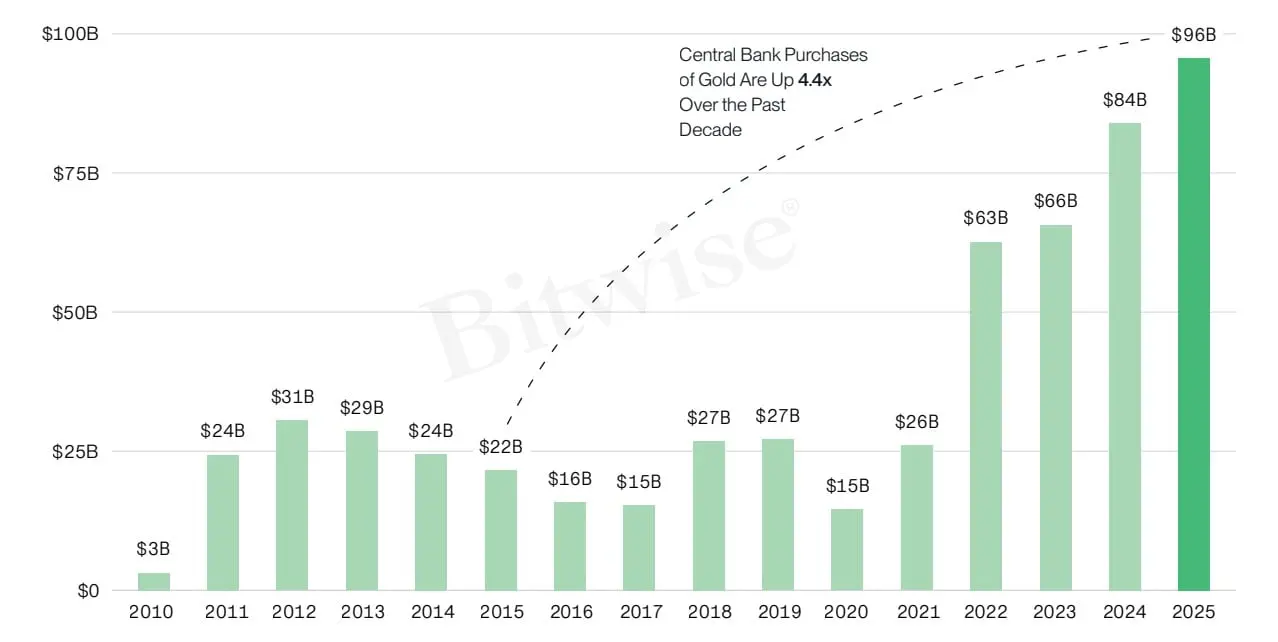
Annual net purchases of gold by global central banks (in billions of dollars), 2010-2025, $96 billion in 2025, a ten-year growth of 4.4 times. Source: World Gold Council, Bloomberg, as of 2025-12-31.
**Regulatory Environment Assumptions**
The global regulatory environment for cryptocurrencies continues to improve. After the 2024 U.S. elections, the anti-crypto government will step down, and leadership changes will occur in the SEC, OCC, CFTC, and the Treasury. Over the past year, regulatory agencies have introduced several friendly policies, enhancing institutional safeguards and facilitating the allocation of crypto assets by institutions.
This trend is not limited to the United States; there has been positive progress in the Middle East, Hong Kong, and the United Kingdom. Almost all major financial institutions in the U.S. have laid out plans for crypto-related businesses. BlackRock, JPMorgan, and Morgan Stanley are deeply involved, along with numerous companies and tens of millions of American citizens participating, making it difficult for policies to be completely reversed.
However, regulation in 2026 is not without its challenges. The highly anticipated Clarity Act crypto bill failed to advance in Congress, primarily due to concerns from Democrats regarding the ethical provisions of the bill. The setback of this bill indicates that regulatory risks will still objectively exist in the future.
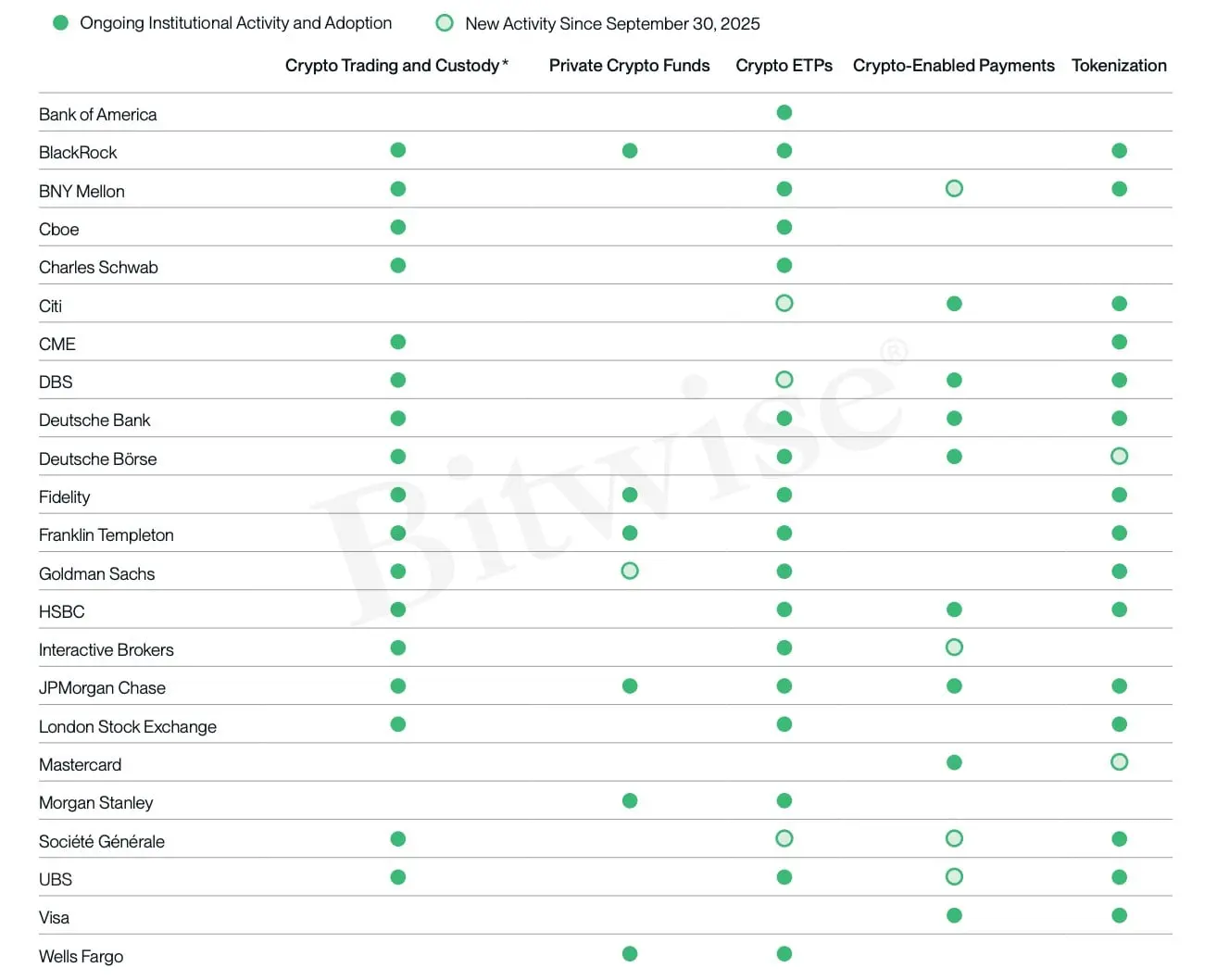
Global large institutions' crypto business layouts include Bank of America, BlackRock, BNY Mellon, Charles Schwab, Citigroup, CME, Deutsche Bank, Deutsche Börse, Fidelity, JPMorgan, Goldman Sachs, HSBC, UBS, Visa, Mastercard, etc. Data source: corporate announcements and presentation materials, as of 2026-09-30.
### Bitcoin Capital Market Assumptions
**Return Assumptions**
We believe that Bitcoin will be the best-performing major asset globally over the next decade, with a compound annual growth rate of 34.3%. There are three core driving forces:
**1) Institutional Demand**
Bitcoin is one of the few assets initially led by retail investors. Traditional assets like private equity and private credit were first accepted by institutions before retail participation; Bitcoin is the opposite.
There are a total of 21 million Bitcoins, with 96% already in circulation, mostly held by retail investors; meanwhile, the vast majority of institutions currently have a 0% allocation.
According to Boston Consulting Group data, the global assets under management by institutions are approximately $147 trillion. We predict that over the next decade, institutions will allocate 1-5% of their portfolios to Bitcoin, corresponding to a potential buying demand of $1.5 trillion to $7.4 trillion. However, Bitcoin's annual new output is only about $14 billion, creating a huge gap between new supply and potential demand, which will be balanced by price increases.
Institutional inflows have already occurred. The U.S. Bitcoin spot ETP has been live for less than three years, with assets under management reaching $108 billion, largely from institutional funds. We expect inflows to accelerate after 2027. In 2026, several leading wealth management platforms have already launched Bitcoin spot ETF products, which will further boost fund inflows.
**2) Supply is Highly Limited and Inelastic**
The total supply of Bitcoin is capped at 21 million, with 20.1 million already in circulation (95.7%). The annual inflation rate is only 0.8%; after the halving in 2028, it will drop to 0.4%, and to 0.2% by 2032. In comparison, the annual new supply inflation of gold is about 2%.
A key feature is that supply is completely inelastic. No matter how high the demand or how much the price rises, no more Bitcoins will be produced. Commodities like gold and crude oil cannot achieve this. The combination of huge institutional demand and rigid supply forms the underlying economic logic for being bullish on Bitcoin.
**3) Concerns About Fiat Currency Depreciation Continue to Rise**
Concerns about global debt, fiscal deficits, and currency depreciation are becoming increasingly common, with the market seeking hard assets to hedge against fiat currency risks. Legendary investor Paul Tudor Jones stated in "The Great Monetary Inflation": "You need to allocate a basket of hard assets; if I had to pick one bet, I would choose Bitcoin."
The U.S. federal debt has increased by $11.7 trillion over five years, reaching $40.2 trillion; annual interest payments amount to $1.1 trillion, making it the third-largest expenditure in the federal budget.
The resonance of institutional demand, rigid supply, and concerns about fiat currency depreciation will allow Bitcoin to benefit doubly: first, by capturing market share in value storage, and second, by the overall expansion of the value storage market itself.
**Valuation Model**
The Bitcoin valuation model is still under development, and there is no unified standard in academia. Bitwise uses the Total Addressable Market (TAM) model: estimating the future size of various markets Bitcoin can penetrate, then estimating penetration rates, and combining Bitcoin's fixed total supply to derive prices.
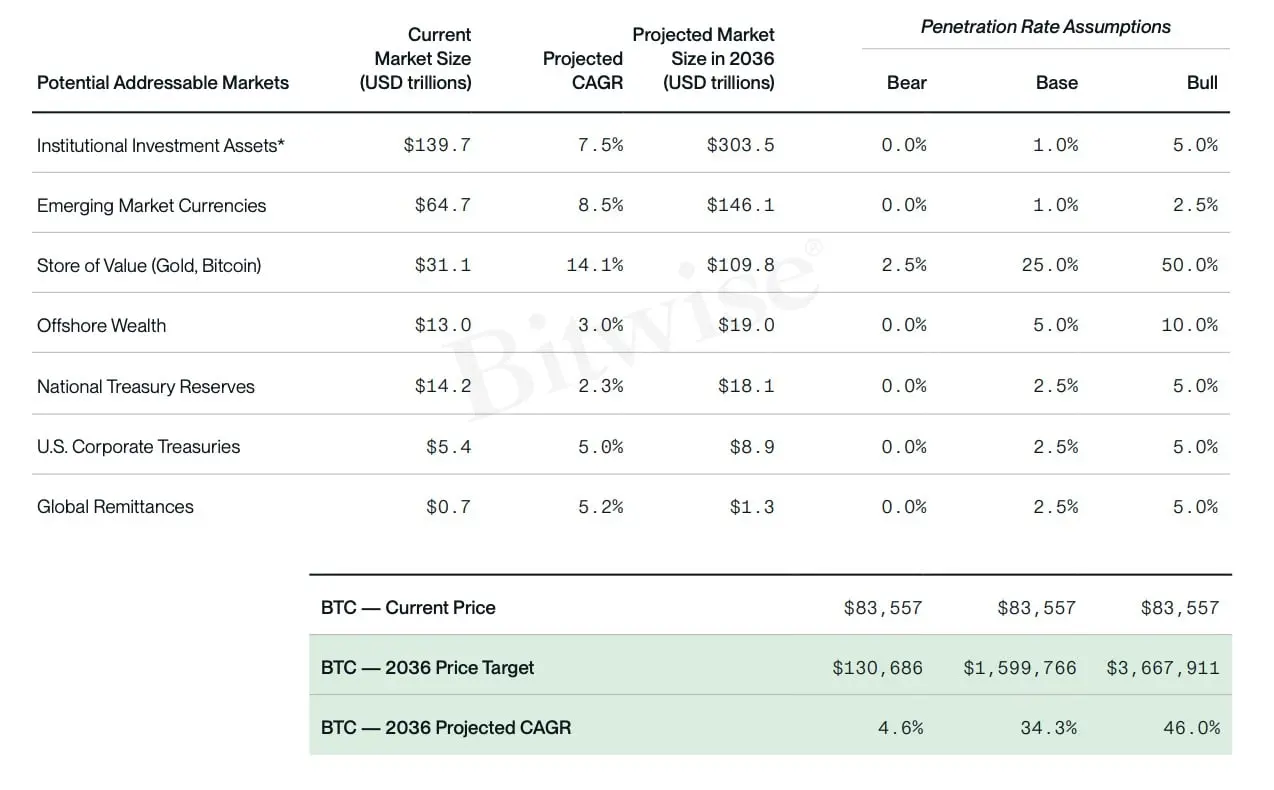
Bitwise Bitcoin valuation framework, divided into pessimistic, baseline, and optimistic scenarios.
The results we derived are:
* Pessimistic scenario: $130,686 in 2036, annualized 4.6%
* Baseline scenario: $1,599,766 in 2036 (approximately $1.6 million), annualized 34.3%
* Optimistic scenario: $3,667,911 in 2036, annualized 46.0%
Among these, we believe the baseline scenario is the most likely. Compared to other institutional predictions: Invesco predicts it will exceed $1 million by 2033; Standard Chartered predicts it will break $500,000 by 2030; Ark Invest's optimistic scenario estimates about $1.2 million by 2030; Michael Saylor's Strategy predicts $21 million by 2046.
**Correlation Assumptions**
Over the past decade, Bitcoin has maintained a low correlation with most major asset classes.
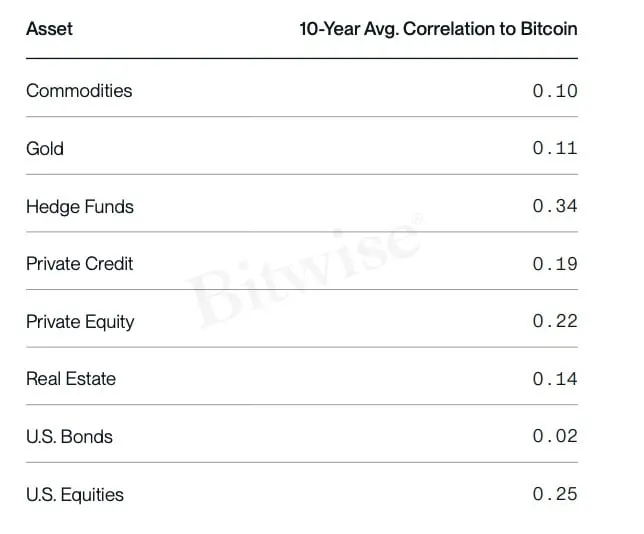
Ten-year average rolling correlation of Bitcoin with other assets.
Market media often describe Bitcoin as a high-beta risk asset, highly correlated with the stock market. In reality, Bitcoin's 90-day rolling correlation with U.S. stocks has rarely exceeded 0.5 historically, failing to reach "highly correlated (>0.75)." The media's impression comes from short-term correlations during bear market crashes.
However, in recent years, the correlation between Bitcoin and U.S. stocks has slowly increased, which is a natural phenomenon of asset maturation: as more traditional investors participate, the correlation will slightly rise.
The long-term correlation between Bitcoin and U.S. Treasuries is close to 0, mostly fluctuating between -0.25 and 0.25, which is significant for portfolio diversification. The reasons are:
A one-time structural shift: Bitcoin has transitioned from a niche asset to a mainstream alternative asset, with millions of investors allocating Bitcoin for the first time, leading to asymmetric capital inflows, unlike the two-way capital flows of mature assets. This effect will weaken in the future but will still play a role.
Different driving factors: Stocks and bonds are primarily driven by economic growth, tax rates, geopolitics, and technological advancements; Bitcoin is additionally influenced by adoption rates, regulation, and concerns about fiat currency depreciation. The differences in driving logic lead to divergent return trends.
On the other hand, the correlation between Bitcoin and gold has continued to rise, reaching a historical high of 0.58 on September 11, 2026; as the narrative of Bitcoin as a value store becomes more widespread, this trend will continue to deepen.
**Volatility Assumptions**
Over the past decade, Bitcoin's volatility has consistently declined, and the range of volatility has also narrowed, indicating that asset risk is decreasing and the investor base is becoming more diversified. The recent cycle's peak saw a 53% retracement, compared to historical retracements of over 80%, further confirming this trend.
We judge that the speed of volatility decline will be halved compared to history, as significant risks such as regulation, custody, and liquidity have largely been priced in. The model takes the midpoint of the current volatility and the expected volatility in 2036, 27.8%, as the overall assumption for the next decade; in reality, the early volatility is higher, and it will further decrease as the asset matures.
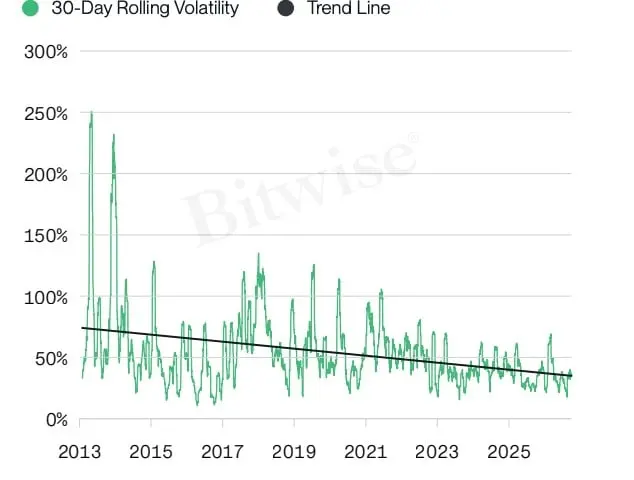
Rolling 30-day volatility of Bitcoin from 2013 to 2025, showing an overall downward trend.
**Four-Year Halving Cycle Assumptions**
Bitcoin's history exhibits a four-year cycle characteristic: three years of significant increases, followed by a year of substantial corrections. From a calendar perspective, 2025 seems to break the cycle, with an annual return of -6%. However, from the price trajectory, the cyclical logic still holds: on October 6, 2025, it peaked at $126,080, rising 696%, then dropped to a low of $58,717 on June 30, 2026, a retracement of 53.4%.
This is the shallowest retracement in history for a bear market; if the low is confirmed, it will be a very important signal for Bitcoin's transition to an institutional asset.
The fundamental forces driving the four-year cycle are weakening, but the "four-year cycle" has already deeply embedded itself in investors' minds. We judge that the cyclical effect will weaken but will not completely disappear.
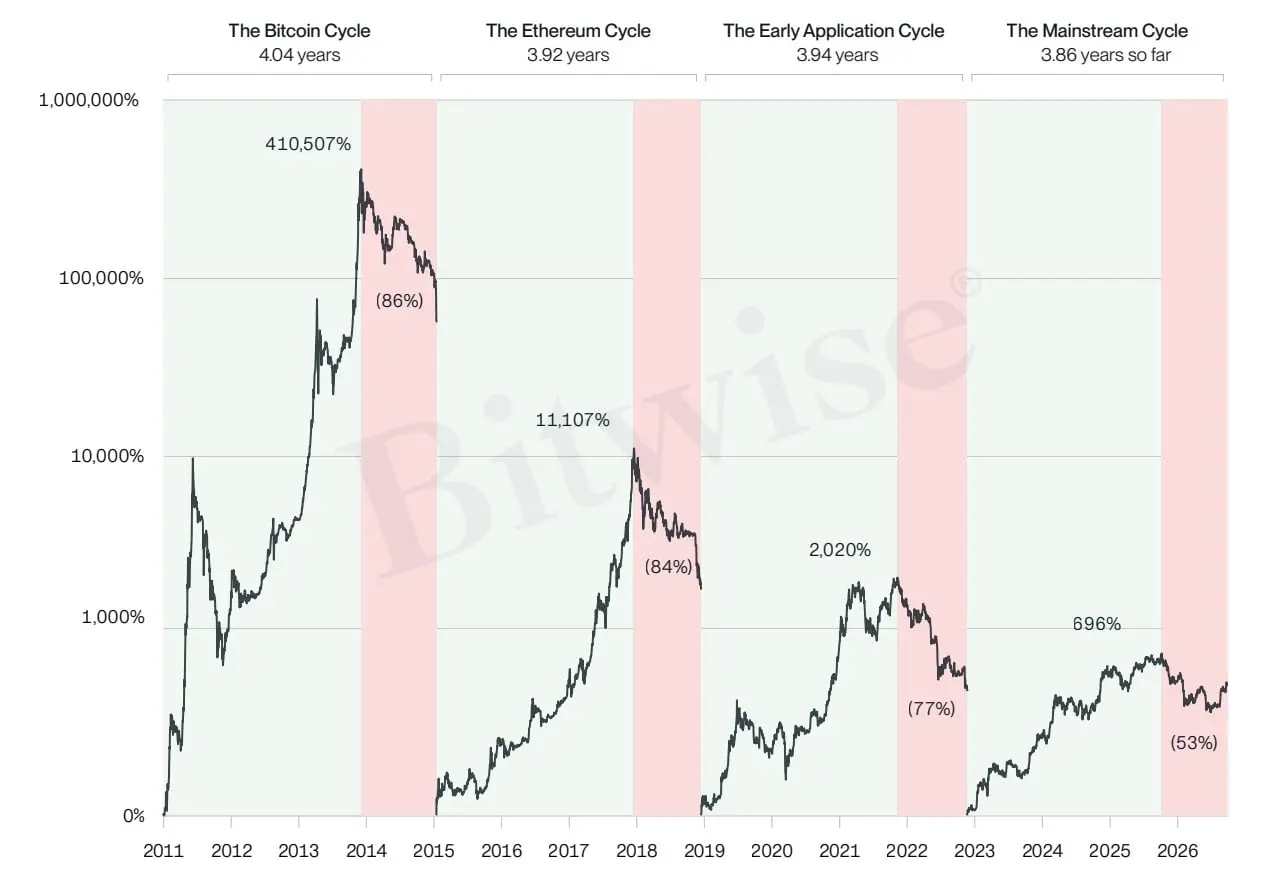
Logarithmic chart of returns for each bull and bear cycle of Bitcoin, with maximum retracements for each cycle: 86%, 84%, 77%, and this cycle 53%.
### Bitcoin vs. Traditional Assets: Long-Term Capital Market Assumptions Comparison
Bitwise integrates the latest capital market assumptions from JPMorgan, PGIM, BlackRock, and Vanguard, compiling the ten-year expectations for major asset classes as a comparison benchmark.
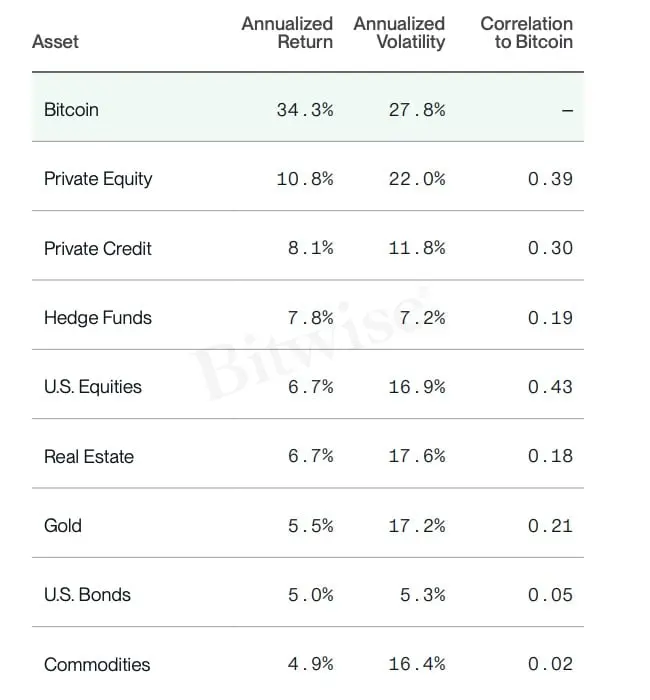
Predictions for major assets over the next decade (2026-2036).
### Risks and Considerations
Bitcoin has a relatively short history, high volatility, a continuously changing regulatory environment, and institutional adoption is still in its early stages, with the underlying technology emerging in 2008-2009. All these factors make long-term predictions inherently uncertain. The main risks include:
* Limited historical samples. Bitcoin only began large-scale public trading in 2010, institutional products started in 2014, and spot ETPs were not launched until 2024. There is not much data available for backtesting. Future macro environments, regulations, and market structures may undergo significant changes, and historical performance may not be replicable.
* Regulatory and legislative risks. Global regulations related to crypto are still immature, and significant shifts could occur at any time, with both positive and negative impacts possible. The currently friendly regulatory environment may not continue in the future.
* Institutional, corporate, and sovereign adoption is a new trend. Bitcoin was initially led by retail investors, and the entry of institutions and governments is a relatively new phenomenon, which cannot guarantee the continuation of this trend.
* Technological and quantum computing risks. Bitcoin relies on underlying code that needs continuous iteration. Breakthroughs in mathematics accelerated by quantum computing and AI could pose threats at the cryptographic level. Bitcoin may require significant upgrades in the future to switch to quantum-resistant cryptography; the upgrade process itself carries uncertainties. Even if the protocol completes the upgrade, if user wallets do not migrate to quantum-resistant addresses, assets will still face risks. The community has already begun related work, but many issues remain to be resolved. The development of AI will accelerate the risk of cryptographic breakthroughs.
In addition, macro environments, trading mechanisms, and self-custody security also pose risks. This report only lists key uncertainties and does not represent an exhaustive list of all risks.
### Conclusion
In just 17 years, Bitcoin has grown from a niche investment to a $1.7 trillion asset, researched and allocated by top institutions worldwide. As more institutions increasingly incorporate Bitcoin into their portfolios, high-quality predictions and assumptions become particularly important.
This report provides our core long-term judgments:
* 34.3% Expected Annual Return: Bitcoin may become the best-performing mainstream asset class globally over the next decade.
* Volatility Down but Still Highest: Volatility has decreased compared to historical levels, but it remains the most volatile mainstream asset.
* Portfolio Diversification Value: Maintains a low to medium correlation with the vast majority of assets, with increased correlation to gold, suitable for institutional portfolio diversification.
* Institutional Capital Inflow of $1.5 Trillion - $7.4 Trillion: Institutional allocation of 1-5% in portfolios leads to massive buying pressure.
* Expansion of Value Storage Demand: Government debt, fiscal expansion, and excessive money supply continue to suppress fiat currency purchasing power, raising demand for hard assets like gold and Bitcoin.
* Regulatory Inertia: Wall Street and the general market widely accept cryptocurrency, and existing favorable regulatory policies are difficult to completely overturn.