Western Securities: Overseas AI may slow down, domestic capital expenditure takes over, bullish on Hong Kong stock internet
The Democratic Party's significant victory in the U.S. midterm elections has led to a series of overseas "input risks" materializing, and the global asset pricing logic is quietly shifting.
The team led by Cao Liulong at Western Securities believes that after the midterm results, concerns about the pace of construction for U.S. AI Data Centers (AIDC) have intensified, combined with expectations of easing U.S.-Iran relations, leading to a simultaneous weakening of U.S. Treasury yields and the dollar. The Democratic Party's victory topics—ending the U.S.-Iran conflict and delaying AIDC construction—point towards a medium-term trend of a weaker dollar, with the impending expiration of temporary funding at the end of the year and the debt ceiling negotiations early next year further reinforcing this window.
Behind the overseas AI deceleration expectations lies a deeper conflict over the distribution of interests between tech companies, the public, and the government, a structural issue that is difficult to resolve in the short term. In contrast, domestic major companies have a relatively low capital expenditure base and significantly better financing costs, quietly opening a narrative window of "the East rising and the West falling" for the China-U.S. AI industry. Based on this, Western Securities maintains a bullish strategic outlook on Hong Kong's internet stocks.
### Midterm Results, "Input Risks" Begin to Materialize
After the Democratic Party's significant victory in the U.S. midterm elections, the overseas input risks previously warned by the market have begun to gradually unfold. The U.S. market is concerned about the pace of AIDC construction being hindered, while expectations for easing U.S.-Iran relations have intensified, putting pressure on U.S. Treasury yields and the dollar.
The election results do not mean that overseas volatility will calm down. After the Democratic victory, there is an emphasis on closely reviewing data center projects, and the entire process is still in the emotional fermentation stage, with the possibility of further fluctuations. Considering that we are still in a rate hike cycle, overseas market volatility should not be underestimated.
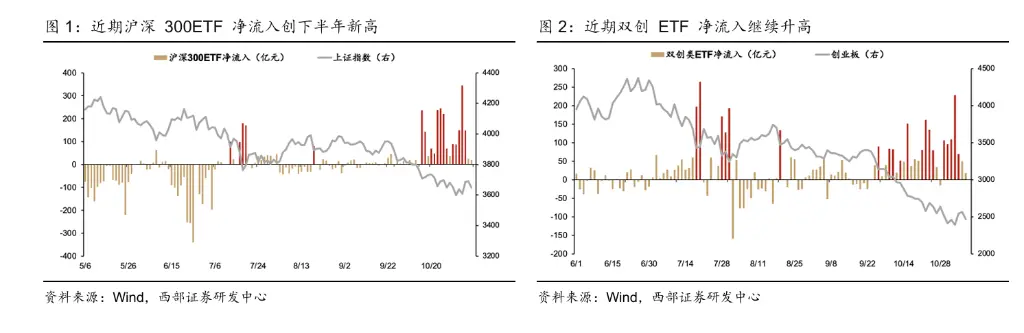
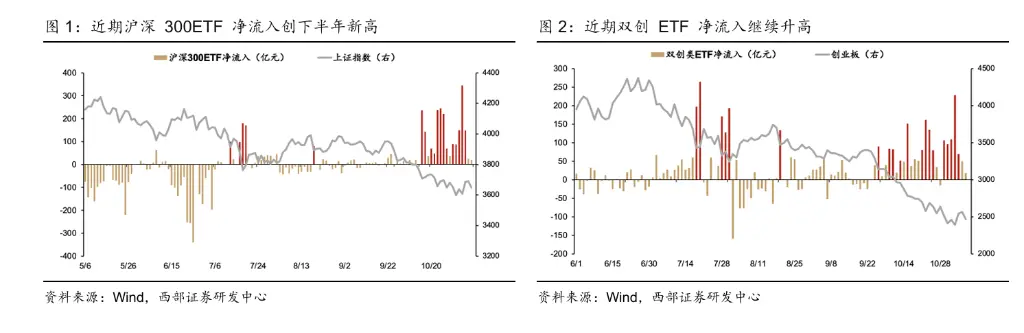
For the A-shares, external input risks still exist, but the bottom area is gradually becoming clearer. Policy support has significantly increased—on November 6, Premier Li Qiang presided over a State Council meeting, clearly requiring the "improvement of capital market stability mechanisms, enhancing the inherent stability of the stock market, and promoting the stable and healthy development of the capital market"; the "Report on the Financial Work Situation" submitted to the Standing Committee of the National People's Congress on November 3 also reiterated relevant statements. Meanwhile, the continuous high-intensity net inflow into broad-based ETFs has formed bottom support—major broad-based ETFs have seen net inflows for 25 consecutive trading days from September 28 to November 6, with a cumulative scale exceeding 414.9 billion yuan for the CSI 300 and ChiNext ETFs, and the daily average net inflow for the CSI 300 ETF recently reached a six-month high.
### Democratic Victory Strengthens Medium-Term Trend of Weaker Dollar
Beyond short-term market volatility, the medium-term trend is more noteworthy. Historical experience shows that after the Democratic Party wins the midterm elections, the dollar tends to weaken relatively; conversely, after a Republican victory, the dollar tends to strengthen. The results of the past few elections related to Trump’s administration or candidacy have also confirmed this pattern.
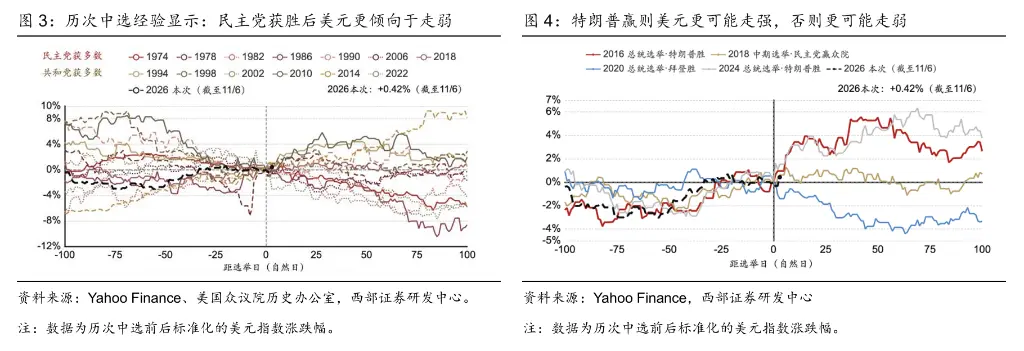
There is also logical support for this. The core issues supporting the Democratic victory—ending the U.S.-Iran conflict and delaying AIDC construction—constitute downward pressure on the dollar, and recent oil prices have begun to reflect expectations of geopolitical easing. At the same time, the Democratic Party is more inclined to increase spending in welfare areas such as healthcare and education, which will further elevate fiscal pressure and raise market concerns about the sustainability of U.S. finances.
Key time points to watch include the expiration date of the temporary funding on December 11 and the anticipated government debt ceiling issue around the first quarter of 2027. The debt ceiling issue is likely to be resolved eventually, but the tug-of-war between the two parties may create a "weaker dollar" trading window.
### AIDC Construction Slows: Surface is Votes, Underlying is Tax Revenue
The expected slowdown in AI data center construction is only a surface manifestation of public dissatisfaction; the deeper conflict lies in the imbalance of fiscal interest distribution structures.
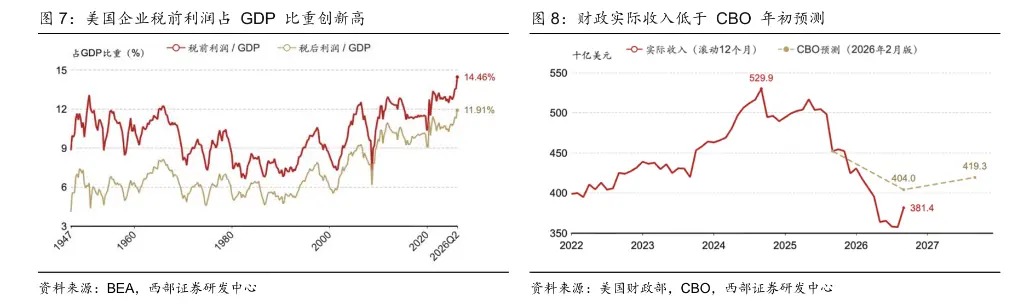
The pre-tax profits of U.S. corporations as a percentage of GDP have reached a historical high, yet corporate income tax revenues have rapidly fallen from previous peaks to about $380 billion, significantly below the Congressional Budget Office (CBO) forecast path at the beginning of the year. The investment in data centers can enjoy a one-time pre-tax deduction policy, which is one of the important reasons for this gap—more current expenditures by corporations lead to less taxable profits, thus putting pressure on actual government tax revenues. In other words, the benefits of AI infrastructure construction are obtained by large tech companies, while the social costs and tax losses are borne by the public and the government.
The Democratic Party is using the midterm elections as a topic to enter, with the core logic being to complete the redistribution of interests rather than ending AI construction itself. In the short term, this change is likely to create rhythmic disturbances in the progress of data center construction. This trend is already becoming apparent: the proportion of restrictive legislation related to data centers in 2026 has significantly increased. There are three key observation points ahead: the ERCOT report released on December 10, 2026, legislative trends after the state legislature convenes on January 12, 2027, and administrative measures after the new governor takes office on January 19.
### China-U.S. AI Welcomes "East Rising and West Falling" Narrative Window
The deceleration doubts faced by overseas AI objectively provide an opportunity for domestic AI to restate the "East rising and West falling" narrative, with the core differences lying in capital expenditure pressure and financing costs.
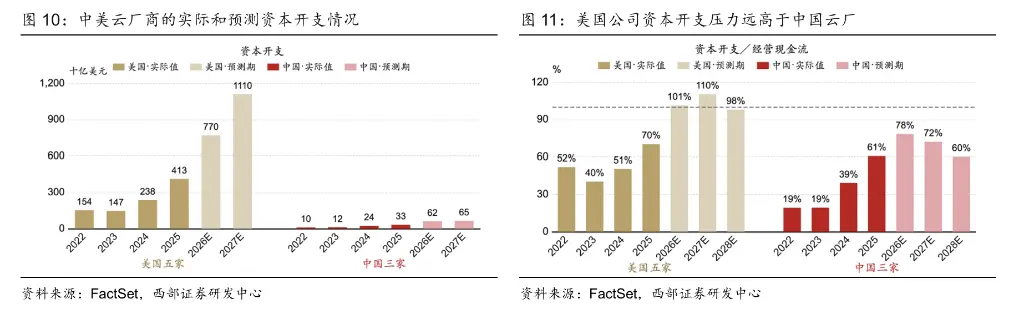
In terms of capital expenditure, the absolute base of domestic major companies is significantly lower than that of overseas cloud companies, resulting in relatively less pressure to decelerate. Data shows that in 2026, capital expenditures of U.S. cloud companies generally exceed operating cash flow, and the situation is expected to worsen further in 2027; meanwhile, domestic cloud companies are expected to see improvements in 2027.
In terms of financing costs, the gap between Chinese and U.S. cloud companies is particularly stark. Leading domestic cloud companies primarily rely on financing in yuan, resulting in significantly lower costs—taking Alibaba as an example, as of March 2026, its weighted average interest rates for short-term and long-term bank loans denominated in yuan are only 1.5% and 2.5%, respectively. In contrast, overseas, high-interest dollar debts have become a significant constraint on AIDC expansion: Oracle's newly issued bonds in November 2026 have coupon rates as high as 7% to 8.65%, while CoreWeave's ordinary bonds range from 8.5% to 9.75%.
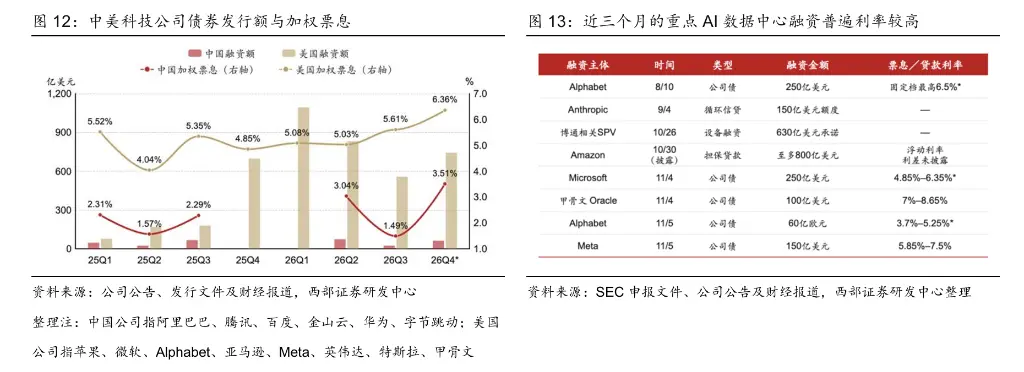
This structural difference gives the domestic AI industry chain relatively stronger risk resistance and more robust growth expectations.
### Strategic Allocation Window: Maintain Bullish Outlook on Hong Kong Internet
The report from Western Securities believes that while overseas input risks disrupt global risk appetite, they also open a narrative window for domestic "overtaking on the curve." The temporary weakening of the dollar after the midterm elections provides a strategic allocation opportunity for Hong Kong's internet stocks.
The report organizes the allocation around three main lines:
Real Estate and Consumption: If overseas liquidity shows a turning point and the external environment improves, a series of domestic fiscal policies are expected to accelerate implementation, supporting housing prices and repairing the balance sheets of households. The report believes that at that time, some real estate stocks may have a repair space of two times or more, and the consumption sector is expected to move towards a "core consumer asset bull market."
Hong Kong Internet: If there is a liquidity shock overseas, Hong Kong stocks may adjust significantly; if overseas liquidity shows a turning point, Hong Kong stocks are expected to welcome a valuation reassessment—after the Fed initiated QE in March 2020, Hong Kong stocks subsequently rose over 170%. The domestic computing power chain under the context of self-control is also expected to recover simultaneously.
Gold and Non-ferrous Metals: If an overseas liquidity shock materializes, gold and non-ferrous metals will be under pressure in the short term; if a liquidity turning point appears, the "super cycle of commodities" narrative is expected to return.
Risk Warning and Disclaimer
The market has risks, and investments should be made cautiously. This article does not constitute personal investment advice and does not take into account the specific investment goals, financial situation, or needs of individual users. Users should consider whether any opinions, views, or conclusions in this article align with their specific circumstances. Investing based on this is at one's own risk.