From Shorting Stablecoins to Building Chains: The Shift of Zhang Shuo, Founder of Air Cloud Exchange, and the Battle for the Payment Settlement Layer
Author: Jack Zhang | Deep Tide TechFlow
Jack Zhang probably did not anticipate that the statement he made on X in June 2025 would become one of the "face-slapping quotes."
The post was unequivocal, stating: "I see no way for stablecoins to reduce costs, as the exit channel fees from stablecoins to receiving currencies are far higher than those in the foreign exchange interbank market."
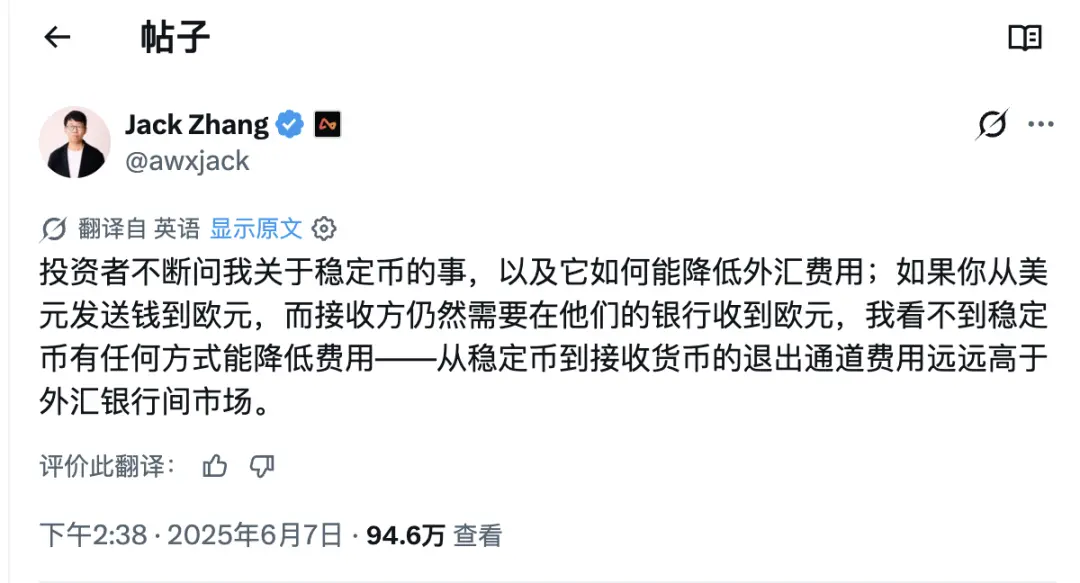
He followed up in the comments with an even harsher remark: "For 15 years, cryptocurrencies have not solved a single real-world problem."
The poster was Jack Zhang, co-founder and CEO of Airwallex. At that time, this cross-border payment company headquartered in Melbourne was valued at $6 billion, held 80 financial licenses globally, covered 200 countries and regions, and had just surpassed $1 billion in annual revenue, making his statements quite assertive.
The reaction from the crypto community was predictably a collective attack.
Dragonfly partner Omar Kanji mocked him, while Huma Finance co-founder Richard Liu wrote a lengthy rebuttal. In the end, Zhang made a slight concession in the comments: he acknowledged that stablecoin wallets could serve as alternative payment methods in emerging markets.
Just 17 months later, on November 10, 2026, a blockchain company called Alta announced it had completed a $47.5 million Series A funding round, led by Index Ventures, with participation from GV (Google Ventures), Blackbird Ventures, and Square Peg. Combined with a previous $32.5 million seed round, the total funding reached $80 million.
Jack Zhang's name was prominently listed among the co-founders of Alta.
### From Bearish to Getting Involved
Zhang's shift did not happen overnight.
After the "verbal sparring" about stablecoins in June 2025, several significant events occurred in the global payment industry.
Stripe acquired the stablecoin infrastructure company Bridge for $1.1 billion, and then co-incubated a payment-specific public chain, Tempo, with Paradigm.
Circle's USDC annual transaction volume reached $18.3 trillion in 2025, surpassing USDT. The total market capitalization of stablecoins doubled from $150 billion to over $300 billion. More importantly, the U.S. GENIUS Act and Hong Kong's stablecoin regulations were implemented, providing regulatory certainty that opened the door for institutional entry.
While Zhang publicly expressed skepticism, his actions told a different story.
In early 2026, Airwallex quietly began forming a stablecoin team under its core foreign exchange and liquidity department. The job postings were straightforward: to integrate stablecoins into existing foreign exchange and payment systems, allowing them to operate on the platform like any fiat currency.
In early 2026, through a mutual friend's introduction, Zhang met Loong Wang. This tech enthusiast, a graduate of the Australian National University, founded Republic Protocol (later renamed Ren Protocol) in Canberra in 2017, a DeFi project for wrapping Bitcoin. In 2021, Alameda Research acquired Ren, and Wang left before the FTX collapse, subsequently shifting focus to quantum chemistry drug discovery.
The two hit it off. Zhang was already considering starting a blockchain company but needed a technical leader to head the team. Wang later recalled in an interview that when Zhang was introduced to him, he was contemplating the stablecoin sector, and they quickly became friends, deciding to do something together.
That "something" became Metal, later renamed Alta.
### What Exactly is Alta Doing?
Alta is not just another general-purpose public chain; it is an L1 specifically designed for licensed financial institutions.
Zhang shared on X the reason for creating Alta, stating: "Most discussions about stablecoins focus on settlement speed and remittances. However, viewing it from the perspective of the evolution of financial markets and infrastructure reveals a more interesting opportunity."
Zhang's core argument is: buying a dollar stablecoin with local currency is a foreign exchange transaction. As adoption grows, stablecoins will create a brand new dollar liquidity market, complete with its own spreads, pricing logic, and connections to traditional foreign exchange markets. Stablecoins are not just "cheap SWIFT"; they are developing an independent financial market structure.
He then presented the real "killer argument": programmability. He stated: "Stablecoins make currency a native component of software, opening up new ways for fund management, automated settlement, and multi-party transaction coordination, ultimately enabling AI agents to conduct autonomous trading."
What is needed to achieve all this? Zhang provided his checklist: reliable liquidity, institutional-level privacy, compliance, and seamless integration with local financial systems in various countries. None of the existing public chains can meet all four criteria simultaneously.
CEO Loong Wang expressed this more directly: "We wouldn't be building an L1 if we weren't forced to." Implicitly, neither Ethereum, Solana, nor any other L2 can meet the baseline privacy and compliance requirements of banks and payment companies.
Thus, Alta made a technically unconventional choice: it built its foundation using recursive zero-knowledge proofs. This solution allows on-chain transactions to verify compliance while protecting privacy: you can prove a transaction complies with regulatory rules in a certain jurisdiction without exposing the identities and amount details of the parties involved.
In product design, Alta did several things that traditional public chains are reluctant to do: it embedded a programmable compliance layer that supports "plug-and-play" regulatory rules from different jurisdictions; the identity and authorization system is directly integrated into the protocol layer rather than relying on external oracles; and it even has an anti-airdrop feature that prevents unauthorized addresses from transferring funds to you. For banks, this last point may be more important than any technological innovation.
Another co-founder, Catherine Porter, was previously an executive responsible for partnerships at Meta for Libra (later Diem) and later served as an advisor for Mysten Labs and Aptos. This choice itself illustrates Alta's path: to encourage the financial system to voluntarily go on-chain rather than disrupt it.
### Airwallex's Role
Airwallex's role in Alta goes far beyond simply leading the seed round.
According to a report by Fortune, Airwallex is acting as a large-scale distribution channel for Alta, persuading its global customer network to use the Alta platform for crypto transactions. Alta's chain will directly connect to Airwallex's payment network, supporting stablecoin transfers and integrating local fiat payment tracks, covering 200 countries and 90 currencies.
This means that a newly funded chain of $80 million is born with a payment giant that has an annual transaction volume of $287 billion and annual revenue of $1.3 billion as its "design partner" and customer acquisition engine, which is almost unprecedented in the public chain space.
Zhang himself provided a new narrative framework in a statement: "With the rise of AI banking and programmable payments, stablecoins are becoming an important vehicle for settlement."
An insider from Airwallex anonymously revealed a version closer to reality to Forbes Australia: "Zhang has not become a crypto believer. But customer demand is rising, and regulation is becoming clearer; he is willing to integrate this technology into the platform."
This is probably the most accurate assessment; Zhang's beliefs have not changed, and this is a victory for commercial rationality.
### Stripe is Already Ahead
Looking at the competitive landscape helps understand why Zhang "had to" do this.
In October 2024, Stripe acquired the stablecoin infrastructure company Bridge for $1.1 billion; by the end of 2025, it acquired wallet developer Privy, gaining 75 million embedded wallets; in early 2026, it co-incubated a payment-specific chain, Tempo, with Paradigm, raising $500 million and achieving a valuation of $5 billion; Tempo went live on its mainnet in March 2026 and is now providing underlying settlement for Stripe Treasury's stablecoin functionality.
Stripe's crypto head stated that the company's goal is to become the "AWS of currency."
It is indeed building a full-stack stablecoin infrastructure: Bridge handles issuance and fiat channels, Privy manages wallets, and Tempo takes care of settlement. With these three layers combined, from the minting of stablecoins to payments at the merchant end, Stripe can operate without relying on any third party.
The list of design partners for Tempo includes OpenAI, Shopify, Visa, and Deutsche Bank. By November 2026, over 100 services had integrated with the Tempo mainnet.
For Airwallex, Stripe is not only a competitor in the cross-border payment space but now also a competitor in the blockchain infrastructure space. If ignored, when stablecoin settlement becomes the standard for enterprise payments, Airwallex will downgrade from "infrastructure" to "application layer," and its payment network will become just an interface running on someone else's chain.
Alta is Airwallex's response to this threat; while Stripe chose to build a full stack, Airwallex opted for incubation + investment + strategic binding.
### A War Over Who Controls the Settlement Layer
The data from the stablecoin market no longer needs defending. By mid-2026, the total market capitalization exceeded $320 billion, with USDT accounting for 59% (about $187 billion) and USDC for 24% (about $75 billion). The on-chain transaction volume for the entire year of 2025 surpassed $33 trillion, with USDC surpassing USDT with $18.3 trillion compared to USDT's $13.3 trillion.
But market capitalization and transaction volume are just the surface. The real battleground is the settlement layer; whoever controls the entire process from minting stablecoins to settlement and withdrawal holds the pricing power of the next generation of financial infrastructure.
This is why payment companies are starting to build chains:
Stripe built Tempo, collaborating with Paradigm, with a valuation of $5 billion. Circle created Arc to provide native infrastructure for cross-chain settlement of USDC. Fireblocks launched a global stablecoin network connecting fiat channels, liquidity, and compliance service providers. The Canton Network, supported by Goldman Sachs, Microsoft, and BNP Paribas, also targets on-chain settlement for licensed financial institutions.
Airwallex + Alta is the latest hand dealt at this table.
The consensus among these players is clear: stablecoins are not a "crypto product"; they are a new payment track.
The competition in payment rails has always been about who has stronger network effects, who has broader compliance coverage, and who can more quickly bring on-chain assets back to real-world bank accounts. Whether the technology is elegant or not is actually the least important variable.
Some say Zhang Shuo "slapped faces." But if you look closely at his statements in both phases, you will find a subtle consistency: he has never been optimistic about "cryptocurrency"; what he is optimistic about now is "tokenized fiat settlement infrastructure."
In his framework, stablecoins are not Crypto; stablecoins are the on-chain form of fiat currency.
This distinction may sound like nitpicking, but it represents a significant paradigm shift that is happening: payment companies no longer see blockchain as a competitor or a scam, but as their next-generation infrastructure. Stripe has done this, Airwallex has done this, and Visa and Mastercard are doing this.
Pragmatists are voting with their feet; belief is actually the least important thing.