After the election, Wall Street collectively became bullish on U.S. stocks, but was slapped in the face in just one day
After the U.S. midterm elections, major trading institutions on Wall Street collectively turned bullish on U.S. stocks, only to face a fierce market backlash within just one day.
Following the election results, institutions such as JPMorgan, Citadel Securities, and UBS issued buy signals to clients, with a core logic that was highly consistent: pre-election positions had been significantly compressed, and the dissipating uncertainty would drive capital back into the market, with the path of least resistance for U.S. stocks before the end of the year being upward. On Wednesday, the S&P 500 index rose nearly 2% in a single day, and the Dow Jones index increased by over 3%, with market movements momentarily confirming this judgment. However, just a day later, anxiety surrounding artificial intelligence trading surged, leading to a single-day evaporation of $2.3 trillion in market value for the Nasdaq 100 index, and the S&P 500 index plummeted by 4.4%, with all sectors suffering losses.
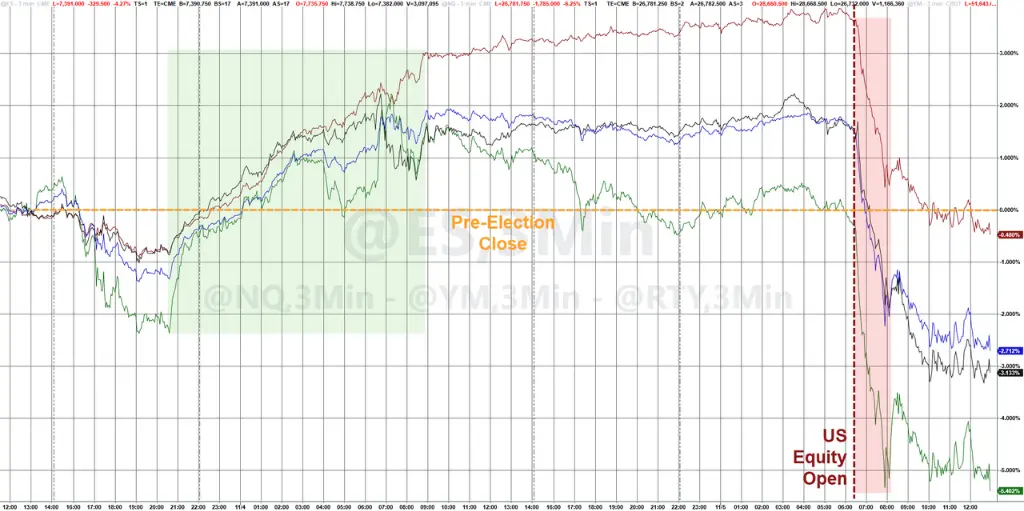
This reversal caught Wall Street trading desks off guard.
John Flood, head of U.S. equity execution services at Goldman Sachs, wrote in a client report that Wednesday was one of the busiest trading days for Goldman Sachs' equity desk this year, while Thursday was "completely the opposite"—"Our phones were bombarded with inquiries, but unfortunately, we couldn't see the direction clearly." He noted that long-term investors were once again "stuck in a stalemate."
### Collective Bullishness Before the Election, Highly Consistent Logic
Before and after the midterm election results were announced, major trading institutions on Wall Street almost unanimously issued bullish signals to clients, based on the core premise that pre-election positions had been extremely compressed and that there was ample fuel for a rebound.
Scott Rubner of Citadel Securities wrote in a client report: "With the election over and volatility expected to normalize, there is considerable room for investors to rebuild their risk exposure. As uncertainty fades and the market's largest buyers gradually return, we believe the path of least resistance for U.S. stocks before the end of the year is upward." Data from Citadel Securities indicated that systematic trend-following strategies currently have a net position in U.S. stocks of about -3.3 standard deviations, placing it in the 10th percentile historically since 2018. Once the market stabilizes at key technical levels, trend-following strategies are expected to trigger systematic buying.
UBS's Davide Montoni also believes that the election could serve as an upward catalyst for tech stocks after their volatility. "The earnings reports from large-scale cloud computing companies clearly failed to reassure investors, but crossing the election hurdle may become the key to triggering a year-end short squeeze." JPMorgan's U.S. market intelligence team maintained a tactical bullish stance, believing that the significant pullback in tech stocks in October had created opportunities for a recent rebound, and recommended a "barbell strategy" of tech stocks and cyclical stocks.
The data supporting this judgment is also ample: hedge funds continuously reduced their exposure to U.S. stocks before the election, with short positions nearing a five-year high; retail investors have net bought U.S. stocks for 22 consecutive trading days since October 5, accumulating nearly $33 billion in purchases; and the corporate buyback window is expected to reopen significantly following the earnings season, with the proportion of buybacks expected to rise to 85% before November 9.
### Within One Day, Bullish Judgments Completely Fall Apart
However, the conclusion of the election did not eliminate the core contradictions suppressing the market.
According to Bloomberg, on Thursday, concerns about the return on investment in artificial intelligence and the costs of computing infrastructure suddenly erupted, leading to a single-day evaporation of $2.3 trillion in market value for the Nasdaq 100 index, and the S&P 500 index fell by 4.4%, with all sectors closing lower. Goldman Sachs' John Flood pointed out that investors who had significantly reduced their positions due to election uncertainty were caught off guard by Wednesday's rebound; hedge funds then began to sell AI large-scale cloud computing stocks that they had just bought the previous day, while long-term investors found themselves once again in a wait-and-see mode.
Prior to this, Alex Altmann, head of global equity tactical strategy at Barclays, was one of the few skeptics among Wall Street's major trading desks. He had previously warned that the midterm elections were unlikely to become the "clearing event" that the market anticipated—factors suppressing the stock market, such as the investment return prospects of AI and the financing costs of computing infrastructure, would not be resolved by the election results.
### Systematic Selling Pressure Amplified, Declines Exceed Expectations
The intensity of this plunge was largely amplified by mechanical selling from systematic strategies.
According to Bloomberg, Barclays' equity tactical strategy model indicated that volatility control funds could reduce their stock exposure by about 30 percentage points in a single day, marking one of the largest single-day reallocations since the market turmoil triggered by the COVID-19 pandemic, corresponding to approximately $135 billion in U.S. stock futures selling over the next 24 to 48 hours. Alex Altmann stated: "We expect this trend to continue tomorrow, as deleveraging will spread to retail and long-term investor channels."
ETF rebalancing further exacerbated the selling pressure. Barclays noted that Thursday was expected to be the largest leveraged ETF selling rebalancing day in history.
Retail investors, previously seen as an important source of buying during market declines, also chose to retreat this time. According to Vanda Research data, as of Thursday at 3 PM New York time, retail investors had net sold $338 million in individual stocks, likely setting a record for the largest single-day net sell-off since the COVID-19 pandemic.
### Short-Term Setbacks, Bullish Logic Not Yet Over
Despite the severe setback, Wall Street's bullish judgment has not been declared over.
As of 6:25 AM New York time on Friday, S&P 500 futures were up 0.3%, and Nasdaq 100 futures surged 1.5%, indicating some stabilization in market sentiment. As Bloomberg pointed out, the significant daily volatility is not enough to change the market trend, and the bullish views from various trading desks may still be realized at some point in the future.
However, this collective "face-slapping" incident profoundly reveals the difficulty of predicting the direction of the stock market—even the top professional institutions on Wall Street find it challenging to foresee outcomes when faced with the structural variable of AI valuation reconstruction.