Global tech stocks "suffered a bloodbath"! Nasdaq futures fell by 2%, the South Korean stock market dropped by 4%, and Asian chip stocks plummeted
Global tech stocks are experiencing the most intense collective decline of this earnings season.
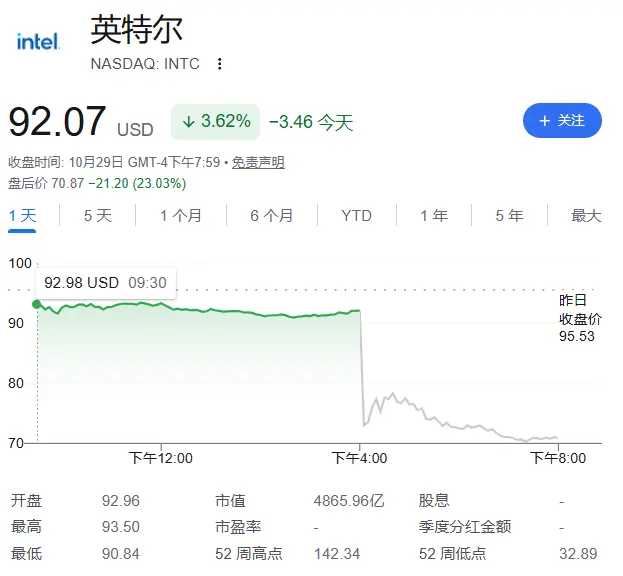
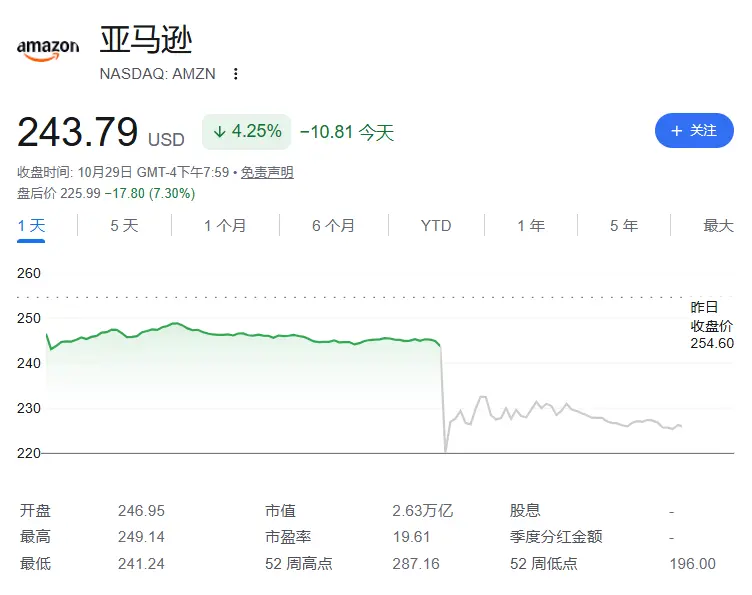
Intel plummeted 23% in after-hours trading, while Amazon fell about 7.3%. The Nasdaq 100 index futures extended their decline to 2%. This marks the second consecutive trading day of decline for tech stocks, as a series of disappointing earnings reports accelerates the withdrawal of funds from AI-related trades.
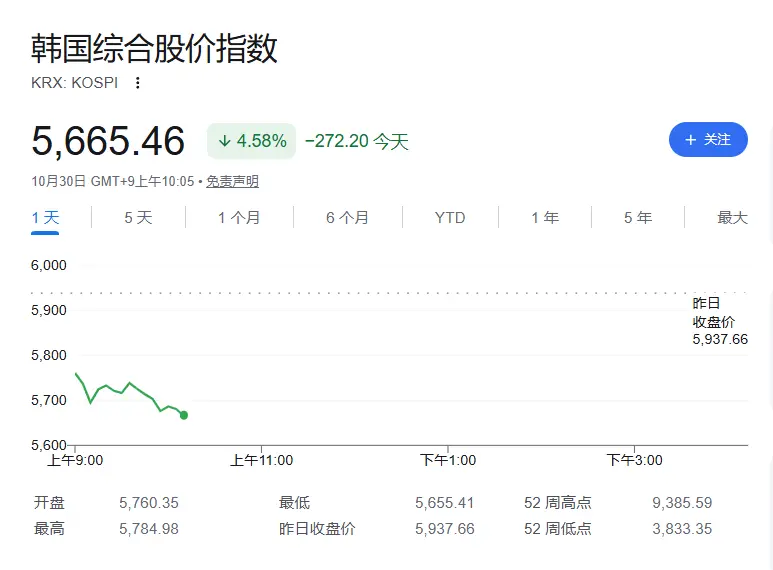
The Asia-Pacific market is the hardest hit. The South Korean KOSPI index dropped 4.5%, prompting the Korea Exchange to activate the SIDECAR mechanism to suspend programmatic selling; chip stocks are under particularly heavy pressure, with SK Hynix down over 8% and Samsung Electronics down over 5%. The Asian chip manufacturer index fell 1.8%. The Taiwan Weighted Stock Index dropped over 3% at the start of trading; the Nikkei 225 index's decline expanded to 2%; and the MSCI Asia-Pacific index fell 1.2% to 259.45 points.
### Three Major Triggers: Amazon, Intel, and Alphabet Take Turns "Stepping on Mines"
Intel's after-hours plunge of 23% was due to revenue forecasts falling short of market expectations. This is the largest single-stock decline of this earnings season.
Amazon fell about 7.3% in after-hours trading. The earnings report showed that total revenue for the third quarter grew 12% year-over-year to $201.9 billion, below analyst expectations. AWS cloud business revenue grew 39% to $46 billion, marking the sixth consecutive quarter of acceleration, but online retail sales growth fell to a three-year low, and advertising business growth hit its lowest level since being disclosed separately in 2020. More concerning for the market is capital expenditure: third-quarter equipment and property spending exceeded $77 billion, far exceeding expectations, with free cash flow recording a negative $42.4 billion over the past 12 months. CEO Andy Jassy also stated in the earnings call that capital expenditures will "significantly" increase further by 2027.
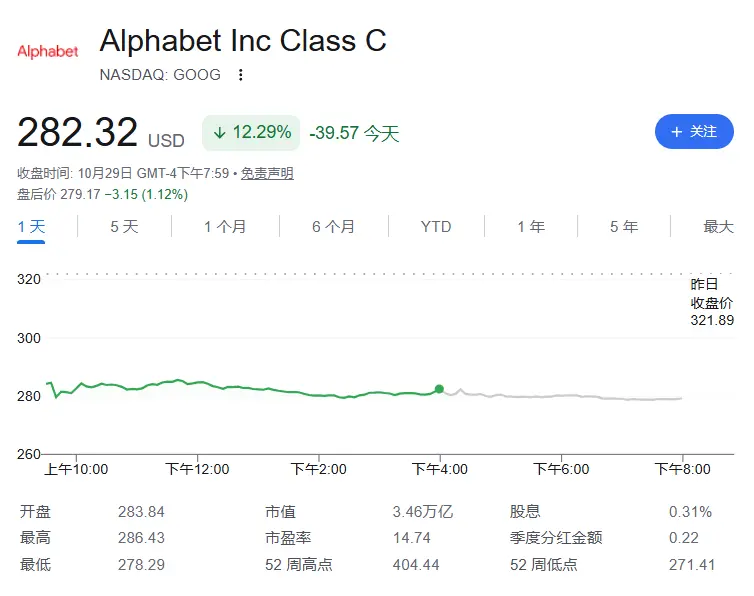
Alphabet saw a sharp decline of 13% at the close of the previous trading day, marking the largest single-day drop in the stock's history. Search advertising revenue grew 12% year-over-year to $63.3 billion, below the market expectation of $64.9 billion, with free cash flow recording a negative $9.1 billion. CEO Sundar Pichai characterized the lag in monetizing AI search as a deliberate choice, comparing the current phase to the mobile transition a decade ago: "Just like we focused on creating the best search user experience before monetization ten years ago, we are doing the same now." However, the market did not buy this explanation.
### AI Spending Fails to Drive Growth, Market Patience Running Thin
AI investments continue to ramp up, but core business growth is slowing, and the monetization timeline remains unclear.
Anna Wu, founder and investment strategist at Floodlines Research, stated: "This earnings season has been quite tough for AI players, as most companies are being punished against the backdrop of AI bubble and inflation concerns. The market is worried not that AI demand has slowed, but that higher financing costs and credit risks may ultimately force large-scale cloud providers to slow down infrastructure development."
Greg Boland, a market strategist at brokerage Moomoo, pointed out: "The broader signal from the market is that investors want more than just AI promises. Tech stock valuations have been stretched, and the market needs clearer evidence that heavy capital investments can translate into profits and cash flow. This risk-averse sentiment is spreading among tech stocks and into the Asian markets."
In contrast, Microsoft reported a 48% growth in cloud business revenue on the same day, with relatively restrained capital expenditures, and its stock price fell less than 1% on Thursday, making it one of the few tech giants that satisfied investors during this earnings season.
On Thursday, over 400 components of the S&P 500 index rose, indicating that funds are rotating from the tech sector to other industries, showing that the current round of sell-off is still mainly concentrated in the tech sector. The Philadelphia Semiconductor Index fell 1.4% on Thursday, the Nasdaq 100 index fell 1.4%, and the S&P 500 index only slightly retreated by 0.3%.
### Funds Shift to Safe-Haven Assets: U.S. Treasury Yields Drop to Seven-Week Low
The sell-off in tech stocks has driven funds into safe-haven assets.
The yield on the U.S. 10-year Treasury bond fell by 8.5 basis points to a seven-week low of 4.902%; the yield on the two-year Treasury bond fell by 8.7 basis points to 4.5648%. Federal funds rate futures rose in tandem, as traders reduced bets on Fed rate hikes, with the market currently expecting a 70% probability of a rate hike in December.
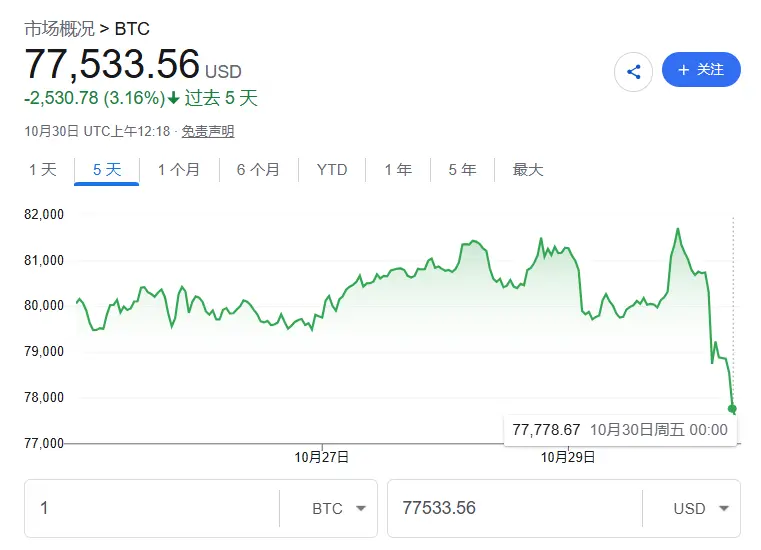
The cryptocurrency market was also not spared. Bitcoin fell about 2% to around $77,200. Meanwhile, Binance, the world's largest cryptocurrency exchange, reportedly suffered a hacking attack, announcing a freeze on assets totaling about $3 billion (previously reported by Bloomberg as over $2.5 billion, Binance later updated the figure to about $3 billion), causing digital token prices to drop. Binance stated that it has not yet confirmed whether customer funds were affected.
Ian Lyngen of BMO Capital Markets commented on the current macro backdrop: "This is yet another round of strong economic data, showing persistent inflationary pressures and a divergence in growth between AI infrastructure development and consumption."
It is noteworthy that the decline in tech stocks has not dragged down the entire U.S. stock market. On Thursday, over 400 components of the S&P 500 index closed higher, as investors rotated funds from the tech sector to other industries, with the overall S&P 500 index only down 0.3%.
Risk Warning and Disclaimer
The market carries risks, and investments should be made cautiously. This article does not constitute personal investment advice and does not take into account individual users' specific investment objectives, financial situations, or needs. Users should consider whether any opinions, views, or conclusions in this article align with their specific circumstances. Investing based on this is at your own risk.