The whole world is waiting for Lao Huang's results
*Author: Zhou, ChainCatcher*
The whole world is discussing Jensen Huang!
In just one week, this founder who has led NVIDIA for 33 years has transformed from the most dazzling CEO of the AI era into the protagonist of a corporate governance crisis.
First, he admitted to infidelity, prompting NVIDIA's board to initiate an investigation to determine whether he has become a target of foreign intelligence operations. Subsequently, The New York Times reported that he also had an extramarital affair with a company vice president who reports directly to him.
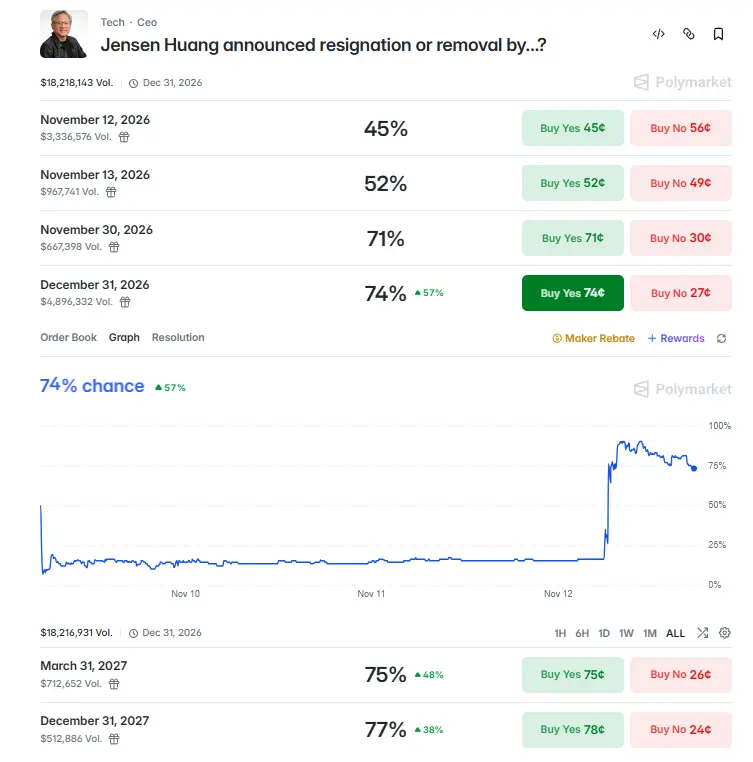
According to The Wall Street Journal, the board is preparing to remove Jensen Huang. The probability of "Jensen Huang announcing his resignation or being dismissed by the end of the year" on Polymarket once rose to 90%.
Some Wall Street institutions have begun to downgrade NVIDIA's rating. According to Reuters, including after-hours declines, NVIDIA's market value has evaporated by about $600 billion since the board announced the investigation.
If Jensen Huang really steps down as CEO, who will take over? What will happen to NVIDIA next? What impact will the capital market endure?
### The Board Holds the Power to Dismiss, Successor Candidates Still Undecided
A few days ago, the focus of external attention was on Jensen Huang's relationship with former Megaspeed executive Alice Huang. Megaspeed is a Singapore-based data center operator and a client of NVIDIA, and the U.S. government is investigating whether it has illegally transferred NVIDIA chips to China.
However, since Alice Huang is not an NVIDIA employee, the board has time to wait for the investigation's conclusion. From November 9 to 11, the probability of Jensen Huang leaving by the end of the year on Polymarket hovered around 15%.
The turning point occurred on November 11. The New York Times cited five current or former employees, reporting that Jensen Huang had an extramarital affair with Kimberly Powell, the vice president of medical business, who reports directly to him.
It is known that the relationship between a CEO and a direct subordinate is typically seen as a governance red line in American companies. Former Intel CEO Brian Krzanich and former McDonald's CEO Steve Easterbrook both left due to violations of company policy regarding relationships with employees.
The key is that Jensen Huang does not have enough chips to resist the board. NVIDIA implements a one-share, one-vote system, with no dual-class share structure. According to the company's proxy statement released in May 2026, Jensen Huang holds about 3.58% of the shares. Among the 11 board members, he is the only non-independent director. According to the company's articles of association, the board can dismiss executives at any time with a majority vote.
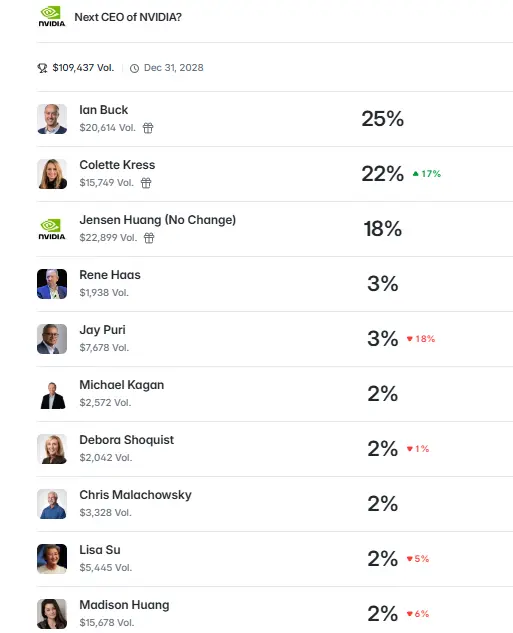
According to Bloomberg, the board has hired an external headhunting firm to look for candidates and is considering appointing an interim CEO first. Semafor cited sources saying that some board members prefer Chief Financial Officer Colette Kress to take the position.
Kress joined NVIDIA in 2013 and previously worked at Microsoft, Cisco, and Texas Instruments. She has long attended earnings calls with Jensen Huang and is one of the most familiar NVIDIA executives on Wall Street.
Traders in the prediction market are more optimistic about Ian Buck. After the dismissal report surfaced, the probability of Buck becoming NVIDIA's next CEO clearly led on the two major prediction market platforms, Polymarket and Kalshi. As of 6 PM on the 12th, Buck led with a 25% probability on Polymarket, followed closely by Kress at 22%.
Buck joined NVIDIA in 2004 and is one of the main developers of the CUDA software system. He is currently responsible for large-scale and high-performance computing business.
Some analysts have suggested that Kress could stabilize the business and finances while Buck handles products and technology, transitioning in a co-CEO manner.
Among external candidates, Arm CEO Rene Haas worked at NVIDIA for seven years and is familiar with the company culture, but he also serves as the international CEO of SoftBank Group, making the cost of poaching very high. According to Semafor, Apple hardware chief Johny Srouji is also under consideration. AMD CEO Lisa Su has also been mentioned, but AMD is a direct competitor of NVIDIA, and she has a familial relationship with Jensen Huang, making her a low-probability option.
Previously, in a Bloomberg documentary, Jensen Huang expressed hope that NVIDIA's next CEO would already be within the company but would not hand the position to his children. He stated that just as he could be fired at any time, the next CEO must also be appointed based on merit.
Of course, not everyone supports a change in leadership. Seaport analyst Jay Goldberg, who gave a sell rating, believes that forcing Jensen Huang to step down would be a mistake for all parties, and he does not see anyone who could easily replace him.
The Kobeissi Letter suggested that the board hold a special shareholders' meeting for a consultative vote, and Elon Musk also expressed support for giving shareholders a voice. However, consultative votes are non-binding, and the final decision still rests with the board.
### Orders and Ecosystem Remain, Jensen Huang's Decision-Making Ability and Political Capital Hard to Replicate
NVIDIA's business will not come to a halt due to a change in leadership; global developers are deeply reliant on the CUDA ecosystem, and cloud vendors' procurement plans have long been set. Bernstein analyst Stacy Rasgon believes this turmoil is a problem within NVIDIA itself, and customers are unlikely to reduce purchases because of it.
Bernstein downgraded NVIDIA's rating to market perform, lowering the target price from $400 to $200, but maintained its profit forecast, only halving the valuation multiple to about 12.7 times the expected profit for the fiscal year 2028. Rasgon stated that the downgrade stems from uncertainty in leadership, and he prefers to observe from the sidelines for now.
Baird downgraded its rating to neutral, lowering the target price from $500 to $200, citing government investigations and export restriction risks. Morgan Stanley removed NVIDIA from its preferred stock list based on stop-loss rules but maintained an overweight rating and a $300 target price. Yorkville Ives senior managing director Dan Ives believes that if Jensen Huang is forced to step down, NVIDIA's stock price could initially drop by 25% to 30%.
What is truly difficult to hand over is Jensen Huang's decision-making style. Tianfeng International Securities analyst Ming-Chi Kuo stated that Jensen Huang's value lies in transforming technically feasible technologies identified by engineers into products that the company must deliver with overall resource investment, which provides strong order visibility for the supply chain and forces competitors to follow suit. In his view, it is unlikely that Jensen Huang can exit unscathed; a more realistic approach is to gradually reduce NVIDIA's reliance on his personal decision-making while preparing for succession.
Another asset that is difficult to transfer is in Washington. Over the past two years, Jensen Huang has frequently communicated with the Trump administration to seek relaxation of chip export restrictions to China. In December 2025, Trump announced that NVIDIA would be allowed to sell H200 chips to China, with the U.S. government collecting a 25% fee from the transaction.
The current pressure mainly comes from Congress, where three Republican committee chairs have requested Jensen Huang to attend a closed-door briefing on November 18, and Foreign Affairs Committee Chairman Brian Mast has stated that if he does not receive a response, he will consider issuing a subpoena.
According to The New York Times, the Department of Commerce's investigation into Megaspeed has been handed over to the Department of Justice, transitioning to a criminal investigation.
These issues will not disappear with a change in leadership; the successor will face them without Jensen Huang's political capital.
### NVIDIA's Turmoil is Spilling Over into the Entire Market
NVIDIA's stock price fluctuations are no longer just a concern for NVIDIA's shareholders. As of October 28, NVIDIA's weight in the SPDR S&P 500 ETF was 7.81%. According to calculations by Benzinga, every 10% fluctuation in NVIDIA's stock price would approximately drive the S&P 500 index up or down by 0.78 percentage points.
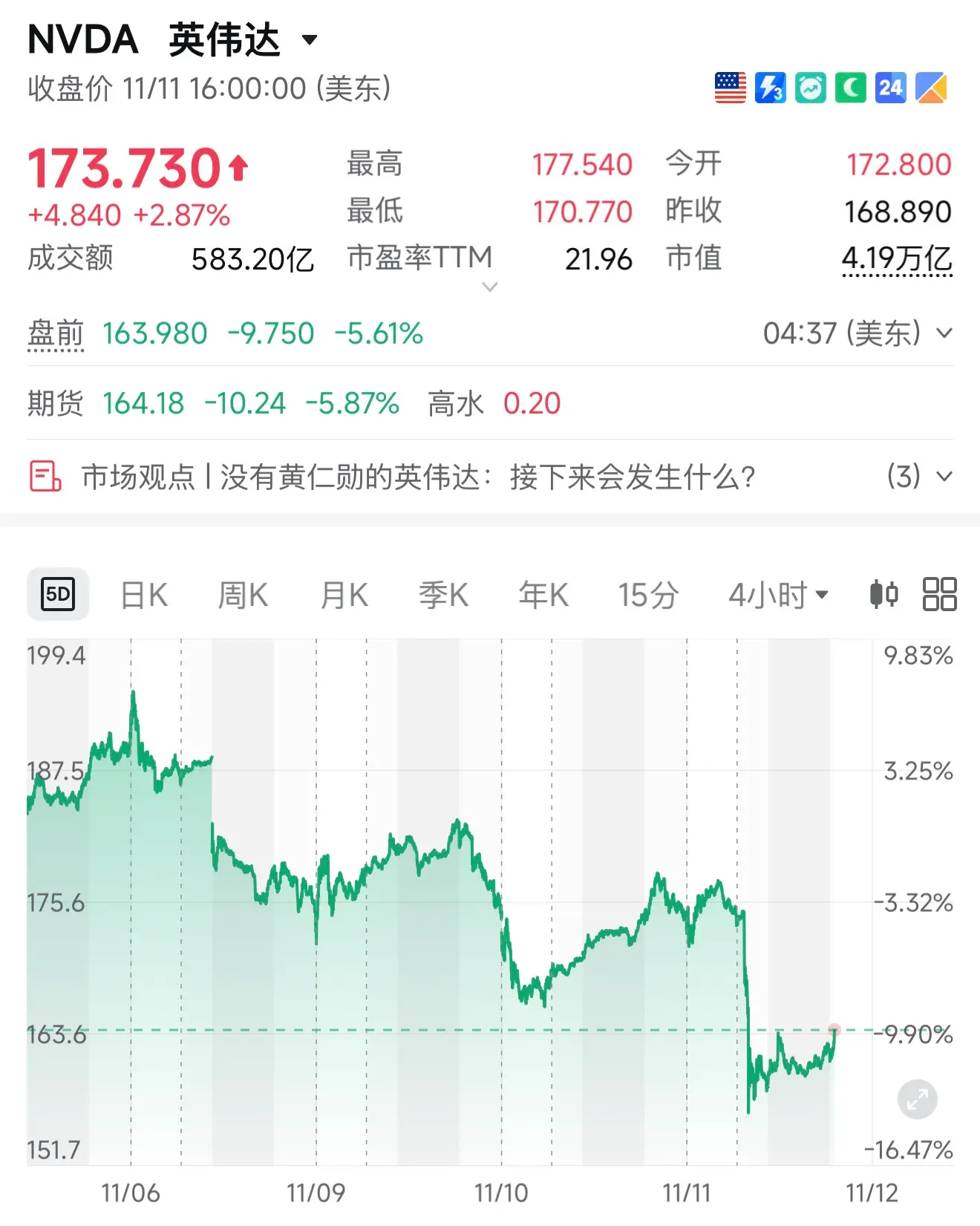
This past Monday, NVIDIA fell by 4.27%, with about 463 million shares traded, roughly four times the usual volume, and a cumulative decline of 9.5% over Monday and Tuesday. Following the dismissal report from The Wall Street Journal, Nasdaq futures fell by about 0.8%, and S&P futures dropped by about 0.3%. Selling pressure concentrated on the AI supply chain, with Advanced Micro Devices, Oracle, and CoreWeave following suit, while AMD rose by 3.8%. NVIDIA suppliers in Taiwan, South Korea, and Japan, which have a high weight in the stock market, became the first to trade on this news.
Market-cap-weighted index funds are not forced to sell due to stock price declines; NVIDIA's weight in the index will automatically shrink with its stock price. The real selling pressure comes from risk control adjustments by active funds and funds specifically betting on founder-led companies. According to Axios, Founder ETFs have indicated that they will sell NVIDIA if Jensen Huang steps down.
According to Reuters, some lawmakers are using this opportunity to push for tighter controls on chip exports to China. If the situation continues to deteriorate, such as if the Department of Justice's criminal investigation involves NVIDIA or if export controls tighten further, the impact will spread from NVIDIA alone to the entire AI hardware chain.
In the crypto market, NVIDIA (NVDA) has currently become the largest HIP-3 market on Hyperliquid in terms of open contract size and is the fourth largest market on the platform, only behind BTC, ETH, and HYPE.
Last weekend, before the U.S. stock market opened, NVIDIA perpetual contracts and tokenized NVIDIA stocks on Hyperliquid and Binance fell by about 3% to 4% first. Bitcoin briefly fell below $74,000 that same weekend, with some analysts suggesting this was a typical risk-averse reaction amplified by leverage.
In addition, many Bitcoin mining companies have transformed into AI computing power suppliers. Among them, IREN signed a five-year AI cloud service contract worth $3.4 billion with NVIDIA in May this year. NVIDIA also received warrants to purchase up to 30 million shares of IREN stock at $70 per share, provided that conditions such as GPU delivery milestones are met.
If NVIDIA changes leadership, whether the pace of such collaborations will change is a question that transforming mining companies will need to face next.
### Conclusion
Bernstein analyst Rasgon once described Jensen Huang as NVIDIA, and NVIDIA as Jensen Huang. For the past thirty years, this has been NVIDIA's greatest advantage, and now it has become its biggest variable.
The fate of Jensen Huang is no longer just about the destiny of NVIDIA alone. From the S&P 500 index to the Asian chip supply chain, and to the on-chain market that continues to trade over the weekend, global capital is waiting for this answer.