Just the day before yesterday, Zhao Changpeng answered 19 questions in Oxford
Author: Xiangwai Thoughts (Liang Jun Cheng)
In December 2014, a year before deciding to start a business, I was fortunate to meet He Yi, now the leading figure.
In the same year, He Yi met Zhao Changpeng for the first time. At that time, Zhao Changpeng was at Blockchain.info, and He Yi was at OKCoin.
June 2014: At He Yi's invitation, Zhao Changpeng joined OKCoin as CTO.
2017: Zhao Changpeng founded Binance and subsequently invited He Yi to join as a co-founder.
Time flies, and 9 years later, on November 3, 2026, I was invited to the Oxford Union to listen to Zhao Changpeng's live interview.

Image: CZLife Book Club European Chapter Launch and Official Invitation to the Oxford Debate
The Oxford Union Society, established in 1823, is one of the oldest and most influential university debating societies in the world. The Oxford Union has always upheld the tradition of free expression and open discussion.
For over 200 years, the Oxford Union has invited numerous heads of state, international dignitaries, Nobel laureates, scientists, entrepreneurs, and cultural figures to give speeches and participate in debates. It has long become a pilgrimage site for public speaking and exchange of ideas with international recognition.

Image: The Oxford Union Debate Hall and Historical Debate Seats
That day, the wind in Oxford was strong and cold. In the morning, I attended the Oxford debate themed around Zhao Changpeng's new book "Freedom of Money." A large bowl of beef noodles next to St Peter College could not block the chilly wind in the afternoon.
By 4 PM, I had already hidden in the debate society's bar, sipping a whiskey while waiting for Zhao Changpeng's arrival, and by around 5 PM, a long queue had formed.
At 6 PM, Zhao Changpeng stepped into the Oxford Union right on time, and the hall was already filled with hundreds of eager attendees.

Image: Zhao Changpeng entering the Oxford Union on time
On October 29, Binance had just experienced a major cybersecurity incident. According to an investigation update released by Binance on November 3, the incident involved approximately $6.34 billion in digital assets; as of this disclosure, about $2.85 billion of the related assets had been frozen or intercepted. Binance stated that it had set aside sufficient funds to cover the losses and was gradually replenishing the affected assets.
Thus, this event became very significant: it might be Zhao Changpeng's first time facing such a large audience for an open discussion after the recent major incident.
Therefore, the entire English interview at the Oxford Union began with a direct question: After such a significant mistake, why should users still trust this platform? The discussion unfolded over nearly an hour, with topics ranging from cybersecurity to entrepreneurial mission, global finance, artificial intelligence, stablecoins, and the Chinese market; after audience questions began, issues such as quantum computing, personal credibility of founders, marriage choices, and traditional asset tokenization also emerged.
The content and depth far exceeded the interview in Hong Kong in August 2026.
Below are 19 questions and Zhao Changpeng's main points compiled in the order of audience inquiries.
### Origin of the Dialogue: Why Choose to Face the Public at the Oxford Union
Zhao Changpeng believes that the Oxford Union truly embodies the spirit of Freedom of Speech. The industry that Binance is engaged in is, to some extent, also quite controversial. Binance focuses on another form of freedom, which is Freedom of Money. This is actually also the title of his latest autobiography.
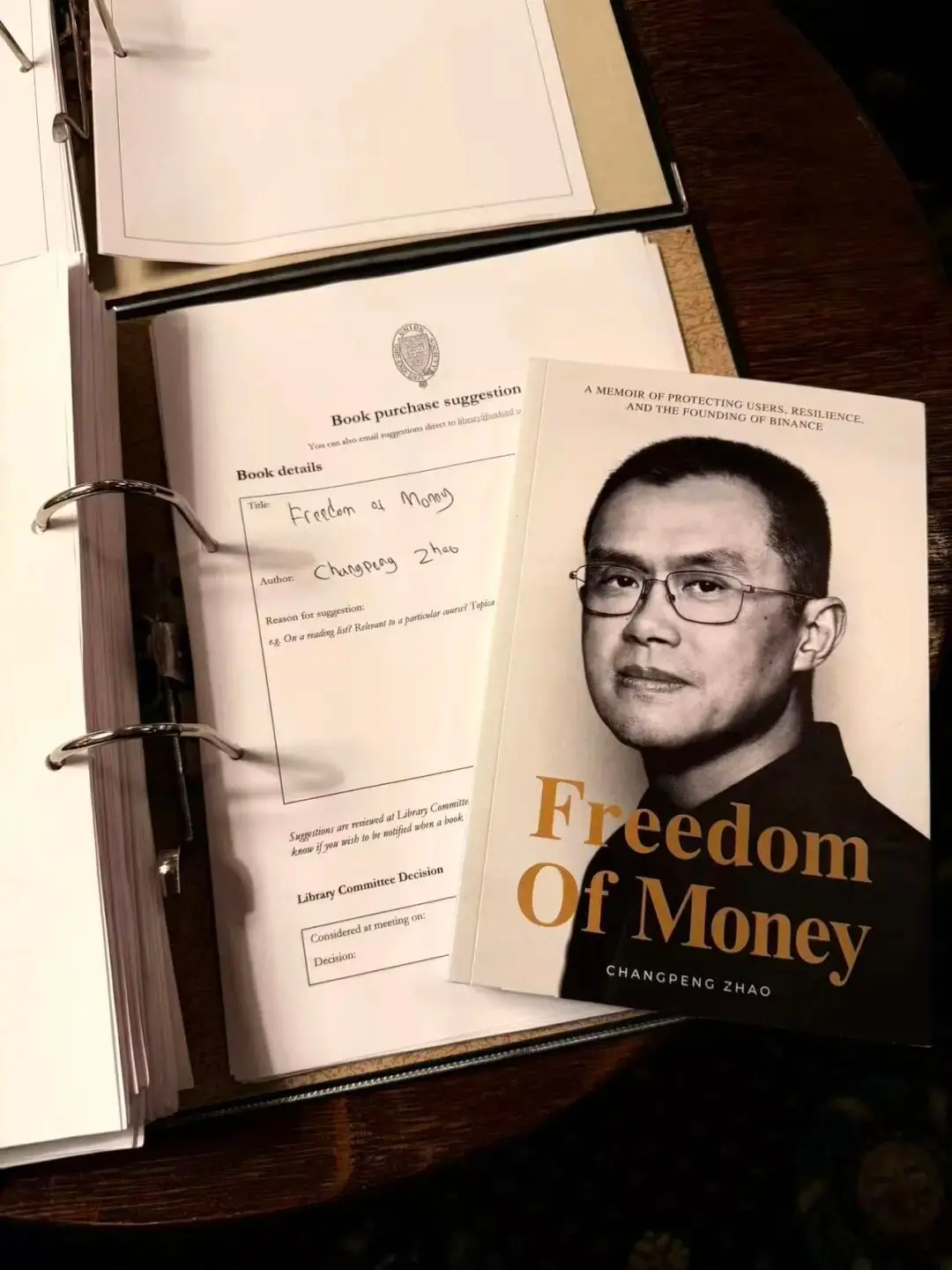
Image: Zhao Changpeng's autobiography "Freedom of Money" and the book suggestion booklet from the debate society
Free expression is very important because it is a necessary foundation for achieving almost all other freedoms. If we look back at the development of human civilization over the past 200 years, we will find that the concept of freedom has been continuously evolving. From the abolition of slavery and the realization of personal freedom to freedom of expression, press freedom, and information freedom.
Now, we are entering a new stage, the Freedom of Intelligence. This is not just a possibility; Zhao Changpeng believes it will definitely happen.
Therefore, being able to come here to discuss these issues is "an honor for me. This is actually a place where different concepts of freedom intersect."
### Response to the Storm: How Binance Maintains User Trust After a Serious Hacking Attack
Focus of the Question: In the face of a major security breach, how does CZ plan to respond to Binance users and the public?
Zhao Changpeng first acknowledged that this attack exposed obvious shortcomings in Binance's security and operational aspects. In his view, regardless of how complex the technology used by hackers is, there are usually multiple possible ways to block an attack beforehand, so one cannot use "the attack was too advanced" to explain away the platform's responsibilities.
However, he also emphasized that Binance's response afterward has at least two commendable points: first, the relatively quick communication of progress to the outside world after the incident; second, the platform's commitment to bear the losses of user assets. He linked the latter to the user protection principles established when he founded Binance, believing that a centralized exchange must take responsibility in a crisis and cannot let users pay for internal vulnerabilities of the platform.
He also compared the public traceability of blockchain with the information disclosure of traditional financial institutions: on-chain fund flows can be tracked in real-time by external analytical agencies, and sometimes third parties can identify anomalies even earlier than the platform itself. His judgment is that this transparency, while amplifying the immediate impact of the crisis, is also the reason why the system can accept public scrutiny.
The core of this question is not "Binance is absolutely secure," but rather CZ's acknowledgment of mistakes while emphasizing emergency transparency and the mechanism for bearing user losses. Additionally, "in the short term, AI has a double-edged effect. But in the long term, I firmly believe that artificial intelligence will make the entire financial and cryptocurrency system more secure. This is just a transitional phase."
### The Myth of Absolute Security: Can the Platform Guarantee Such Attacks Will Never Happen Again?
Focus of the Question: Since it is believed that attacks can be prevented, what specific guarantees can the platform make?
CZ did not give a 100% security promise. He believes that similar attack paths should be thoroughly investigated and blocked, but anyone claiming that a complex information system can be immune to attacks forever is unrealistic.
According to his on-site introduction, attackers may have spent about five to six months preparing, first trying to approach the company's internal systems through traditional methods like fake recruitment and social engineering, and then using AI to accelerate their understanding of the system. He specifically pointed out that certain basic operational security procedures were not strictly enforced, which should not occur in a large trading platform.
"There is a fundamental asymmetry problem in cybersecurity": the difficulty of security: attackers only need to find one entry point, while defenders must try to check all entry points. As AI rapidly increases the efficiency of attacks, the defense side must also strengthen equipment, permissions, internal processes, and behavior anomaly monitoring, and collaborate with AI companies, cybersecurity experts, regulators, and law enforcement.
Therefore, his attitude towards the future is not to guarantee "there will be no more incidents," but to push the industry from passive remediation to stronger proactive defense. Regarding the cross-institutional collaboration triggered by this attack, he expressed that he has seen positive changes, but the related recovery work is still ongoing.
### Entrepreneurial Choice: Why Establish Blockchain as a Lifelong Mission in His Forties
Focus of the Question: Why does CZ see Binance as a long-term investment?
CZ believes that sustained entrepreneurship over the years cannot rely solely on the motivation of making money. When a person first enters the workforce, they often consider survival first and then family; finding a true mission worth long-term investment may take longer. For him personally, this process was not achieved overnight.
He reflected on his experiences of being born in China, growing up in Canada, and later working in different countries, believing that these experiences reinforced his emphasis on personal freedom. The internet has made information dissemination more open, but at that time he did not seize the early internet entrepreneurial opportunities. After encountering blockchain, he gradually believed that this technology could bring similar changes to the flow of funds and the way of economic participation.
He also mentioned that many historically significant technologies were accompanied by strong controversies in their early appearances. "For example, when printing technology first emerged, it was restricted or even banned in many places. Later, press freedom was also a highly controversial topic that sparked extensive discussions. Technologies that can profoundly change society often go through similar processes." The volatility and skepticism faced by the blockchain industry, in his view, do not necessarily negate its long-term value.
His entrepreneurial narrative thus centers on one word: mission, which is the belief that technology can improve certain limitations in reality.
### Underlying Value: With Existing Traditional Banks and Fiat Currency, Why Does the World Still Need Cryptocurrency?
Focus of the Question: If the existing financial system can already complete transactions, what new problems does blockchain solve?
This is one of the most content-rich questions in the entire interview. CZ first emphasized the accessibility of financial services: in a mature financial system like the UK, it may be difficult for people to appreciate the ongoing inconveniences of opening accounts, transferring money, and cross-border payments in certain regions. For groups with insufficient bank coverage or high cross-border payment costs, mobile wallets and blockchain payments may provide an alternative.
He then discussed the purchasing power of wealth. In a high-inflation environment, people want tools to protect their assets, but he also acknowledged that not all cryptocurrencies are suitable for this function. "Those who successfully invested in large tech companies early on often received disproportionately high returns. But they also took significant risks at that time. Therefore, some people becoming wealthy through cryptocurrency is not an inexplicable phenomenon."
The third value comes from cross-border payments, and the fourth is the trading time and global accessibility of financial markets. He believes that friction still exists between the financial systems of different countries, while on-chain payments and transactions have the technical potential to operate around the clock. Finally, he extends this convenience to global asset allocation: investors from different countries should have the opportunity to access quality financial assets in different markets more conveniently.
However, this is a claim about technological potential, not a conclusion that all crypto financial services have proven to be superior to banks. Practical applications still need to address issues such as costs, compliance, asset custody, and consumer protection.
### Adoption Cycle: How Long Until the Global Financial System Fully Embraces Blockchain?
Focus of the Question: What kind of time cycle will technology experience as it moves from the margins to the mainstream? Where are the resistances?
CZ uses the "S-curve" of technology diffusion to describe possible paths: slow growth in the initial stage, acceleration after reaching a certain adoption rate, and a slowdown again as it matures. He provided a very rough personal estimate on-site: achieving a preliminary level of diffusion may take five to ten years, with an intermediate stage possibly lasting ten to fifteen years, while the conversion of the last segment of users or institutions could be very lengthy. These numbers are not industry forecasts validated by models.
He believes that changes in the United States' attitude towards digital assets will influence regulatory discussions in other countries. However, what may be harder to change than policy positions is the massive financial infrastructure: the existing banking system, internal processes, compliance requirements, and technical interfaces cannot be changed overnight. Even if new platforms grow rapidly, they may still face difficulties accessing traditional banking services in different regions.
Another layer of resistance comes from the government's control over monetary policy and capital flows. "Governments are not always the most efficient institutions for solving economic problems. In many cases, excessive government intervention can also create new issues." CZ tends to favor a more free global economic system but also acknowledges that the crypto industry itself still has security, fraud, and governance issues, so it cannot demand that countries fully open up overnight.
He did not provide a precise year but rather a judgment of "long-term, non-linear, with institutional and technological advancements progressing in sync."
### Technological Resonance: How AI Will Deeply Reshape the Crypto Ecosystem
Question focus: Are AI and cryptocurrency two parallel hotspots, or will they form actual business connections?
CZ first talked about software development. He mentioned that he has also used natural language-driven AI programming tools (Vibe Coding) and felt that technological capabilities have significantly improved recently. In the past, startup teams had to spend a lot of energy writing code and building systems, but this part of the work is gradually becoming easier; competitive advantages may shift from pure coding ability to product design, market understanding, and problem-solving skills.
For the cryptocurrency industry, AI can accelerate product development, system improvements, and security analysis, while also potentially driving updates to cryptographic algorithms. However, he believes that what is more noteworthy is the potential for massive micropayments between AI agents in the future, as agents represent users to seek services, complete tasks, and settle automatically, leading to frequent payment demands between machines.
For example, a very small software development task might be automatically matched with an executor by the system, acceptance of results, and payment of rewards in the future. If similar transactions occur tens of thousands of times a day, low-cost, digitally native, and automatable payment infrastructure will be required.
CZ did not assert that any existing public chain would definitely prevail. His view is that AI may create new payment demands, and blockchain and stablecoins have the opportunity to participate in meeting this demand.
### Physical Hard Constraints: Can Computing Power, Data Centers, and Electricity Keep Up with AI Expansion?
Question focus: With increasing demands for software and models, can the physical world provide sufficient electricity, equipment, and infrastructure?
CZ maintains an overall optimistic attitude. One reason is capital investment: global tech companies and investment institutions are investing huge resources into AI and computing power infrastructure, which he believes will accelerate the iteration of hardware, data centers, and power technologies.
He envisions that in the future, solar facilities and data centers may occupy more land; as computing power demands grow, the scale and form of energy systems may undergo significant changes. However, he does not deny resource bottlenecks, such as the supply of certain materials possibly not keeping pace with the expansion speed in the short term.
More importantly, he disagrees with projecting decades into the future based solely on current equipment structures. "If AI can create new algorithms for our industry, it can also help develop new solutions in areas like energy, materials, and computing."
This is an optimistic judgment about technological progress, not a guarantee that future power grids, chips, or material supplies will be worry-free.
### The Debate on Lowering Startup Barriers: Will AI Empowerment Lead to a Flood of Mediocre Products?
Question focus: If trial and error and programming are done by AI, will young entrepreneurs still learn real skills?
The host shifted the question from technology to education, mentioning products lacking real value in some entrepreneurial trends and expressing concern that AI might lead to more similar projects after lowering development barriers.
CZ's response is that learning fundamental principles is still important. AI can write programs, but it cannot allow entrepreneurs to completely abandon judgment, validation, and system understanding. Blindly trusting AI-generated code is particularly dangerous for critical systems.
He gave an example where one model could write code, another could cross-check it, and even multiple agents could repeatedly check the results. He also proposed a more distant vision: machines may no longer always generate source code that is easy for humans to read but may directly generate code closer to the underlying execution form.
In other words, he does not believe that "being able to write every line of code" is necessarily the most important skill for future entrepreneurs, but understanding product goals, mastering basic logic, and establishing reliable verification mechanisms are still essential. "I believe what will be truly important in the future is understanding fundamental principles, rather than requiring everyone to master all specific technical details."
### Cyclical Cold Reflection: The Cooling of Crypto Public Opinion and the Deep Logic of Sovereign Government Cautious Regulation
Question focus: Why is public opinion no longer as fervent as it was from 2020 to 2022? Why have countries not fully embraced it?
CZ offered a counterintuitive explanation: "When a technology gradually matures and becomes part of social infrastructure, people often stop discussing it as much." Internet protocols, mobile networks, or roads are part of daily life but do not always make headlines. Therefore, a decrease in media heat does not necessarily mean that the technology has lost value; it may indicate that some applications are becoming more routine.
He also believes that AI has attracted a lot of capital and media attention, objectively changing the topic center of the tech industry.
Regarding government attitudes, he emphasized that the interests of different countries are not the same. For example, part of the reserves of dollar stablecoins may be allocated to U.S. Treasury bonds, which could expand the demand for U.S. Treasury bonds; the global use of dollar-denominated stablecoins may also extend the influence of the dollar. This can explain why the U.S. may see the strategic and financial value of stablecoins.
However, for countries with stricter capital management, the cross-border flow freedom brought by crypto assets may not align with current policy goals. CZ did not provide a unified answer applicable to all countries, nor did he fully address the host's concerns about illegal transactions.
### The Chinese Perspective: Capital Controls, Renminbi Internationalization, and Hong Kong as a Regulatory Testing Ground
Question focus: How to balance the desire to promote the international use of the renminbi while managing capital flows across borders?
In discussing the financial systems of different countries, CZ specifically talked about China. He believes that one of the purposes of capital controls is to manage capital outflows, but investors will also consider whether future profits can be smoothly repatriated. Even if it is possible, procedural and time costs may still affect cross-border investment decisions.
He pointed out that there is a need for long-term coordination between renminbi internationalization and capital flow management. However, he did not claim to have the best policy answers but emphasized that different countries have different economic scales, institutional goals, and risk tolerance.
Regarding Hong Kong, CZ described it as a "sandbox" for observing digital asset innovation. This should be understood as his judgment on Hong Kong's role, rather than a policy signal that mainland China will soon fully open up crypto asset trading.
He specifically reminded the market not to become overly excited by certain statements supporting financial innovation: "If China fully opens up a certain field, it could lead to millions, or even tens of millions, of new projects in a very short time. Among them, there may be legitimate and excellent innovative projects. But there could also be fraudulent projects, malicious actors, and various management challenges. When the number of projects becomes so large, regulation will become very complex.
Therefore, China must consider more cautiously how to implement open policies." The focus is that different economies can have different choices regarding the speed of opening and risk management, rather than simply "supporting" or "opposing" cryptocurrency.
Audience Q&A Session

Image: Zhao Changpeng answering questions from students and the audience at the Oxford Debate Society hall.
### Breaking the Deadlock: Will the Next Wave of Mass Adoption Be Driven by Institutions or General Users?
Question focus: After the waves of ICOs, NFTs, etc., what will be the next application that brings true mass users?
An MBA student from Oxford asked whether the industry's growth, which has often been driven by new concepts in the past, is now increasingly turning its attention to institutional finance and asset tokenization. Will the next mass adoption be triggered by around-the-clock trading, payments, or some new consumer-grade application?
CZ did not provide a definitive "next killer application." He outlined the market narratives of different periods, such as Bitcoin, altcoins, ICOs, and NFTs, believing that the industry indeed lacks sufficiently attractive consumer innovations at certain stages.
Currently, the increased participation of institutions and the exploration of tokenization of traditional assets like U.S. stocks are directions he believes are worth paying attention to; however, breakthroughs aimed at ordinary people, especially for daily payments, may still take years to mature. He admitted that he cannot accurately predict which product will trigger the next growth.
This is a rare question where CZ clearly stated, "I still don't know the exact answer." "But I believe this industry will continue to generate new innovations."
### Monetary Spectrum: The Essential Differences Between Central Bank Digital Currencies, Stablecoins, and Bitcoin
Question focus: With the continuous development of CBDCs, will they replace stablecoins or native crypto assets?
CZ distinguishes these three types of assets by their different uses. Central Bank Digital Currencies (CBDCs) are issued by central banks and have a sovereign credit background; under specific designs, they may also have clearer authority management, funding usage restrictions, and issuance arrangements. They are not inherently equivalent to decentralized cryptocurrencies.
Stablecoins are typically issued by companies and are often pegged to fiat currencies like the dollar. They can circulate on the blockchain and are suitable for transactions and cross-border payments, but holders still need to consider risks related to the issuer, reserve assets, redemption, and regulation. CZ recalled that in the past, traditional banks were unwilling to provide services to many crypto platforms, which also promoted the popularity of dollar stablecoins in the industry.
Native crypto assets like Bitcoin, Ethereum, and BNB have their own networks, economic mechanisms, and price volatility characteristics, which are more about participation or risk exposure in the corresponding ecosystem rather than simply pursuing price stability with a certain fiat currency.
His conclusion is not about who replaces whom, but rather that different tools meet different needs: "Different types of digital assets satisfy different demands. If you just want to use cryptocurrency for cross-border payments, then today you are likely to choose stablecoins. But if you want to invest in the long-term development of the cryptocurrency industry, you might consider Bitcoin, Ethereum, BNB, or other projects with long-term development potential.
"Payments, fiat currency digitization, and participation in the blockchain ecosystem are not the same question."
### Cryptographic Defense: Can Quantum Computing Break Bitcoin in the Future?
Question focus: If quantum computing capabilities leap significantly, how long can the existing cryptographic security system hold up?
CZ first clarified that he is not a quantum computing expert and does not wish to make absolute judgments on technical details he is not familiar with. He acknowledges that quantum computing may pose challenges to certain existing cryptographic algorithms and has noticed that tech companies are continuously announcing related research progress.
However, he reminds that new technologies can often be used for both attack and defense. As quantum computing gradually develops, research in post-quantum cryptography and system migration may also have the opportunity to advance in sync. What truly needs to be faced is the extent to which quantum capabilities will reach in the future, when existing technologies will need to be upgraded, and how upgrades will be implemented.
Therefore, his attitude is to value risks and be continuously prepared, but not to conclude that Bitcoin or the entire industry is bound to lose its future due to this potential risk. "I won't be overly pessimistic about the future of Bitcoin or the entire cryptocurrency industry just because of the development of quantum computing."
### Trust Anchor: Do Users Trust the Binance Platform or the Founder Personally?
Focus of the question: After CZ leaves the CEO position, can personal reputation be separated from institutional credit?
This on-site question touches on the essence of centralized exchanges. CZ believes that trust needs to be built over a long time but can be damaged quickly; when an exchange accepts user assets, it also takes on the responsibility of being a counterparty that must be continuously verified.
He emphasized that although he is no longer directly managing Binance, the principle of protecting user assets should not depend on whether a particular founder is in office, but should become the platform's own system and behavior. He also mentioned that after the incident, when withdrawals resumed, the observed net outflow of funds was lower than he initially feared, and he stated that subsequent fund flows have improved. However, the relevant withdrawal ratios and net inflow data are part of his on-site statement, and this article does not provide independent audit conclusions based on that.
He believes that publicly disclosing the issues exposed by the incident, although potentially embarrassing, can help Binance and other platforms learn lessons. For a centralized financial institution, true credit cannot rely solely on the personal charm of the founder but must also depend on the ability to continuously fulfill commitments.
"For me, what truly matters is not whether an institution can avoid mistakes forever, but how it resolves issues, takes responsibility, learns from them, and moves forward after problems arise."
### Life Reflections: Sincere Advice on Choosing Life Partners for the Younger Generation
Focus of the question: People often discuss how to choose business partners, but what about life partners?
After a series of serious questions involving technology, finance, and security, an audience member suddenly shifted the topic to personal life. He asked CZ how young people should choose life partners and what role partners play in personal careers.
CZ did not respond with the typical success formulas common among entrepreneurs. He stated that finding business partners is already challenging, and choosing a life partner may be even more complex; he also does not have a standard answer that applies to everyone. He mentioned his experiences with marriage and divorce and acknowledged that people change over time, and relationships may change accordingly.
"This is indeed a very difficult question. I don't have a simple standard answer to provide everyone. I can only wish everyone good luck."
The host then took over the topic in a relaxed manner, mentioning an upcoming event related to interpersonal relationships organized by the debate society. This became one of the few moments that shifted from financial topics to personal life, making the on-site interaction feel more natural.
### Truth About Loss Bearing: Who Covers the $6.34 Billion Theft Loss, and Is Private Wealth Used?
Focus of the question: Where does the money for Binance to compensate user assets come from?
An audience member from Indonesia mentioned that there are speculations online that, in addition to Binance's protection funds, CZ might also use personal funds to help compensate users. He hoped for a clear explanation.
CZ introduced three sources of funds according to his understanding: the SAFU user asset security fund, the futures insurance fund, and the funds on Binance's own balance sheet. He mentioned that the SAFU fund is approximately at the billion-dollar level and stated that part of the funds has been used; for the futures insurance fund, he also provided a rough scale and usage situation. However, these details are part of his on-site estimates and should not be considered precise balances subject to independent audit.
He also specifically distinguished between "frozen or restricted stolen assets" and "funds that have been recovered and can be reused." Even if assets are tracked down, they may still need to go through judicial and enforcement procedures to be actually returned.
### Decentralization Analysis: Is Government Law Enforcement Freezing Contradictory to the Concept of Decentralization?
Focus of the question: Does government enforcement and seizure of digital assets contradict the concept of decentralization?
An audience member mentioned that the U.S. government has taken measures against cryptocurrency assets involving specific countries or entities and wanted to know how the government manages to freeze or seize them.
CZ emphasized that he does not understand all the details of the specific cases referred to by the questioner and can only explain a common mechanism: when digital assets enter centralized exchanges or other regulated intermediaries, the exchange may receive court orders, legal enforcement requests, or other legal documents, and therefore must take restrictive measures on the relevant accounts and assets.
Thus, the operational mode of decentralized networks itself and whether funds are held and traded through centralized custody and trading platforms are two issues that need to be discussed separately. Having the ability to transfer on-chain does not mean that all real-world transaction paths are free from judicial jurisdiction.
### Liquidity Competition: Will Tokenization of U.S. Stocks and Commodities Divert Native Crypto Funds?
Focus of the question: When traditional assets also enter digital asset platforms, will native crypto assets like Bitcoin lose liquidity?
The last on-site questioner was from China. He was concerned whether the entry of traditional financial assets like U.S. stocks and commodities into crypto platforms would siphon off investment funds that originally belonged to crypto assets.
"My answer is: both yes and no." CZ's analysis is divided into two time dimensions. In the short term, if the native crypto industry lacks sufficient new applications, investors may indeed shift some funds from crypto assets to stocks and other categories; but in the long term, the increase in asset types may also attract a group of traditional investors who have never used digital wallets, stablecoins, and crypto trading services before.
For example, an Asian investor who was originally only interested in U.S. stocks might enter a digital asset platform due to more convenient trading channels. After becoming familiar with stablecoin payments and platform operations, he might also start paying attention to Bitcoin or other on-chain assets. According to this logic, the tokenization of traditional assets may not only be a competition for existing market funds but may also expand the potential user base of the entire ecosystem.
CZ therefore emphasized that making it easier for more people to access more quality assets is more meaningful than limiting users to a specific type of crypto asset. Of course, whether actual tokenized securities can be opened to investors from different countries still depends on securities laws, issuance structures, custody, and investor protection arrangements, and just because they can be traded technically does not mean they can circulate without legal restrictions.
### Summary
From the 19 answers, what does CZ most want to emphasize?
This exchange began with the Binance security incident but did not stop at the "incident response." The 19 questions presented four intertwined main lines.
First, security and credit are the bottom line for financial platforms. CZ acknowledges that there are weak links in the system and admits that no one can guarantee absolute security; however, he insists that the platform taking responsibility, disclosing issues in a timely manner, and fixing institutional flaws after problems arise are important conditions for maintaining trust in centralized exchanges.
Second, the value of cryptocurrency needs to return to real use cases. Financial service coverage, cross-border payments, global asset accessibility, and round-the-clock trading are closer to the long-term technological direction he understands than short-term market speculation.
Third, AI may simultaneously change both the supply side and the demand side. It makes software easier to develop and makes network attacks more complex; future AI entities may also create huge demands for automated trading and micro-payments between machines.
Finally, technological evolution will not bypass institutional realities. From U.S. stablecoins, Hong Kong's exploration of digital assets, to China's capital management, and the freezing of assets by centralized exchanges in cooperation with law enforcement, the development of the entire industry still needs to interact with national laws, financial regulations, and institutional governance.
### On-Site Observations and Conclusion: Examining the Coming of Age of the Crypto Industry at the Historical Debate Stage
The dialogue at the Oxford Debate Society did not provide a definitive timeline for when cryptocurrencies will fully enter the mainstream, nor did it find answers that could eliminate all technological and security risks. It is more like a re-discussion of what this industry needs to rely on to gain long-term trust after a significant security crisis.

Image: A panoramic view of the historical hall of the Oxford Debate Society
(This is a general view of the debate society, not a photo from this event.)
### Extras
After the event, when I told my son that Zhao Changpeng's net worth is $114.6 billion, approximately 810 billion RMB, making him the 18th richest person in the world, my son, who is into music, exclaimed: "So rich!"
I said: "You know? He moved to Canada at 12, started working at McDonald's at 14, and the last time he took money from home was for his first-year college tuition..."