Tonight's Federal Reserve decision: Inflation is heating up, but will interest rates hit the pause button? Waller faces a major test of credibility
*Author: [Xu Chao](https://wallstreetcn.com/articles/3784651#from=ios?ivk=1), Wall Street Journal*
Inflation data continues to exceed expectations, yet the Federal Reserve is almost certain to remain inactive this week. This contradictory situation is concentrating all pressure on tonight's press conference—how will Waller explain to the market the decision to pause interest rate hikes despite inflation clearly deviating from the target, while also maintaining the credibility of the Federal Reserve's policy?
According to the latest Reuters survey, **94 out of 100 economists expect the Federal Reserve to keep interest rates unchanged at 3.75%-4.00% tonight,** with the implied probability of a rate hike in this meeting being only about 10%, and the implied probability estimated by Goldman Sachs' equity volatility department dropping as low as 7%.
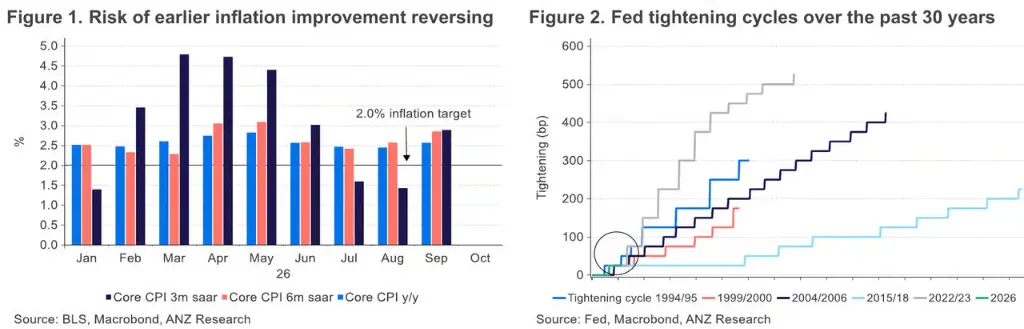
However, the inflation data does not support this stance: the core CPI rose 0.3% month-on-month in September, higher than the market expectation of 0.2%, with the annual rate increasing to 2.6%; the annualized growth rate of the core CPI over three months surged from 2.0% to 3.4%. After the release of the September CPI data, the probability of a rate hike in October briefly rose to about 50%—this dramatic fluctuation itself reflects the market's deep uncertainty about the Federal Reserve's path.
Bank of America is currently the most prominent dissenting voice on Wall Street, with its economist team maintaining the prediction of a rate hike in October, believing that the inflation data constitutes sufficient reason. **Bank of America interest rate strategist Mark Cabana warned in a report that if Waller chooses to pause but fails to provide a clear explanation, there is a risk of repeating the "dovish misstep" from the July press conference, which could put significant pressure on the dollar and the Treasury yield curve. For investors, the real suspense tonight lies not in the decision itself, but in every word Waller chooses.**
### Consensus Formation: The "Understanding" of Hiking Every Other Meeting
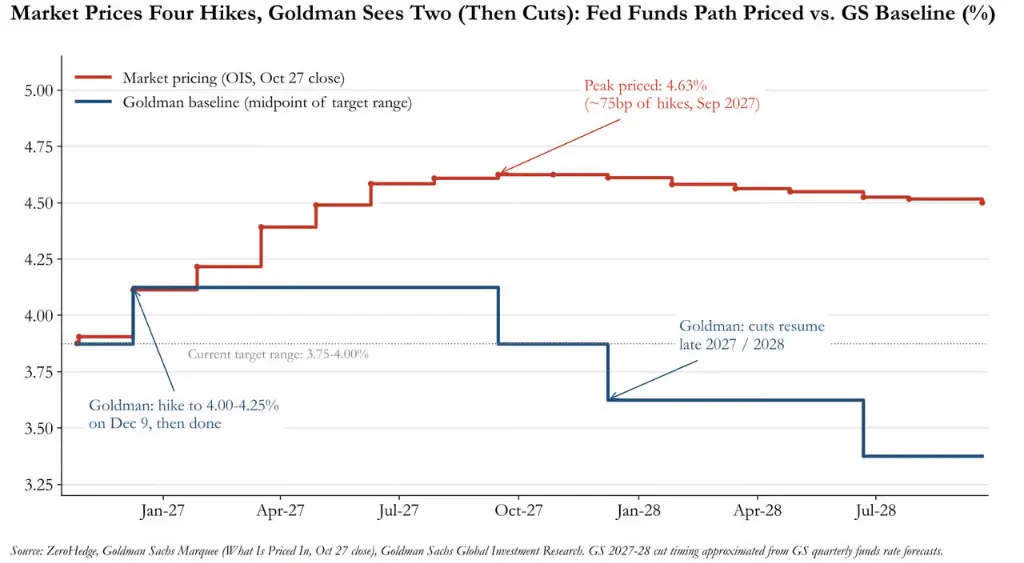
The core logic driving the expectation of a pause comes from the dense signals released by Federal Reserve officials during the intervals between meetings. According to Goldman Sachs' chief U.S. economist David Mericle's FOMC preview report, the speeches of FOMC members point to a consensus: **to advance tightening at a pace of "hiking every other meeting"—that is, having raised rates in September, skipping October, and hiking again in December.**
****
New York Fed President John Williams clearly stated that "there is no urgent need for action in October," and hinted that there would only be one more rate hike this year, with no further tightening until 2027; Fed Vice Chair Philip Jefferson mentioned that policymakers may need more time to assess the data; and Governor Waller summarized this position as: rate hikes "do not need to occur at consecutive meetings, but should be implemented in a reasonable timeframe."
The FOMC meeting minutes also confirmed this framework: all 19 officials supported the rate hike in September, and "most" officials believed that one more rate hike this year would be appropriate. This means that a rate hike in December is the compromise point for all parties, and October was never truly on the discussion table—despite Waller's previous public speeches not explicitly ruling out this possibility.
### Hawkish Dissent: Three Votes Against May Reappear
Remaining inactive does not mean internal consensus. Several institutions expect multiple hawkish dissenting votes at this meeting.
Rabobank and Natixis both expect that the three hawkish members who voted against the pause in July—Cleveland Fed President Beth Hammack, Dallas Fed President Lorie Logan, and Minneapolis Fed President Neel Kashkari—will again join forces to oppose and support a 25 basis point rate hike. JPMorgan's chief U.S. economist Michael Feroli expects at least two dissenting votes (Hammack and Logan), with Kashkari possibly following suit.
The hawkish arguments are well-supported. Logan believes rates need to be "raised by another 50 basis points or more"; Hammack emphasized the need to quickly advance to a restrictive policy level, and it should be done at a smaller magnitude and faster pace; Boston Fed President Susan Collins (not a voting member this time) also pointed out that the probability of inflation significantly deviating from the 2% target is rising.
ANZ economist Brian Martin is the most prominent hawkish voice on Wall Street this week, citing Waller's own standards set during his Jackson Hole speech: "The FOMC must be convinced that 'underlying inflation is clearly and sufficiently moving toward the target, otherwise our work is not done.'" He believes that the September CPI data did not provide this confidence, and the market has significantly underestimated the probability of a rate hike.
### Bank of America Goes Against the Grain: A Bold Bet on an October Rate Hike
In a market consensus where almost all institutions expect a pause, Bank of America (BofA) is a rare outlier.
According to the FOMC preview report from Bank of America's interest rate and foreign exchange research team, BofA economists maintain their prediction of a rate hike in October, believing that persistent inflationary pressures should drive the Federal Reserve to continue tightening—although the team also acknowledges that market pricing reflects a Federal Reserve "willing to wait until after the elections" and confident in dovish inflation forecasts.
The BofA research team pointed out that if the Federal Reserve unexpectedly raises rates, it would be the largest hawkish surprise at the lowest market pricing since 2009 (about 3 basis points), with historically 90% of hawkish surprises occurring when prior market pricing was at least above this level. BofA believes this move would lead to a sharp rise of 15-20 basis points in the 2-year Treasury yield, significantly flattening the curve.
BofA maintains its core trades of shorting 2-year Treasuries and flattening the 2s30s curve. Even if the final result is a pause, the team believes that if Waller's press conference statements are not clear enough, the 2s30s curve may experience a bear steepening of 5-7 basis points—about half of the 12.5 basis points steepening observed after the July FOMC.
### Goldman Sachs: The Rate Hike Cycle Ends in December
Goldman Sachs economists are among the most dovish institutions on Wall Street, with their baseline scenario still predicting one more rate hike in December before ending the current tightening cycle, as analysts believe the cumulative 75 basis points rate hike priced in for 2027 is considered overly aggressive.
Goldman's core argument is that **the sources of inflation exceeding targets are transitory. According to David Mericle's estimates, tariffs, Iranian energy shocks, and statistical errors related to AI prices collectively explain all 1.1 percentage points of the current core PCE deviation from the 2% target. As these factors gradually fade, Goldman expects core PCE to fall back to about 2.2% by the end of 2027.**
However, **the latest data from the San Francisco Fed challenges this "waiting for inflation to dissipate on its own" logic.**
According to Apollo Global Management's chief economist Torsten Slok, who cited this data, the current 3% core PCE inflation is driven equally by demand and supply—whereas in 2022, supply was the dominant factor. Slok emphasized that interest rate policy can cool demand-driven inflation, but has limited effects on supply shocks, meaning that half of the current inflation may not be resolved simply by waiting.
On the upside risks, Goldman particularly focuses on energy prices. Currently, oil prices are above Goldman's own forecasts, reflecting market concerns about further deterioration in the Middle East situation. If oil prices follow the futures curve, core PCE inflation could increase by about 0.1 percentage points before March next year, while headline inflation could rise by about 0.4 percentage points. Therefore, Goldman does not rule out the possibility of a rate hike in March, but does not consider it a baseline forecast.
### Waller's Dilemma: The Press Conference is the Real Exam
The outcome of this meeting's decision is almost a foregone conclusion, with the real focus of the market on Waller's performance at the press conference. **At the July press conference, when Waller faced questions about "why not raise rates," he responded that the data's impact on decision-making was "in two words, 'not much'," which immediately triggered the first wave of a sharp decline in long-term bonds.**
Natixis expects this to be a "short press conference, with no follow-up questions and no in-depth explanations"; Goldman Sachs economists also "do not expect to gain substantial new information from the press conference." Goldman Sachs' U.S. interest rate strategy head Will Marshall pointed out that **the key lies in the proportion of time Waller allocates to the topics of inflation versus financial conditions: emphasizing inflation more will reinforce curve flattening and push front-end rates higher; emphasizing tightening financial conditions may cause the curve to steepen again.**
Michael Feroli provided Waller with a feasible script: stating that "the committee leans toward raising rates but hopes for more time to observe the transmission effects of last month's rate hike on the economy." Feroli then pointed out the contradiction—this is essentially a form of forward guidance, while Waller has explicitly refused to provide forward guidance. His warning is thought-provoking: a decision to maintain rates unchanged made less than a week before the midterm elections, against a backdrop of hot inflation data, if not sufficiently explained, will inevitably lead the market to associate the policy with non-economic factors.
In terms of statement wording, Goldman expects the FOMC may draw on Vice Chair Jefferson's recent speech, **using phrasing similar to "any further adjustments to interest rates will depend on data trends, outlook developments, and risk balances." If Waller considers this too close to forward guidance, another option would be to remain completely silent on the policy path.**