In 90 days, it surged by nearly 1 trillion, with AI off-balance-sheet liabilities quietly surpassing 4.1 trillion USD
*Author: [Zhang Yaqi](https://wallstreetcn.com/articles/3784949#from=ios?ivk=1), Wall Street Journal*
Under the frenzy of AI infrastructure construction, an unprecedented off-balance-sheet liability storm is quietly gathering in Silicon Valley.
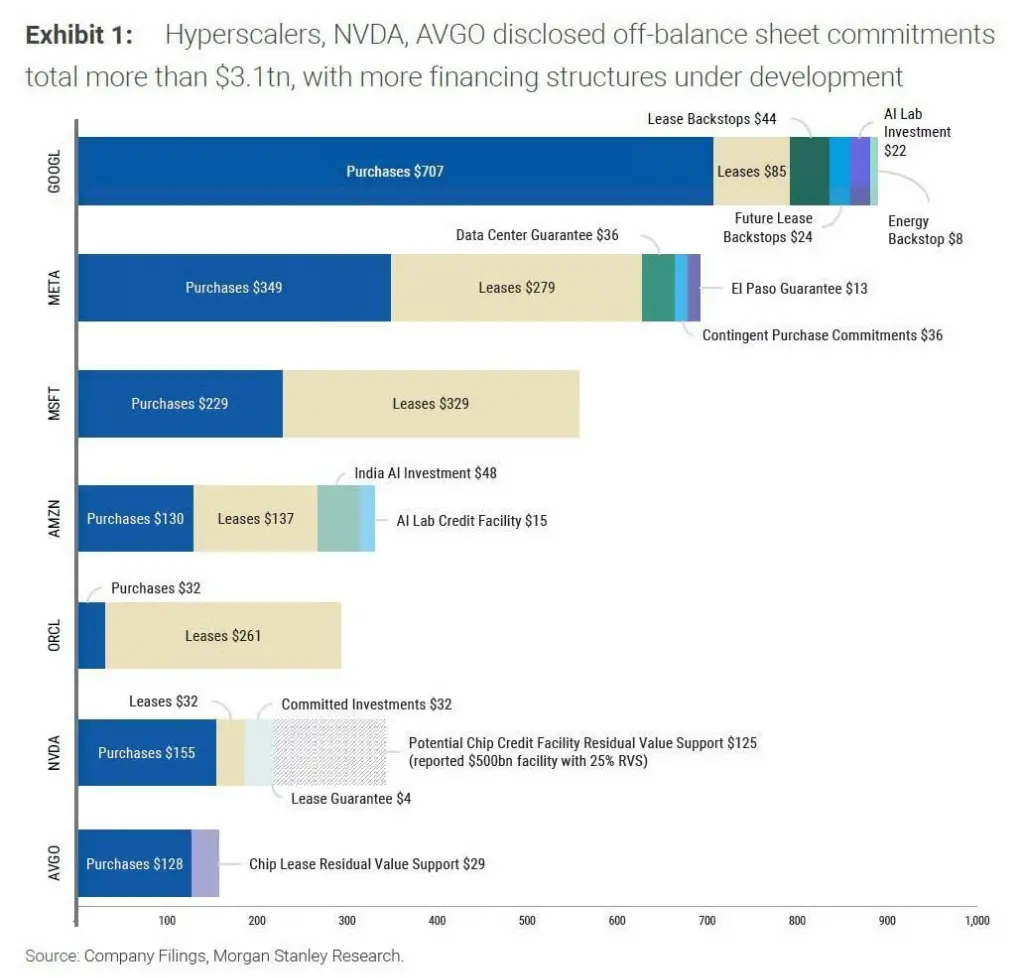
According to the latest quarterly report data, the total disclosed off-balance-sheet commitments of the super-large cloud computing companies centered around Alphabet, Meta, Microsoft, Amazon, as well as Nvidia, Broadcom, and SpaceX, **has reached $4.11 trillion, an increase of nearly $992 billion compared to Morgan Stanley's August-end statistic of $3.12 trillion------an increase of almost $1 trillion in just about 90 days.** If we also include the off-balance-sheet commitments based on news reports rather than formal financial disclosures that were included in Morgan Stanley's previous statistics, **the total will reach $4.29 trillion.**
**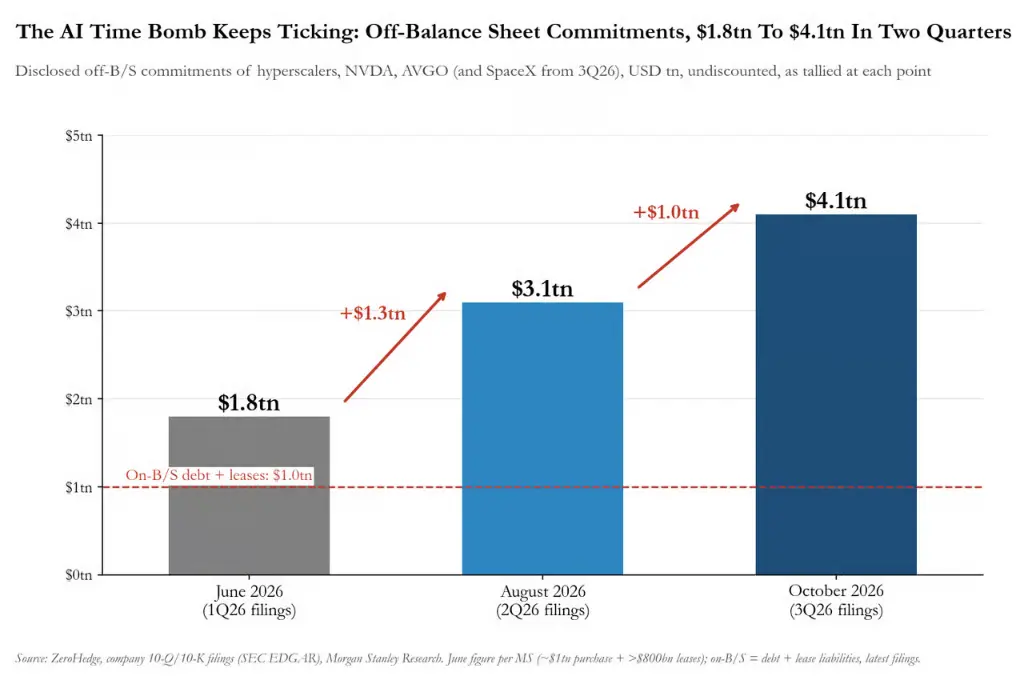**
At the same time, the actual debt and lease liabilities on the books of these companies total about $1 trillion, meaning that for every $1 of on-balance-sheet liabilities, there are over $4 of commitments not shown on the balance sheet.
This number has not yet peaked. Nvidia will release its quarterly report in late November, while Oracle and Broadcom will disclose theirs in December; all three companies have not yet updated to the latest quarterly data. The current $4.1 trillion is just the lower limit. Goldman Sachs Chief Credit Strategist Amanda Lynam also pointed out that investor attention to the off-balance-sheet exposures of these companies continues to rise, warning that major rating agencies have not reached a unified approach in handling this------S&P adjusts for off-balance-sheet leases in its leverage calculations, while Moody's and Fitch have not made corresponding adjustments, making potential changes in rating methodologies worth ongoing attention.
### New Increase of $57.7 Billion in a Single Quarter, No Signs of Slowing Down
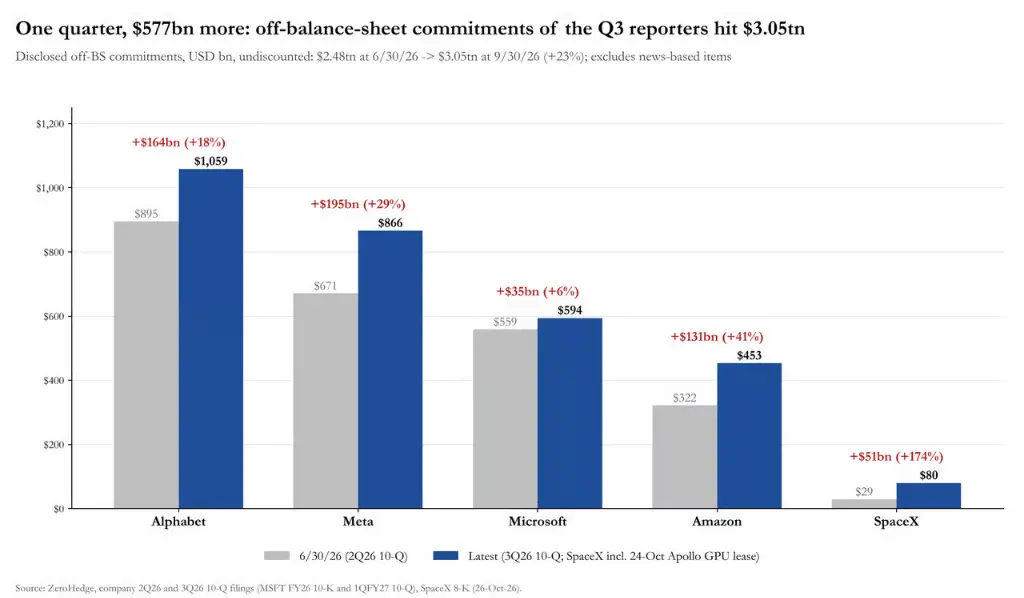
To accurately present the changes in the third quarter, we can compare the five companies that have submitted their third-quarter reports with their second-quarter data. The combined off-balance-sheet commitments of these five companies increased from $2.48 trillion to $3.05 trillion, **with a single-quarter increase of $577 billion, a growth rate of 23%.**
****
The specific situations of each company are as follows:
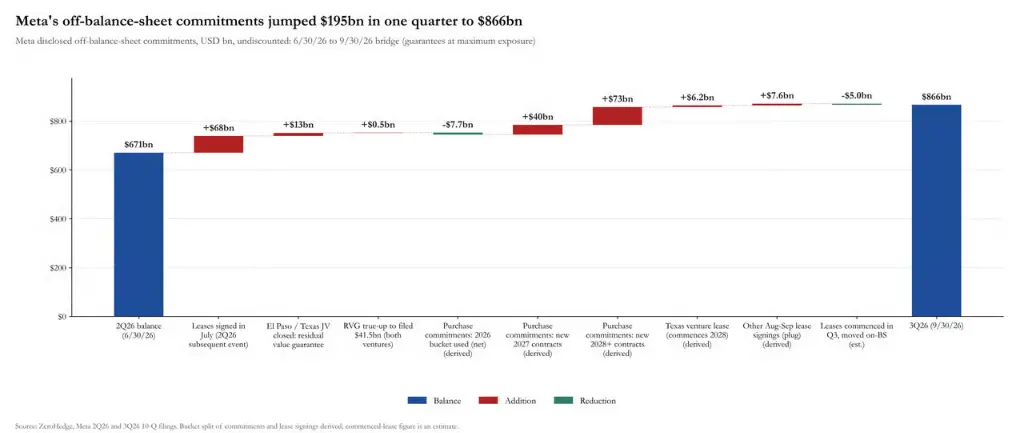
**Meta added $195 billion, an increase of 29%.** Irrevocable purchase commitments surged from $349 billion to $455 billion, mainly involving third-party cloud computing capacity for 2027 and beyond (the counterparties are not disclosed). The unused signed leases increased from $279 billion to $356 billion, including a $68 billion lease signed in July; the remaining value guarantees for its joint venture projects at the Hyperion data center in Louisiana and the El Paso data center in Texas total $41.5 billion. Notably, Meta, with $97 billion in operating cash flow and a credit rating of Aa3/AA-, saw its credit default swaps (CDS) hit an all-time high after the earnings report, and subsequently announced a maximum $95 billion equity financing plan, of which $37.5 billion has been completed, with about $60 billion of an ATM project pending execution.
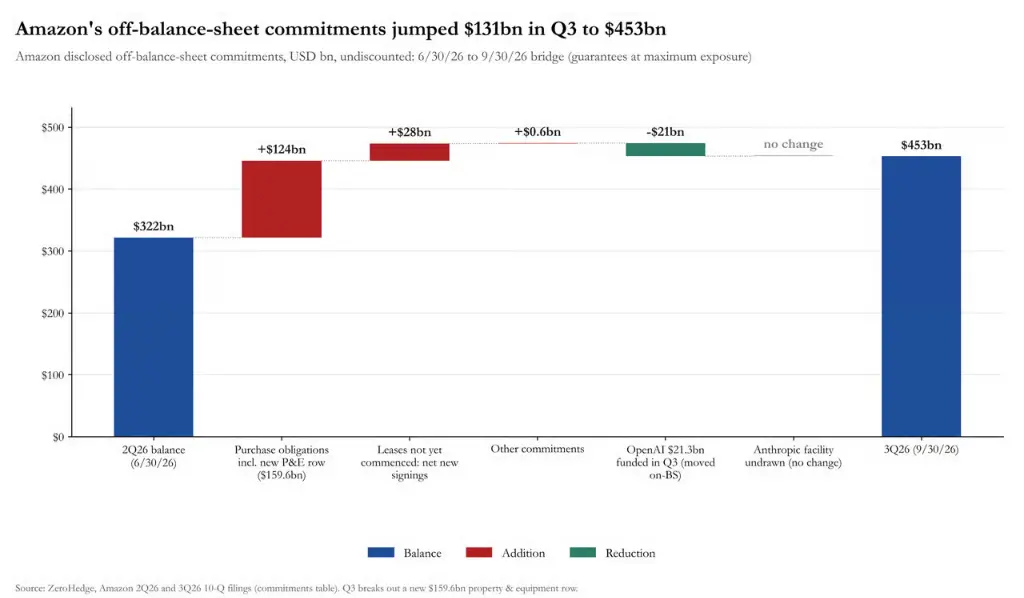
**Amazon added $131 billion, an increase of 41%,** the largest percentage increase among the super-large cloud companies. Unconditional purchase obligations nearly doubled, from $130 billion to $254 billion, with a new entry of $159.6 billion for "property and equipment"; unused leases increased from $137 billion to $165 billion. The only offset was the $21.3 billion owed to OpenAI, which was recorded in the third quarter and transferred to the balance sheet. Amazon's stock price plummeted last Friday due to unexpected capital expenditures.
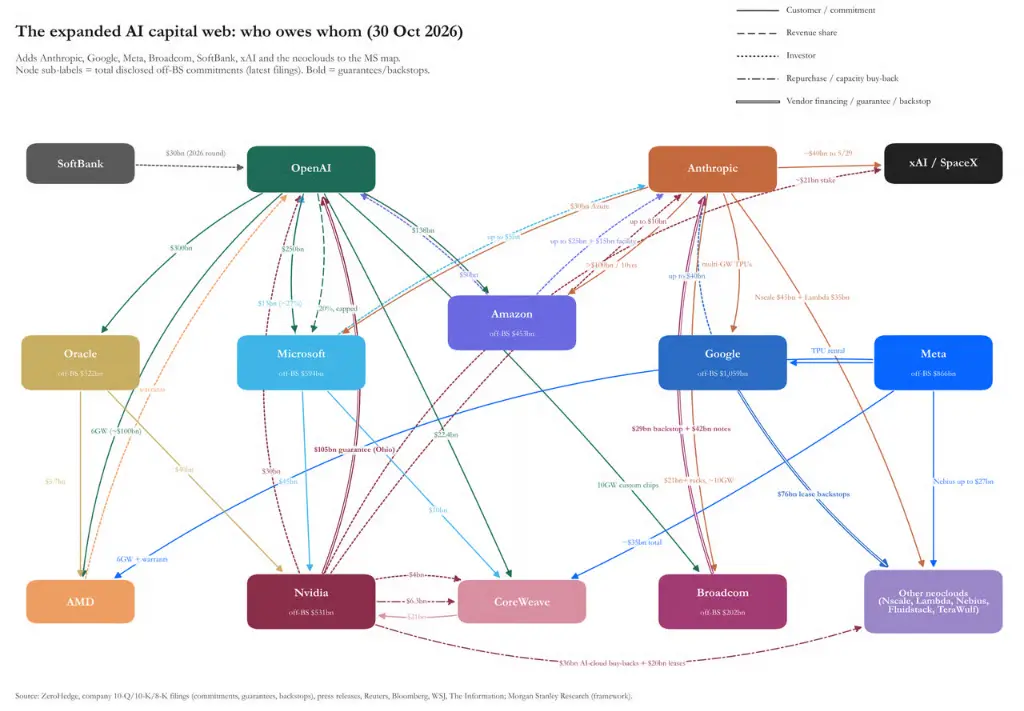
**Alphabet added $164 billion, an increase of 18%.** Purchase commitments rose by $95 billion, and unused leases increased from $85 billion to $131 billion, while energy equipment guarantees (extended to 2049) doubled from $7.6 billion to $16.2 billion, and a new $6.6 billion TPU hardware buyback guarantee was added. Against the backdrop of Alphabet having previously raised $80 billion in the equity market and continuing to report negative free cash flow, its off-balance-sheet commitments have surpassed the $1 trillion mark, making it the first single company to exceed $1 trillion in off-balance-sheet commitments, reaching $1,059 billion.
**Microsoft added $35 billion, an increase of 6%,** making it the relatively "restrained" one in terms of off-balance-sheet commitment expansion. In the third quarter, new data center lease agreements totaled about $53 billion, of which $17 billion has been activated and transferred to the balance sheet, while unused leases increased from $329 billion to $365 billion. It should be noted that Microsoft’s procurement and construction commitments are only disclosed once a year in the 10-K, and the current figure of $229 billion is still based on the end of June, with the actual number likely to be significantly revised upward at that time. Nevertheless, the "cleanest" super-large cloud company still needs to issue $25 billion in bonds for financing.
**SpaceX added $51 billion, an increase of 174%,** the most aggressive growth rate. Its off-balance-sheet commitments increased from $29 billion at the end of the second quarter to $40 billion at the end of the third quarter, and after disclosing a $40 billion Apollo GPU main financing lease agreement (scheduled to commence in the first half of 2027) through an 8-K filing on October 26, the total scale surged to $80 billion.
### Inconsistent Ratings from Agencies, Market Begins to Price Itself
Goldman’s Amanda Lynam pointed out that if we combine the off-balance-sheet leases and purchase commitments of the five major super-large cloud companies, the related scale has increased eightfold since 2023. However, this risk exposure has not received uniform treatment in the rating system: S&P adjusts for off-balance-sheet leases when calculating leverage, while Moody's and Fitch have not made similar adjustments, making potential changes in rating methodologies a risk point worth close tracking.
This lack of transparency in accounting treatment has begun to elicit direct market responses. Analysis firm Needham pointed out that once off-balance-sheet liabilities are included in calculations, Meta's enterprise value would increase by 35%. After the earnings report, Meta's CDS hit an all-time high, leading to a large-scale equity financing announcement. Lynam also emphasized that some companies have clearly stated the need to lock in capital ahead of market saturation, a statement considered a direct footnote to Meta's equity financing and likely not the last instance.
### Three Main Components of Off-Balance-Sheet Commitment Expansion
Breaking down the $4.1 trillion structurally reveals three main lines:
**First, the unused signed leases, totaling $1.39 trillion,** further expanded from $1.12 trillion in August. These assets typically consist of data center shells funded by special purpose vehicles (SPVs), which only transfer to the company's balance sheet once officially powered on.
**Second, the purchase commitments, totaling $2.25 trillion,** significantly increased from $1.73 trillion at the end of August. This category includes the massive third-party cloud computing capacity locked in by Meta and the new property and equipment purchase obligations added by Amazon.
**Third, guarantees and backstop commitments have surged from $158 billion to $273 billion,** including Alphabet's energy equipment guarantees and TPU hardware buyback guarantees, as well as Meta's remaining value guarantees for two joint venture projects.
### Expansion of Off-Balance-Sheet Debt, Market Value Correspondingly Evaporates
Morgan Stanley warned in August that these commitments have "strategic value" during periods of constrained computing supply, but "if supply and demand normalize sooner than expected, companies will have to pay for excess capacity or attempt to renegotiate contract terms."
The market has begun to provide answers. Alphabet's stock price experienced a record single-day drop this month, Amazon continues to decline, and the total market value of Nasdaq 100 index constituents has evaporated by over $1.2 trillion this month.
In other words, within a single quarter, large tech companies added about $1 trillion in off-balance-sheet liabilities; within a month, the market value of these companies has also shrunk by over $1 trillion. Off-balance-sheet commitments do not disappear due to fluctuations in stock prices and must be settled upon maturity. The current core suspense lies in whether AI commercialization revenue can catch up before the next wave of commitments arrives------and the next 10-Q quarterly report season is not far off.