Successfully recovered the upper stage of the Starship, SpaceX first reveals the "chopstick-clamping spacecraft," analysts: the most critical step to support a trillion-dollar valuation
*Author: [Bao Yilong](https://wallstreetcn.com/articles/3785950#from=ios?ivk=1), Wall Street Journal*
**SpaceX successfully catches the upper stage of the Starship in mid-air using the launch tower's mechanical arm for the first time, marking the first instance in global aerospace history where a spacecraft returning from orbit is "caught" by a tower for recovery.** This brings Musk's company significantly closer to its goal of "rapid reuse," which analysts believe is a key component supporting its multi-trillion-dollar valuation narrative.
On Sunday, November 15, Beijing time, the upper stage of the Starship returned to the atmosphere after completing 14 orbits around the Earth and was securely caught by the giant mechanical arm "Mechazilla" on the launch tower at the Texas Starbase. Live footage showed that over 5 million people watched the recovery.

For investors, the significance of this success lies in cost. **Bernstein analysts** wrote in a report to clients before the launch that **full reusability is "key to achieving high launch frequency and lower orbital costs, both of which are central to the orbital data center network plan," and stated that demonstrating the reusability of the Starship is "the most important step" for SpaceX to support its "multi-trillion-dollar valuation."**
**Citigroup analysts** pointed out in a report on Thursday that **the industry has long viewed 100% reusable rockets as the "holy grail" of rocket technology.**
Morgan Stanley previously published a research report emphasizing that **the market underestimates the potential impact of the Starship's rapid reusability**. **If the booster and spacecraft can be successfully captured, it would not only constitute a substantial positive for stock prices but also have greater positive implications for the business itself, significantly reducing the potential market size uncertainty across various core business segments.**
**However, SpaceX only achieved half of its goal this time.** According to the plan, the company was supposed to recover both the first-stage booster "Super Heavy" and the upper stage spacecraft simultaneously, but the booster shut down its engines prematurely during descent, autonomously aborting the recovery attempt, and was subsequently directed to the surface of the Gulf of Mexico, exploding before touching the water. SpaceX stated that engineers are investigating the cause.
### Booster Missed, But Spacecraft Successfully Recovered
This flight marked the 15th test flight of the Starship and was the most aggressive one yet: the company attempted to recover both stages of the rocket simultaneously for the first time.
Previously, SpaceX had successfully caught the Super Heavy booster three times, but Friday's attempt was interrupted during the descent phase due to an early engine shutdown, resulting in the booster ultimately splashing down in the Gulf of Mexico and exploding.
Wall Street Journal noted that on the afternoon of November 13, local U.S. time, the Starship completed its fifteenth integrated flight test launch; however, after stage separation, the V3 version of the Super Heavy booster Booster 22 failed to return to the launch site as planned and ultimately splashed down in the Gulf of Mexico, missing the opportunity to be captured by the launch tower's mechanical arm.

**SpaceX has previously successfully recovered boosters multiple times.** In the fifth integrated flight test in October 2024, Booster 12 was captured by the launch tower's mechanical arm for the first time, and booster recovery gradually became a routine part of testing. However, past successes do not guarantee that every new generation of boosters will pass smoothly.
The upper stage spacecraft continued to enter orbit as planned. The Starship released 26 of the latest Starlink V3 satellites during flight, then re-entered the atmosphere, flying at speeds exceeding 26,000 kilometers per hour, with the temperature of the vehicle wrapped in plasma reaching 7,000 degrees Fahrenheit.
**According to media reports, this is the first time a spacecraft has returned from orbit and been recovered since NASA's space shuttle completed its last flight in 2011; since the space shuttle is not strictly a rocket, this return of the Starship represents another "first" for SpaceX.**
Musk himself also posted a video of the recovered spacecraft on X.
****
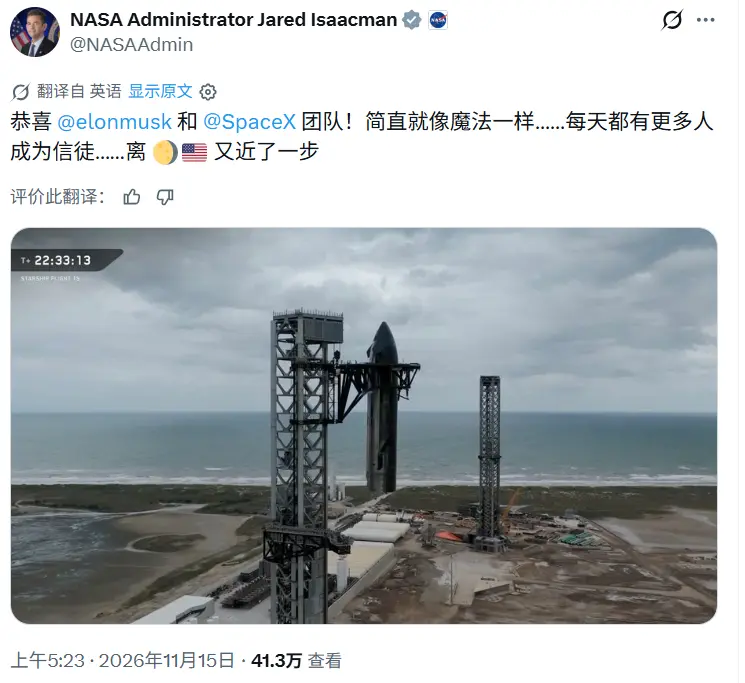
NASA Administrator Jared Isaacman congratulated on X:
> It's like magic, making more people believe in this every day.
>
> 
**NASA's "Artemis" lunar program relies on Starship technology to transport astronauts and cargo from lunar orbit to the lunar surface and back, while Musk hopes to eventually use Starship for Mars missions.**
Walter Isaacson, Musk's biographer, recalled on X that during a meeting in December 2020, Musk proposed and insisted that the mechanical arm of the launch tower could catch the returning Starship, stating, "The significance for humanity is much greater than most people imagine; I will always remember the expressions of the engineers in the Starbase conference room at that time."

### Milestones and Stock Price Pressure
After the booster recovery failure on Friday, SpaceX's stock price (ticker SPCX) fell by 2% in after-hours trading; entering trading on Monday, the stock price was only 3% higher than the IPO price of $135, down 38% from the historical high of $225.64 shortly after its listing in June last year.
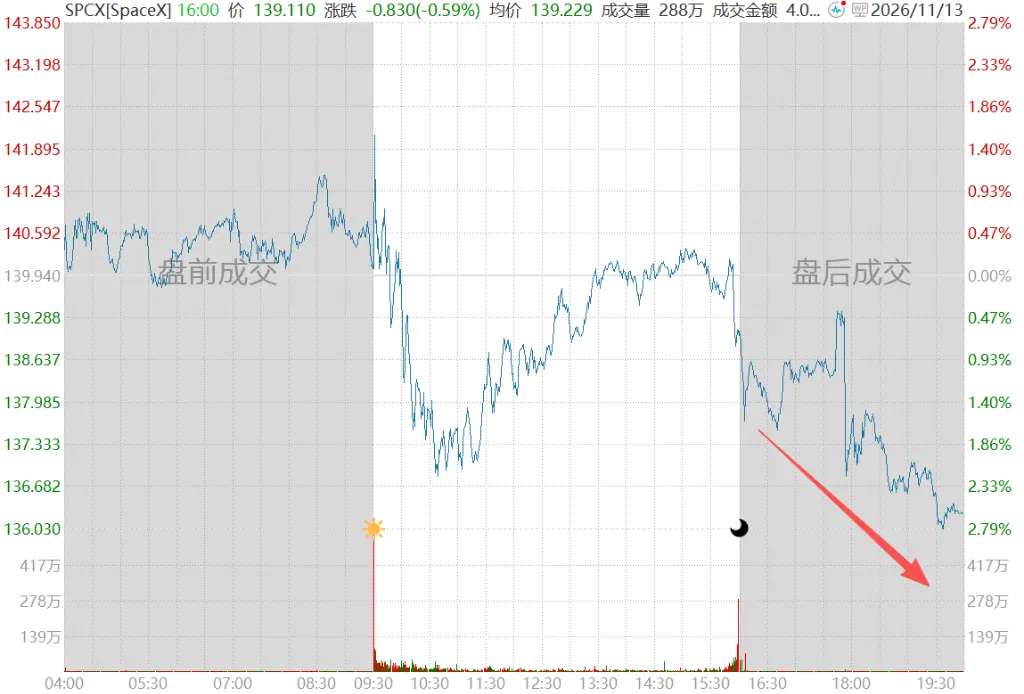
Market sentiment is further suppressed by AI-related factors, as there are concerns that the industry-wide growth of this new technology may slow down. For this reason, **the progress of the Starship is seen as a key variable affecting valuation: it can both expand the capacity of Starlink and provide a cost pathway for space computing power.**
**In terms of competitive landscape, Bernstein believes that competitors are still far from SpaceX.** The firm pointed out that SpaceX demonstrated reusability on the Falcon 9 as early as 2016, stating, "SpaceX is effectively about ten years ahead of its competitors."
Reportedly, SpaceX is also the first private company to launch a liquid-fueled rocket into orbit, the first private company to visit the International Space Station, and the first rocket company to be valued at over $1 trillion. Saturday's "chopstick catches spacecraft" adds another item to this list.
### Starship Reusability is the "Cost Inflection Point" of SpaceX's Business Model
Catching the spacecraft back to the launch tower instead of letting it splash into the sea means that rocket maintenance and re-launch can be completed on the ground, without the need to salvage and rebuild piece by piece. **Citigroup commented that fully reusable rockets are the "holy grail" of the industry.**
**SpaceX's long-term goal is to launch Starship thousands of times a year, while its partially reusable Falcon 9 currently launches hundreds of times a year, handling most of the global orbital cargo.**
**Morgan Stanley believes that capturing the spacecraft itself is more challenging than capturing the booster.** The booster does not experience the thermal and mechanical stresses of complete orbital re-entry, while the Starship must withstand extreme conditions during high-speed re-entry into the atmosphere. If the spacecraft can still be captured by the tower after re-entry, it will be the most critical step in a fully reusable system.
This is also why Morgan Stanley emphasizes that the market underestimates the importance of this mission. If both captures are successful, it would not only catalyze short-term stock price increases but also significantly reduce the execution risks of the Starship system in commercial reusability, Starlink deployment, and future AI computing power expansion.
**The commercial value of the Starship is primarily reflected in Starlink.** Starlink is currently SpaceX's profit center, serving over 13 million users in more than 170 countries, operating over 11,000 satellites in low Earth orbit, with an EBITDA of approximately $3.5 billion in the third quarter, up from $1.9 billion in the same period in 2025.
The Starship can carry up to 60 Starlink V3 satellites at a time. The V3 is nearly four times the size of the V2, with data transmission capabilities about ten times greater than the latter, meaning only the Starship can launch heavier satellites into space. In the 14th test flight on September 28, SpaceX already released 26 V3 satellites.
**From a commercial perspective,** the progress of Starship reusability directly determines whether SpaceX can further reduce launch costs and significantly expand single-launch capacity. The faster and more stable the rocket reusability, the quicker the Starlink deployment, and the higher the revenue ceiling for global connectivity and AI infrastructure businesses.
**Analysts believe that the longer-term imagination space is online computing. Musk hopes to build AI data centers in space, potentially starting by the end of 2027, and the reusability of the Starship is a prerequisite for lowering unit orbital costs.** He posted on November 4 that "space data centers now look quite attractive"; Bernstein also believes that the bottleneck for orbital data centers lies not in the physical aspect but in the deployment rhythm.