Sam Altman: Installing memory on PCs is too wasteful; it's best to reserve it for AI data centers
*Editor: [Zenan](https://mp.weixin.qq.com/s/wMJKK0dNp77jIKWiL3-vyA), Machine Heart*
"From the perspective of global resource allocation, having everyone hoard scarce DRAM in their computers, mostly idle, is a 'quite terrible' arrangement; memory should be concentrated in cloud data centers."
The statement has been made.
During an interview on Thursday with the YouTube channel Cheeky Pint, OpenAI CEO Sam Altman casually discussed local inference of AI large models while drinking beer, touching on the issue of insufficient memory in personal computers, inadvertently sparking a debate.
We know that the current global AI wave has caused memory prices to skyrocket, making PCs and smartphones unaffordable for individual consumers. Meanwhile, the capacity expansion of major memory manufacturers will take some time. While leading AI companies are consuming a large portion of memory, they have already begun discussing whether the memory in personal computers is being fully utilized.
Altman mentioned a hypothesis that people could run local AI on their own computers, which could either be ones they already own or new ones they want to assemble due to the rise of AI large model technology. He believes this is a bad idea.
"From the perspective of global resource allocation, having everyone hoard the limited global DRAM memory in their computers, with a utilization rate of only 5%, is actually very bad," Altman said. "If you want to work in such a resource-constrained environment, then the cloud should maximize resource utilization as much as possible. But for some reason, many people's intuition is exactly the opposite."
Currently, OpenAI's main business is based on closed-source models running in large-scale data centers, and his defense of the company's business model has sparked a debate within the AI community.
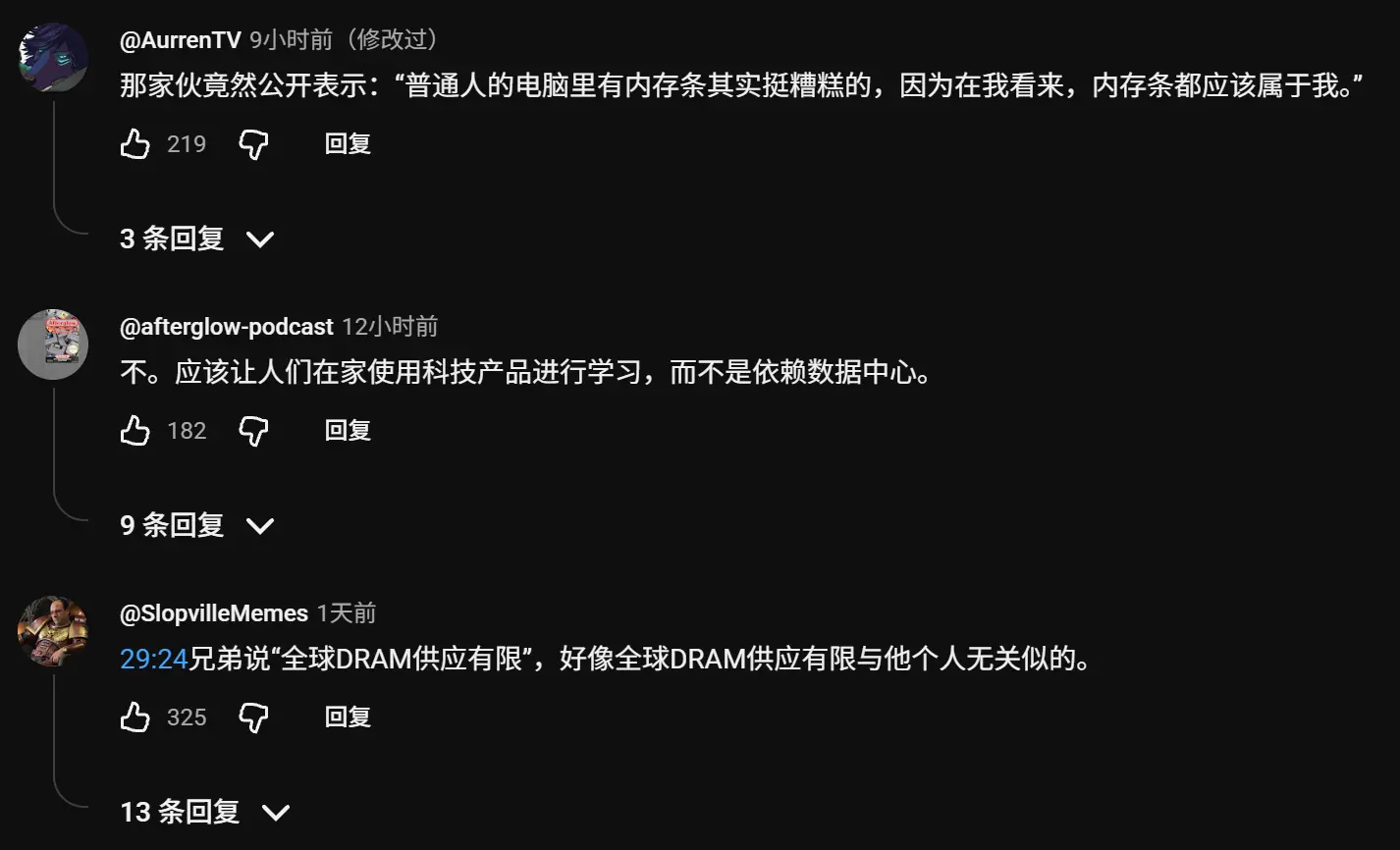

This has also raised concerns among many: in the future, it may become more difficult for us to own our own hardware or software, and we may only consider renting cloud-based agents and computers.
Although the memory used by ordinary PCs, smartphones, and AI accelerator cards is not the same, their production competes for some upstream wafer capacity. Altman is discussing the global allocation of DRAM resources, and when it comes to who has the right to decide where memory capacity is used, most of the time it is naturally the user placing the larger orders.
Some of Altman's views are based on the assumption that the construction of data centers will not slow down. He also assumes that memory used for AI data centers around the clock is more valuable than memory used for spreadsheets, web browsing, gaming, or even occasionally for local AI.
In fact, this interview was quite lengthy, and Altman also discussed the PHP vulnerability that has caused global panic over the past two weeks, the sandboxing of training models, and AI research in the field of mathematics.
Here’s a look at what he mainly said:
### AI is Triggering a Wave of Vulnerabilities
Regarding the massive vulnerability in PHP, Altman's judgment is that the ability of large models to discover vulnerabilities is rapidly improving, and the code landscape on the internet is extremely vast. When people start systematically using AI to scan all code, "we will find ourselves in a world where serious vulnerabilities far exceed expectations." He believes that merely patching is not enough; the architecture must be restructured, and routers, operating systems, and application layers need to be redesigned for a world where "vulnerabilities will become increasingly intelligent." Two years ago, "rewriting the entire tech stack" sounded like madness, but now startups are emerging to create entirely new stacks.
He rarely made a self-critique of the industry: "I don't think we have explained well to people why all the potential downsides of this technology are worth it." He said the narrative of the AI industry is a poor sales pitch, promising to cure cancer and reduce costs while depicting a future of unemployment, loss of control, and the need for strong regulation. He reiterated that OpenAI insists on iterative deployment and capability overhang, arguing that we cannot let "the few square miles of San Francisco make all the decisions."
When asked if it is possible to build a "maximum security prison" for models, Altman gave a pessimistic answer: sandboxes are only effective to a certain extent, and monitoring (including thought chain review and activation monitoring) can go further, but ultimately, there must be a high degree of trust alignment. He countered, facing a model that is a million times smarter than the smartest security researcher and can discover new sciences that humanity does not yet understand, would you really trust that sandbox?
He explicitly stated that he hates the term "agent swarms" because "swarm" evokes images of locusts, insisting on calling them "agent teams" and believing that the property of mutual checks and balances among teams corresponds to the mechanism of achieving robustness through pluralism, which is a security direction worth promoting.
### The Cost of Intelligence Explosion and Scientific Discovery
Altman outlined a curve: in the GPT-4 era, it is difficult to effectively invest $1 in computing power for a single question; chain of thought allows models to "think hard," and now we can parallelize entire teams of agents thousands of times. The usage gap between ordinary users and the most advanced users is continuously widening.
Regarding how OpenAI allocates computing power internally, he said employees enjoy a lot of freedom but are never rewarded for high token consumption, "being high on the token leaderboard is actually a bit embarrassing and definitely not a reason for promotion." He used the proof of the Navier-Stokes equations as a case study: a single proof costs about $10 million, and during that time, "it was out of control for a week" because everyone was unaware of the scaling laws of agent teams. But he expects that a year later, with smarter models and methods, it could be redone at 1/100 the cost.
He also rarely expressed emotion: the situation at that time was truly incredible. On the weekend when a new model went live internally, everyone threw various challenging problems at this model, and it managed to solve them one by one. People originally had no expectation that the model could achieve these. Everyone witnessed many of the most challenging scientific problems in people's academic careers being solved by this model one after another, covering multiple different fields, and the scene was simply astonishing.
"There were two nights when I hardly slept because I was so excited that I couldn't fall asleep. Many of the results we later published were actually those problems solved at that time."
Altman felt immense excitement and joy at that time, but also experienced an unexpected sadness, melancholy, and a sense that "an era is coming to an end." It was not just nostalgia; there was also empathy for human scientists' "to hear the Dao in the morning and die in the evening." He insisted that humanity should obtain foundational knowledge, but the industry owes those practitioners in these fields a solution.
Although it is still early to talk about superintelligence, Altman believes that a trillion slightly superhuman AIs are better than one AI with a trillion IQ:
> "I would much rather intuitively have a trillion AIs of slightly superhuman intelligence join society than one AI of one trillion IQ join society."
>
> "Intuitively, I would prefer to have a trillion AIs with slightly superhuman intelligence join society rather than one AI with a trillion IQ join society."
His argument is that the strong robustness of society comes from a large number of members checking and balancing each other; a "single-brain" world lacks this resilience. But he emphasized that this will not happen automatically; it must be actively promoted.
### Market Regulation, Is It Not Working in the AI Era?
Regarding the global memory shortage, Altman introduced OpenAI's layout: self-developed chips (to improve intelligence performance per watt), self-built data centers, robotics projects, and a bolder concept of "self-replicating data centers," using AI to control robots to operate wafer fabs, manufacture turbines and solar panels, and build data centers. He stated, "This is already within our grasp."
When discussing why "the market self-regulation" has not yet materialized, he believes the current progress is very poor and provided the behavioral logic of memory manufacturers: this industry has long been a tough business of investing $20 billion in capex to earn $1.9 billion, with several giants historically nearly going bankrupt due to overbuilding factories. Now each company can earn about $100 billion in free cash flow per year, but painful memories make them extremely conservative in expanding production. He thus asserted, "the invisible hand is now malfunctioning."
He distinguished between two types of capabilities in the chip industry: lithography, "only one company on Earth seems to know how to do it," but chip design (the documents ultimately sent to the wafer fab) is an excellent application for AI.
Regarding the true level of recursive self-improvement (RSI), Altman stated that models can now complete tasks like "finding a 5% improvement in computational efficiency," but no one knows how to enable AI to discover new architectures at the level of transformers; what is lacking are smarter models. He even predicted that society may need to agree to limit the IQ of single models for a period of time, "if future progress is insufficient, it will stem from this decision, not from AI's ability to conduct research."
He revealed his deflationary belief: the total cost of ownership for leading AI computing power per GW is currently about $70 billion over five years; ideally, it should be reduced to $20 billion, while models need to improve performance by another tenfold each year. The path to achieving this is to make energy cheaper and compress the gross profit stacked layer by layer from "sand to output token."
Regarding enterprises' anxiety over token budgets, he believes the more common problem is that AI is not being used enough, rather than too much.
### How to Price Personal Agents?
Regarding the recently popular personal agent products (such as Muse), Altman's current judgment is that "the Macintosh moment has not yet arrived." People like these products, but it is not yet at the point where "life without it is unimaginable." The winning form will resemble current products, but "it'll just work," being reliable and capable of handling more complex tasks. In the cat-and-mouse game of computer use, he believes it will ultimately converge on "you have the right to let AI operate your own computer on your behalf."
Regarding the commercialization of agents, Altman believes that companies are clinging to AI pop-ups and HTML within their products, fearing the loss of customer relationships, but consumers want AI to handle everything in their main chat applications. He believes the real moat comes from branding, product selection, and fulfillment networks, rather than HTML. He voluntarily disclosed that he chooses Amazon Pay 10 out of 10 times, even if the price is higher, praising Amazon's fulfillment network while admitting that the collaborative platform within ChatGPT is not doing well enough. He also referred to all web forms as "fake work" and compared the current situation to the App Store era of the past.
It is precisely for this reason that when designing pricing, OpenAI almost learned from AWS to quote by task and completely abandon the token billing method, but faced strong opposition from customers: "I need to know what I am paying for," even if it means paying more, they prefer the understandable unit of tokens.