Staking yields have dropped to 2.2%, what else can Bitmine and others rely on to make money?
*Author: Golem Foundation, Ethereum Institutional*
*Compiled by: Jiahua, ChainCatcher*
*An increasing number of publicly listed companies, funds, and crypto institutions are incorporating ETH into their balance sheets. After holding it, the next question is how to utilize these assets.*
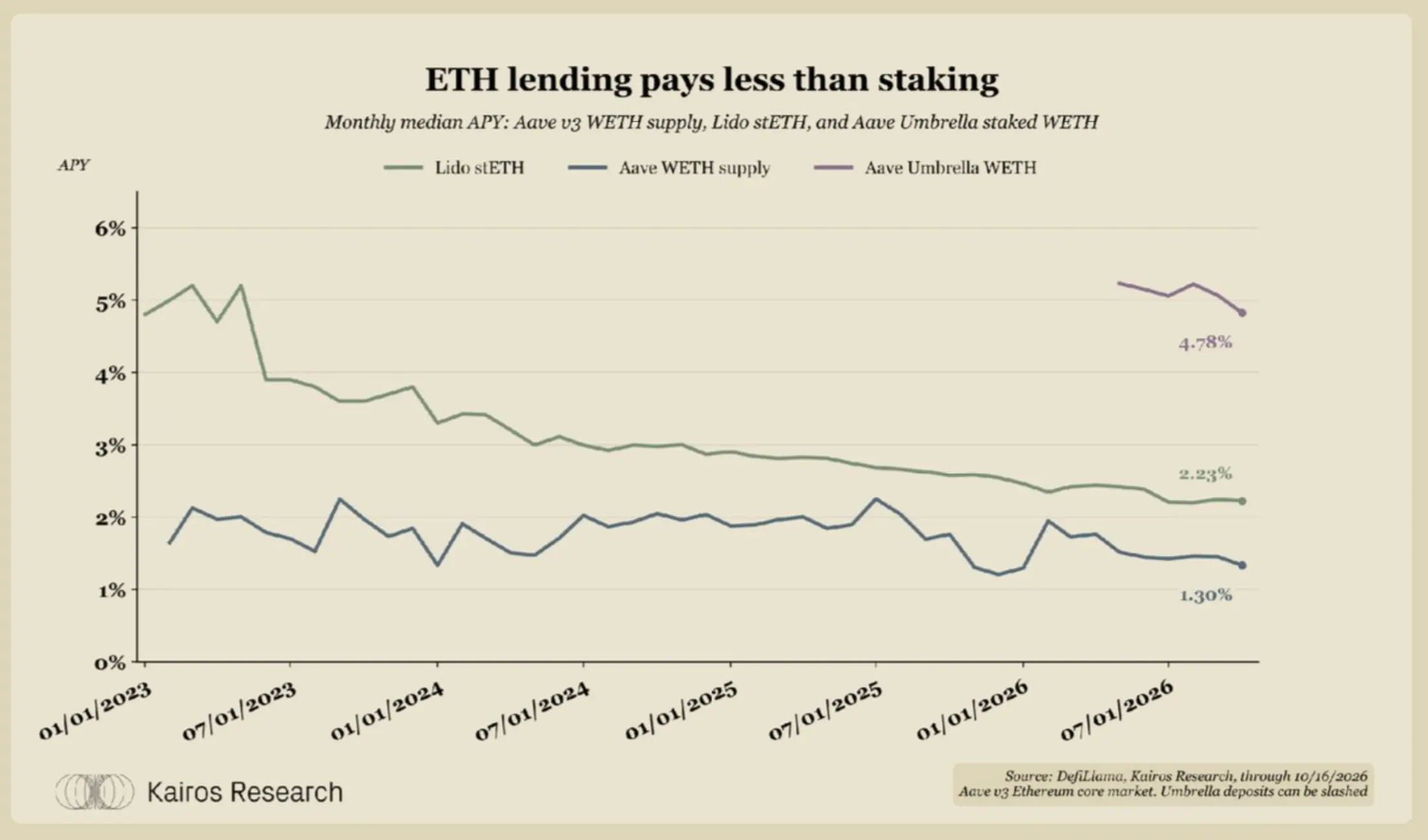
*Staking is the most straightforward option. However, as the amount of ETH being staked increases, the yield has dropped from an average of 4.5% in 2022 to about 2.2% now.*
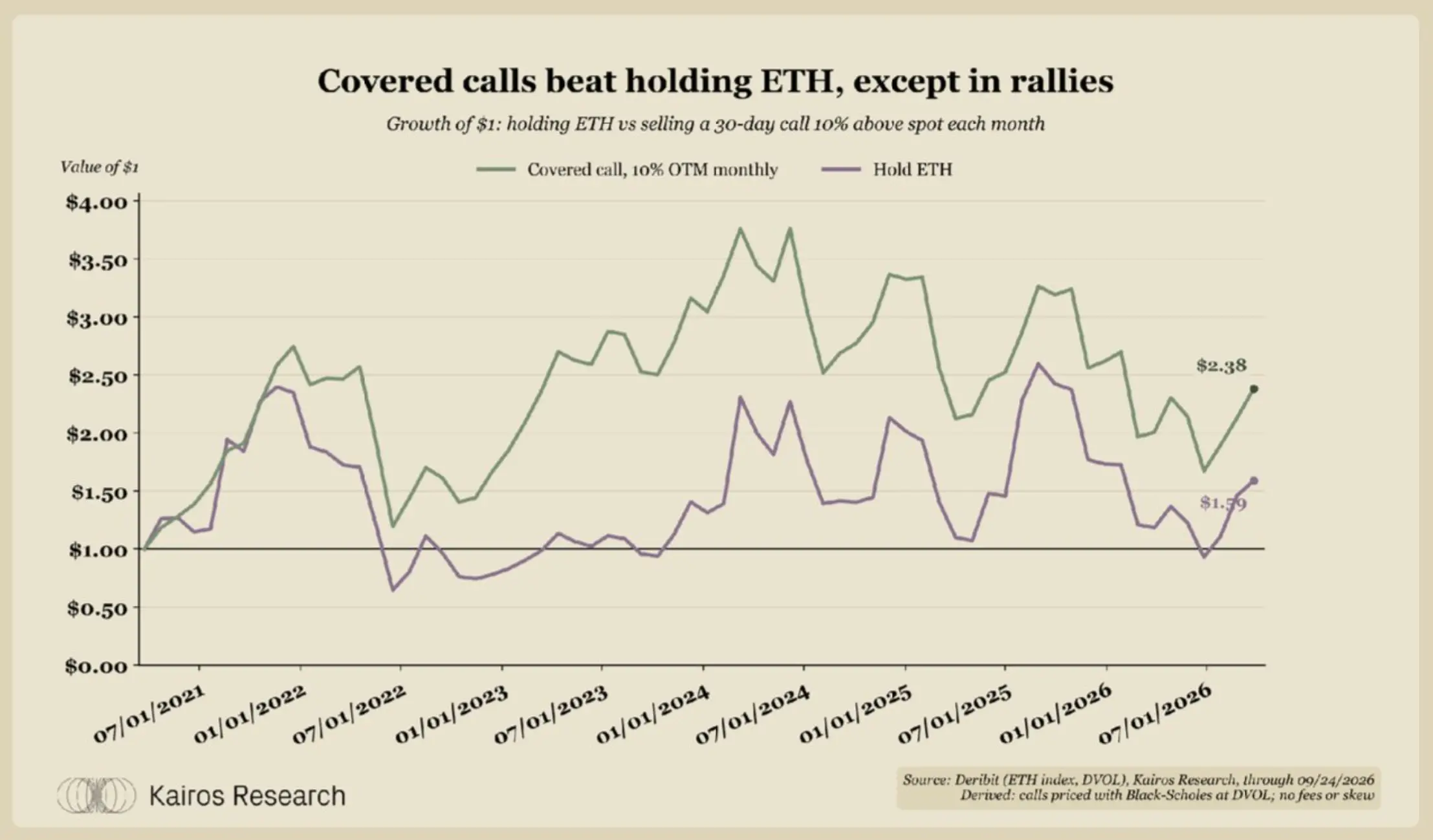
*In terms of ETH, the yields from lending and providing liquidity are both lower than staking. Higher-yield options include first-loss protection and covered call options: the former generates returns by assuming the risk of bad debts in the protocol, while the latter involves selling call options while holding ETH, exchanging part of the future upside for option premiums.*
*This report published by Kairos Research in collaboration with Golem Foundation and Ethereum Institutional outlines the holdings and allocation methods of major ETH treasuries, comparing the returns and risks of different strategies, as well as institutional judgments on the future demand for ETH.*
Core Points
----
* **Staking yields have halved.** With the amount of staked ETH growing approximately 3.5 times to 45.2 million, Lido's yield has dropped from an average of 4.5% in 2022 to the current 2.2%. Currently, the yields of all major liquid staking tokens are between 2.1% and 2.3%.
* **Treasuries hold a significant proportion of ETH.** Publicly listed companies hold 8.03 million ETH, accounting for 6.6% of the total supply; U.S. spot ETFs hold about 6.1 million ETH, accounting for 5.0%. Among the 28 treasuries we track, approximately 74% of the visible ETH allocation has been staked.
* **Few strategies outperform staking in ETH terms.** The lending yield is 1.3%, and the yield from providing liquidity is 1.2%, both lower than staking's 2.2%. Only the first-loss protection mechanism and covered call options have higher yields, at 4.8% and 7.6%, respectively, but both come with different risks.
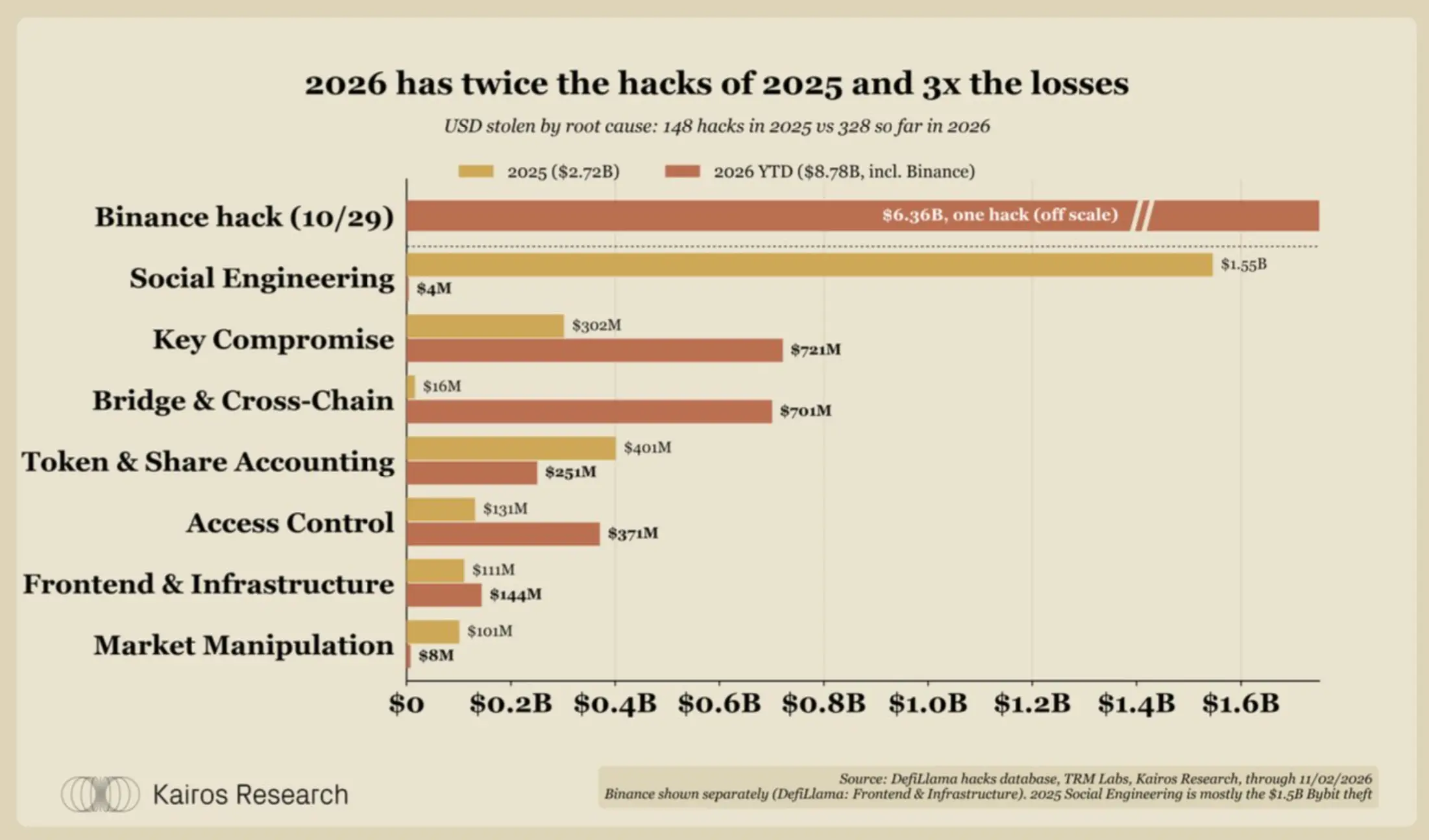
* **Security is the primary single concern.** There have been 328 hacking incidents in 2026 to date, compared to 148 for the entire year of 2025; the amounts stolen were $8.78 billion and $2.72 billion, respectively. This includes the $6.36 billion Binance hack that occurred on October 29, 2026.
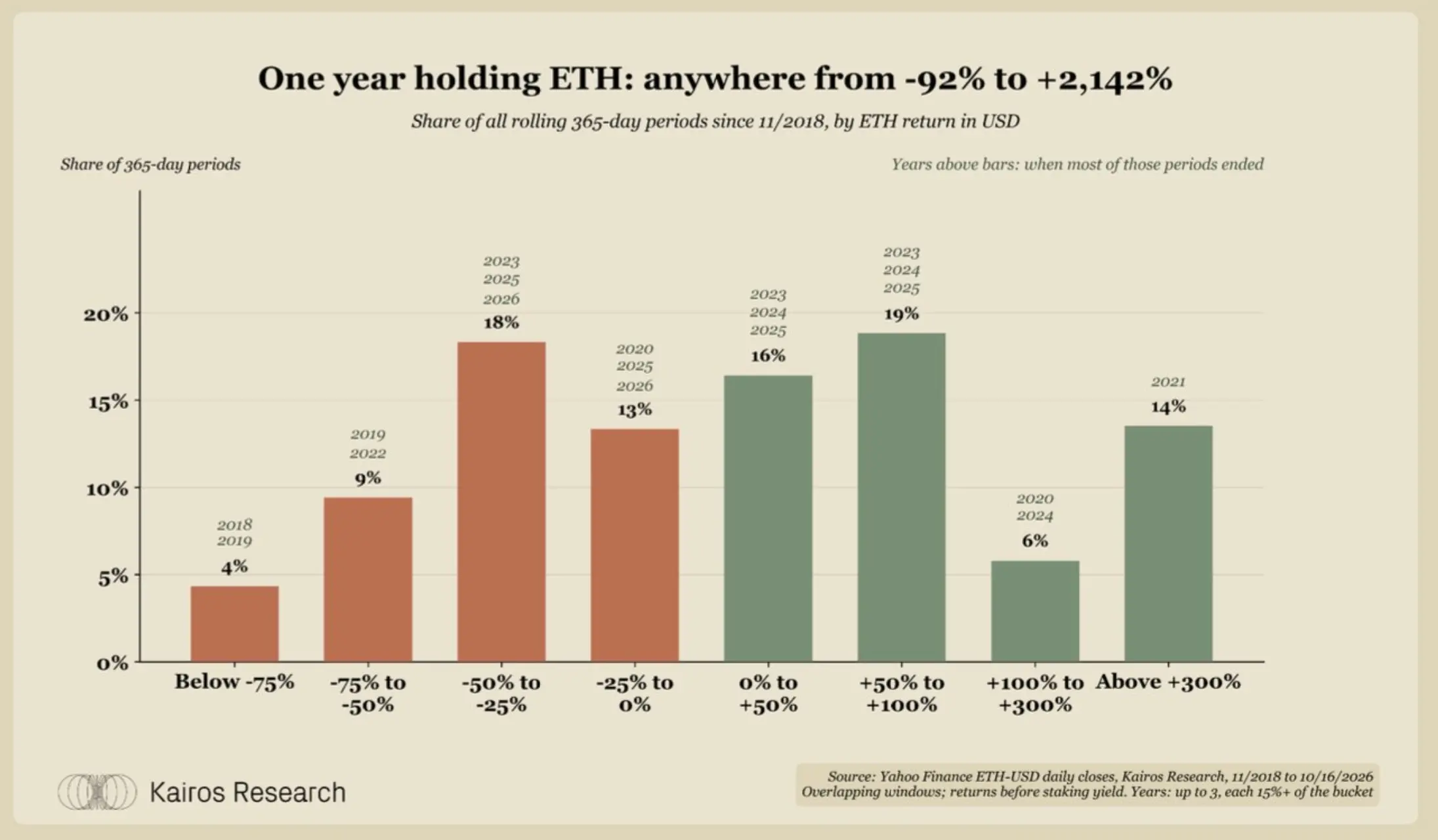
* **Holding ETH is also a currency position.** Since November 2018, the one-year return for holding ETH has ranged from -92% to +2,142%, with a median of +14%; 45% of one-year holding periods recorded losses.
* **Holders are looking for options beyond staking.** All surveyed service providers believe that staking yields are "a foundation, but not enough on their own." These respondents, along with the treasury companies interviewed, collectively hold or manage 7.1 million ETH, valued at approximately $16 billion. Governance issues, rather than yield, are the main barriers to asset deployment.
### Introduction
In recent years, ETH has become an asset on the balance sheets of various organizations. Publicly listed companies, funds, and crypto-native institutions now hold significant amounts of ETH, and most institutions use it for staking. Staking provides institutions with a return that few assets can offer: native yields from the protocol itself. This also creates new income sources for holders. As staking yields decline, the question shifts: what else can these treasuries do with ETH?
This report, published in collaboration with Kairos Research and Golem Foundation, provides a practical guide to these options. Golem Foundation has managed its own ETH treasury since 2019, and this report draws on its practical experience. The report examines various ways ETH holders can choose to generate returns, measures their returns, and candidly discusses the associated risks, including what ETH volatility means for organizations with dollar-denominated costs.
At Ethereum Institutional, we have spent considerable time discussing these issues with banks, asset management firms, and corporations, as well as exploring broader topics such as tokenization and Ethereum on-chain settlement. Most of these conversations occur privately, and public research like this helps to advance the discussion.
The first phase of institutional adoption of ETH focused on whether to hold ETH. The next phase focuses on how to use it better, and this report provides a practical reference for that.
### Where is the Problem?
Today, various treasuries hold a significant portion of the total supply of ETH. Publicly listed companies hold 8.03 million ETH, accounting for 6.6% of the total supply; U.S. spot ETFs hold about 6.1 million ETH, accounting for 5.0%; DAOs and foundations hold hundreds of thousands of ETH.
A large portion of this is used for staking, but ETH used for other purposes remains limited: approximately 37% of ETH has been staked across the network, with only about 3% deposited in lending protocols and 2% used for re-staking.
The question has shifted from "Should we hold ETH on the balance sheet?" to "How should we allocate our ETH exposure?"
In the past, staking was a simple and direct answer. However, as the amount of staked ETH across the network has increased approximately 3.5 times during the same period, Lido's yield has dropped from an average of 4.5% in 2022 to the current 2.2%.
This raises the core question of this report: Is staking alone sufficient for large ETH treasuries? What other options do some of the largest ETH holders have to generate returns from these assets?
Among the treasury companies, service providers, and asset management institutions we interviewed or surveyed, nearly all respondents believe it is time to seek returns beyond staking. Although the sample size is small, participants include some of the largest companies in the field, collectively holding or managing 7.1 million ETH, valued at approximately $16 billion.
The following report uses data to understand which institutions are incorporating ETH into their balance sheets, how they are using these assets, and the investment logic behind holding ETH. The report is structured as follows:
* Where ETH is distributed: who holds ETH and how the largest treasuries and companies allocate these assets.
* Staking and other options: from staking, re-staking to lending, first-loss protection, and covered call options, outlining on-chain methods to generate returns from ETH, with yields measured in ETH.
* Risks to consider: analyzing the smart contracts, credit, liquidity, forfeiture, and operational risks behind each option to help treasuries make decisions based on their short-term funding needs.
* Performance of ETH: reviewing the best, worst, and median annual performance of ETH. Most organizations that need to continuously pay operating costs settle in dollars, so holding ETH is also a currency position. We will explore ETH's volatility and how it has gradually matured over the years.
* Comparison with stablecoin yields: comparing the yields from Aave lending, Ethena basis trading, OnRe reinsurance, USDai GPU lending, and tokenized U.S. Treasury bonds. These dollar yields can serve as benchmarks and reflect how much yield applications on Ethereum and other networks now directly provide to users.
* Perspectives of holders: exploring whether the demand for ETH will grow with the development of stablecoins, tokenized assets, and L2s, and what the current data indicates.
### 1. Who Holds ETH? How Do They Use These Assets?
To better understand the yield opportunities of ETH and what major holders are looking for, it is necessary to first understand the distribution of ETH supply. More than one-third of ETH has been staked, and publicly listed companies currently hold 6.6% of the total supply. Based on the price of $2,253.47 per ETH on October 31, 2026, this portion of assets is valued at approximately $18.1 billion. DAOs and foundation treasuries hold a smaller proportion, most of which has been staked.
More than one-third of ETH has been staked
----------------
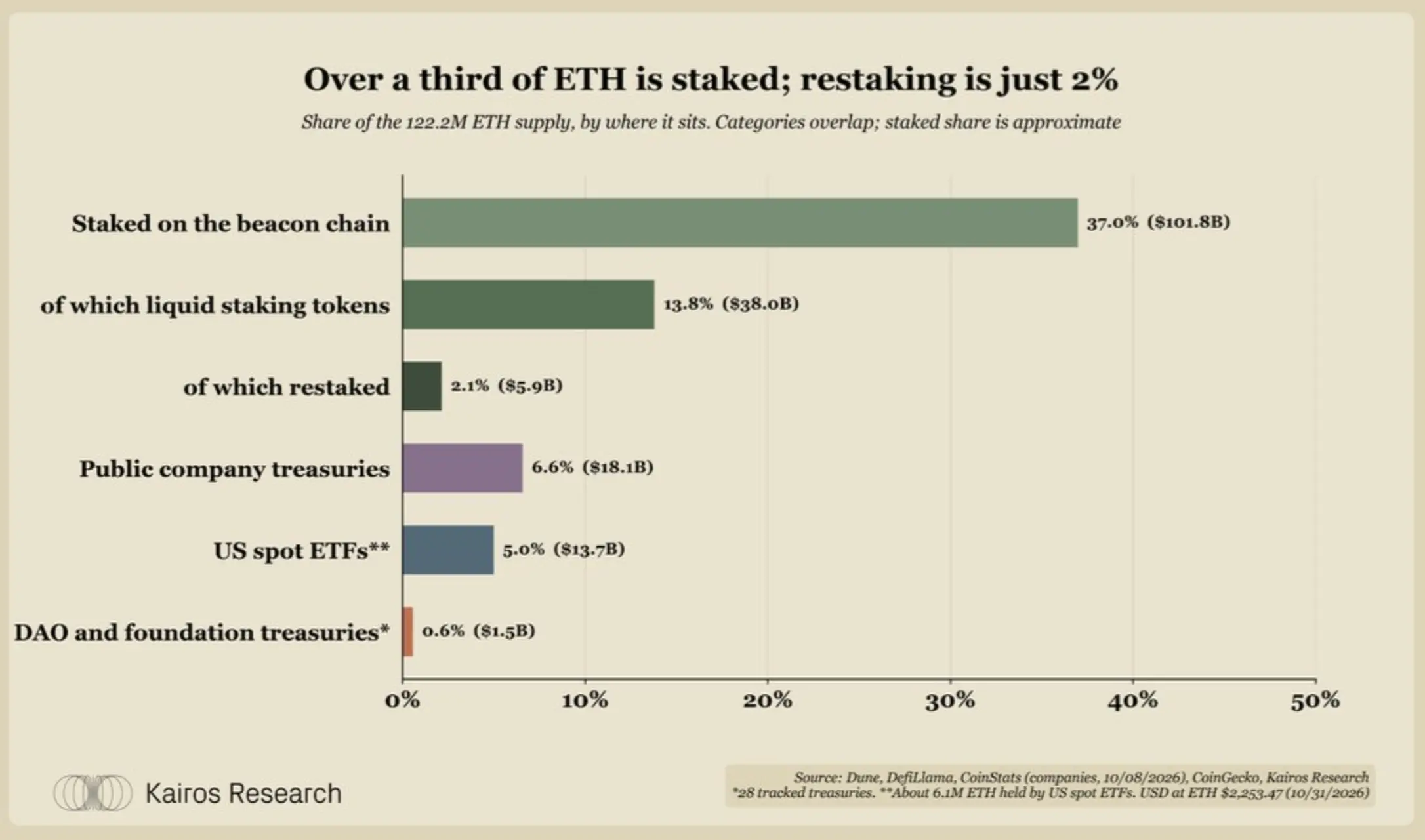
*ETH Supply Distribution and Staking Status*
* Approximately 45.2 million ETH has been staked, accounting for 37% of the total supply; of this, 16.8 million corresponds to liquid staking tokens.
* Publicly listed companies hold 8.03 million ETH, with Bitmine holding the most at 6.05 million; Sharplink holds 890,000. U.S. spot ETFs hold about 6.1 million ETH, accounting for 5.0% of the total supply. The DAO and foundation treasuries we track hold 0.6% of the total supply.
How Treasuries Hold ETH
----------
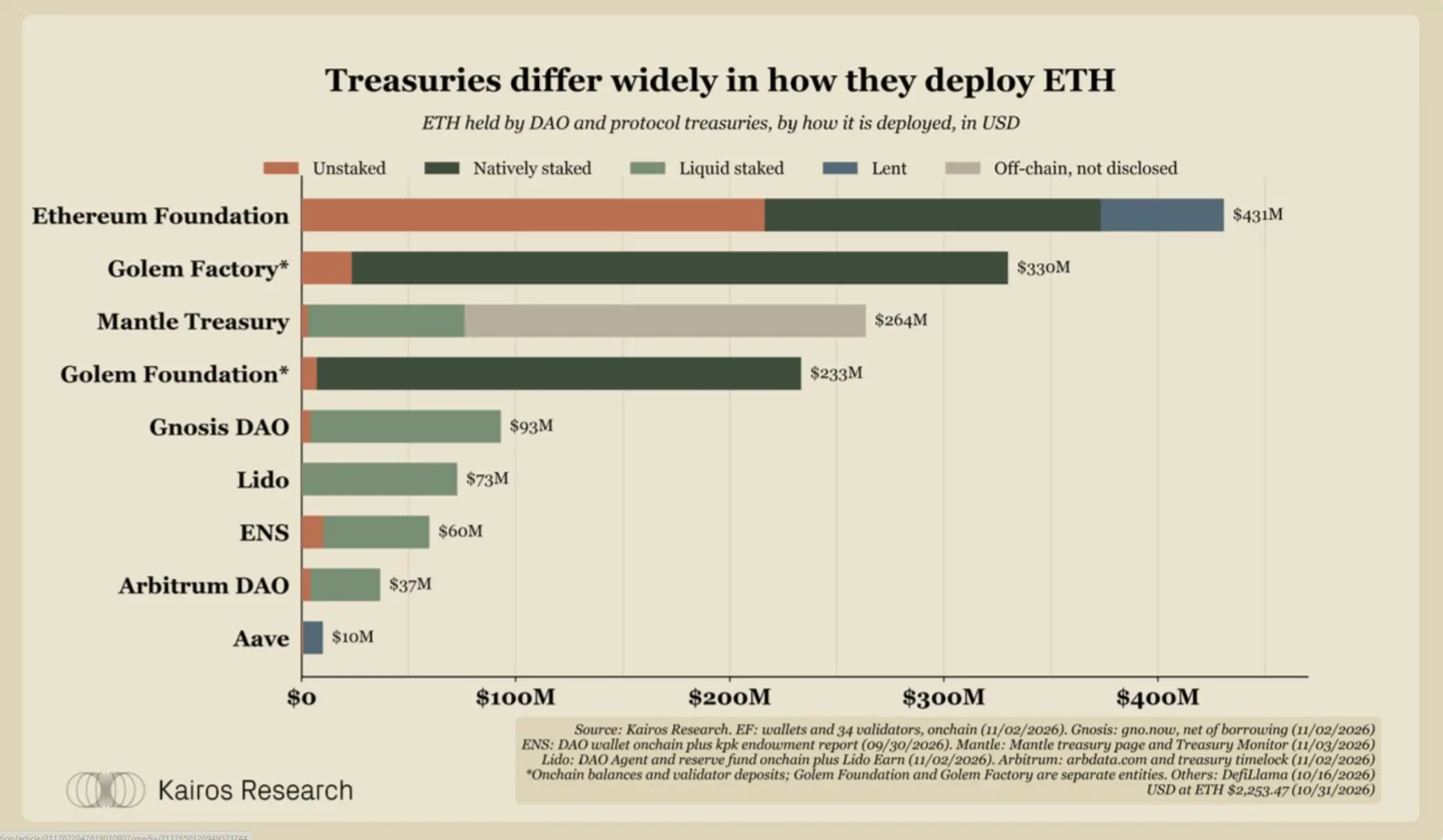
*ETH Allocation of Major Treasuries*
* Among the 28 treasuries we track, approximately 74% of the visible ETH allocation has been staked, with 51% being natively staked and 23% held through liquid staking tokens; about 21% is unstaked, and around 5% is used for lending. Additionally, approximately 12% of the total holdings of ETH is stored off-chain, primarily belonging to Mantle, with specific uses undisclosed. The above numbers are rounded.
* Different treasuries have varying practices. Lido, Gnosis, and Golem Foundation all have staking ratios reaching or exceeding 95%, with Gnosis also borrowing approximately $25 million worth of ETH against staked ETH. Arbitrum's staking ratio is 89%, while ENS is at 83%.
* Mantle has staked almost all ETH held on-chain, but about 71% of its ETH is stored off-chain, with specific uses not disclosed. The Ethereum Foundation is the largest holder among them, holding approximately 191,000 ETH: 36% is staked, 13% is used for lending, and about half is unstaked. Based on a yield of 2.2%, every 100,000 idle ETH would miss out on approximately 2,200 ETH annually. This is the opportunity cost that is easily overlooked when ETH is not participating in staking.
> "From day one, we have had a firm belief in Ethereum. Since its establishment in 2019, Golem Foundation has adopted a long-term holding strategy for ETH as its treasury strategy and has staked ETH and operated its own validation nodes for many years. Staking has played an important role in our sustainability and has allowed us to provide funding support of 5,273 ETH to users and the best teams in Ethereum through Octant. I believe that the phase of merely holding and staking ETH is over. We need an Ethereum economy priced in ETH. As staking yields decline, we realize that relying solely on staking will limit what we can achieve. We are committed to diversifying into lower-risk tools that maintain long positions in ETH and actively exploring how to make the ETH treasury work more effectively."
>
> *Julian Zawistowski, Founder and Executive Director of Golem Foundation*
On-chain data supports this judgment: protocols, investment firms, and operating enterprises have established and continue to hold significant ETH exposure. The Arkham data on the next page is just a small part of the ETH treasury world. We can confirm that L2 and exchanges also hold large amounts of ETH, including Arbitrum DAO, which holds approximately 16,300 ETH, worth about $37 million.
Who else holds ETH and stakes ETH on-chain
--------------------
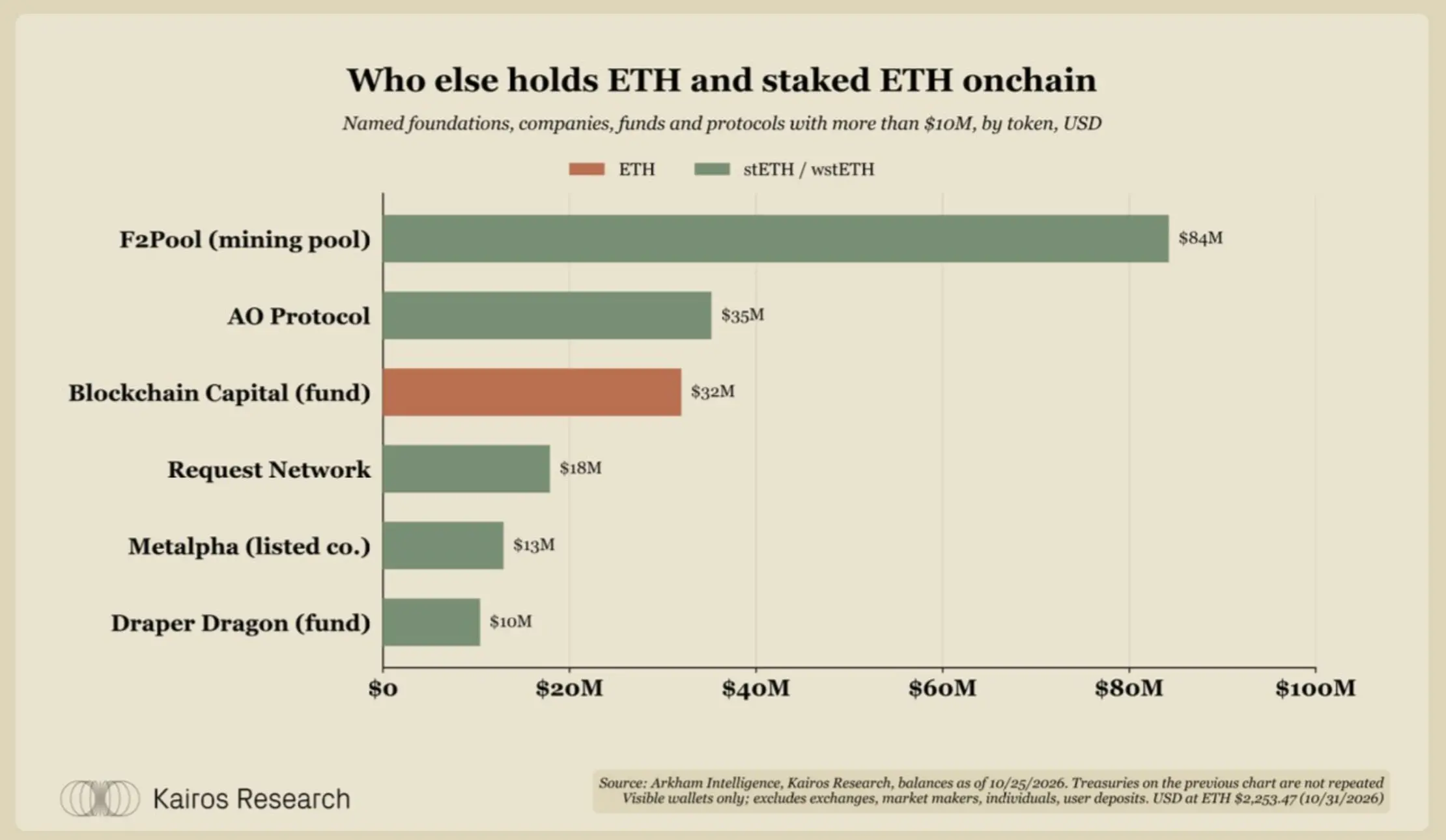
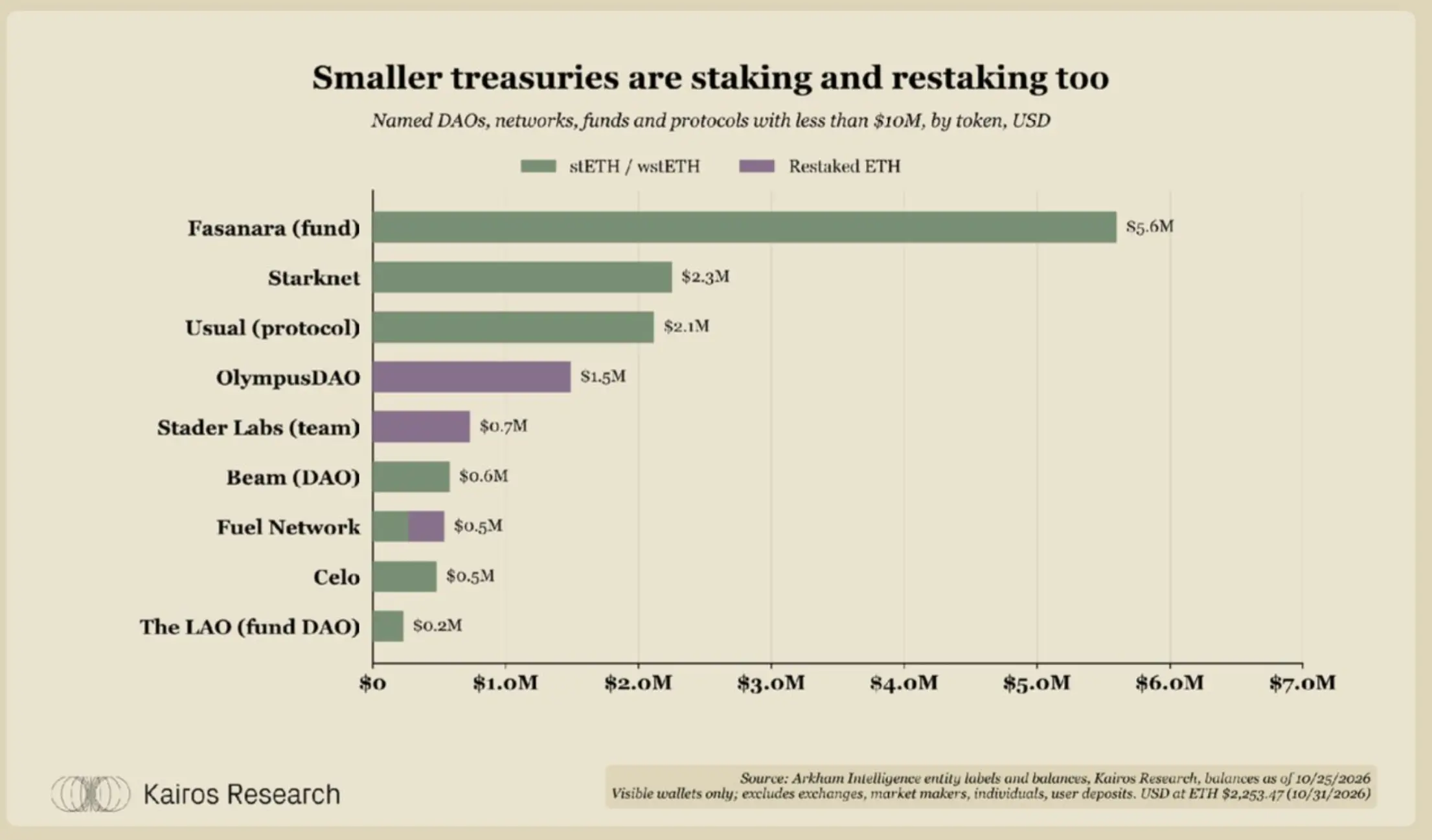
------------------------------------------------------------------------------------
How the largest corporate holders allocate ETH
----------------
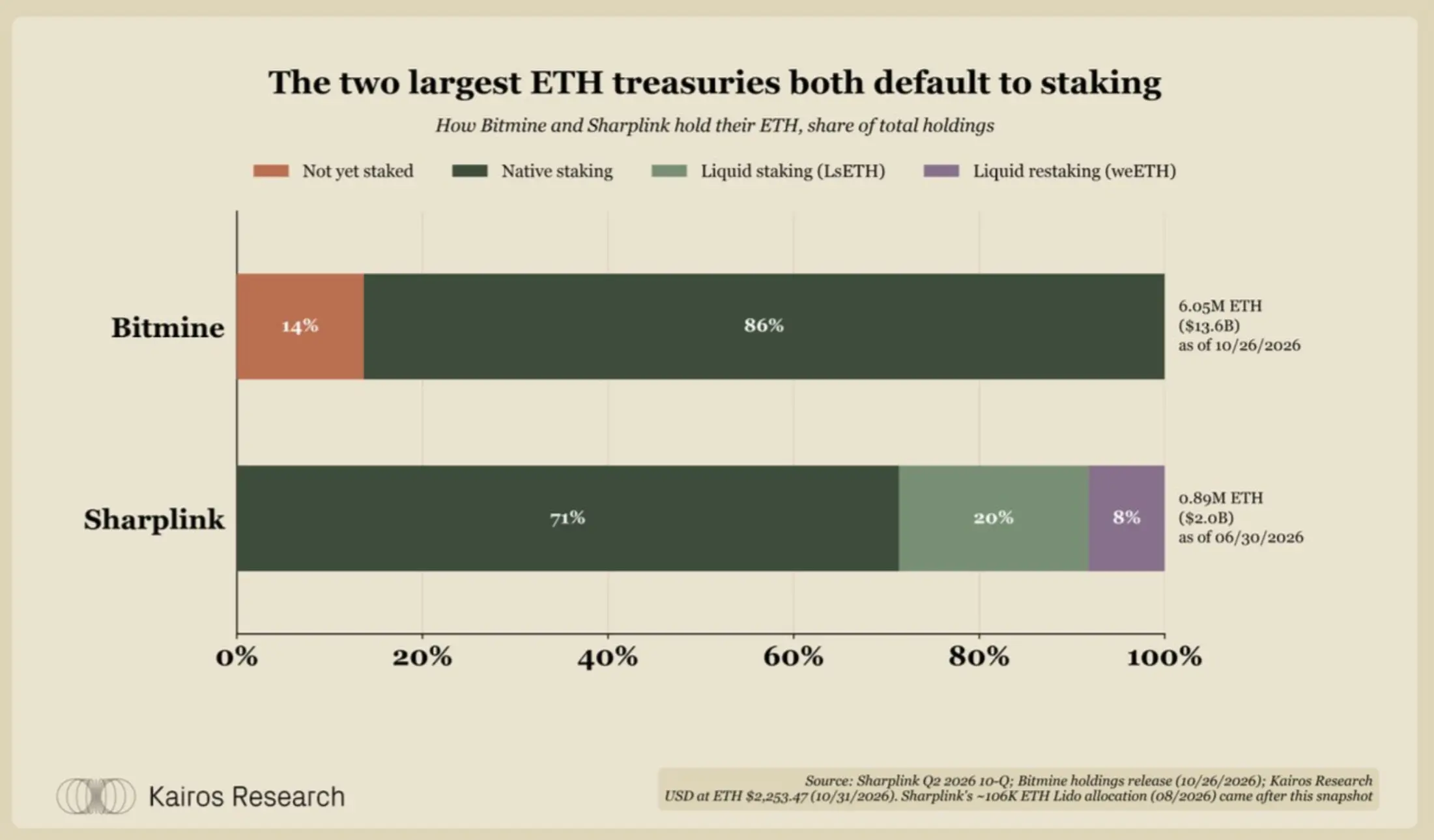
*Asset allocation of major corporate ETH holders*
* Bitmine holds 6.05 million ETH, of which 5.23 million, or 86%, is staked through native validation nodes rather than using liquid staking tokens. Most of the staking is completed through MAVAN. Bitmine established this validation node network after acquiring the node operator Pier Two in March 2026. Bitmine disclosed a staking yield of 2.58%, generating approximately $318 million in staking income annually; staking income accounted for 98% of its total revenue in the previous quarter. The company did not disclose any information on re-staking, lending, liquidity provision, or options positions.
* Sharplink's asset allocation is somewhat different: about two-thirds is for native staking, and one-third is for liquid staking. Since its establishment, the company has deployed $200 million worth of ether.fi weETH to Linea and EigenCloud; it holds approximately 106,000 ETH of wstETH through Lido, valued at about $200 million; and it has invested $100 million worth of staked ETH into an on-chain yield fund managed by Galaxy. As of September 29, 2026, Sharplink has accumulated staking rewards of 28,351 ETH.
What they say
-----
> "As the world's largest corporate ETH holder, Bitmine has been increasing its holdings weekly since launching its treasury strategy in June 2025, and we are approaching our goal of holding 5% of the total supply of ETH. Through MAVAN, we stake our ETH alongside our clients' ETH and other digital assets, ensuring network security while providing critical infrastructure services to the ecosystem. We are also investing in the commercialization of the Ethereum ecosystem and look forward to creating value for our shareholders. These investments include 'moonshot' projects like Beast Industries and Eightco Holdings, as well as recent incubations from the Ethereum Foundation such as Ethlabs, Ethereum Institutional, and EthSystems. The latter's common goal is to help the network serve institutions at scale."
>
> *Young Kim, Chief Operating Officer and Chief Financial Officer of Bitmine*
>
> "In the past year, we have seen stablecoins, tokenized assets, DeFi, and AI Agents simultaneously enter Ethereum, creating an economic boom that will bring unprecedented growth. As the world's second-largest corporate ETH holder, we see 2027 as an opportunity to leverage permanent capital on our balance sheet to accelerate this transition through targeted investments while returning value to shareholders. We stake ETH to help secure the network; provide the first liquidity for new protocols; and help fund organizations like ETHLabs, Ethereum Institutional, and ETH Systems to prepare Ethereum for the individuals and institutions entering next."
>
> *Joseph Chalom, Chief Executive Officer of Sharplink*
### II. Staking yields halved, institutions begin to seek new options
Staking is the default source of yield on the Ethereum network and serves as the benchmark that other strategies need to surpass. This benchmark is declining, and re-staking has yet to become a meaningful additional source of yield.
Declining staking yields, treasuries are seeking more options
-----------------
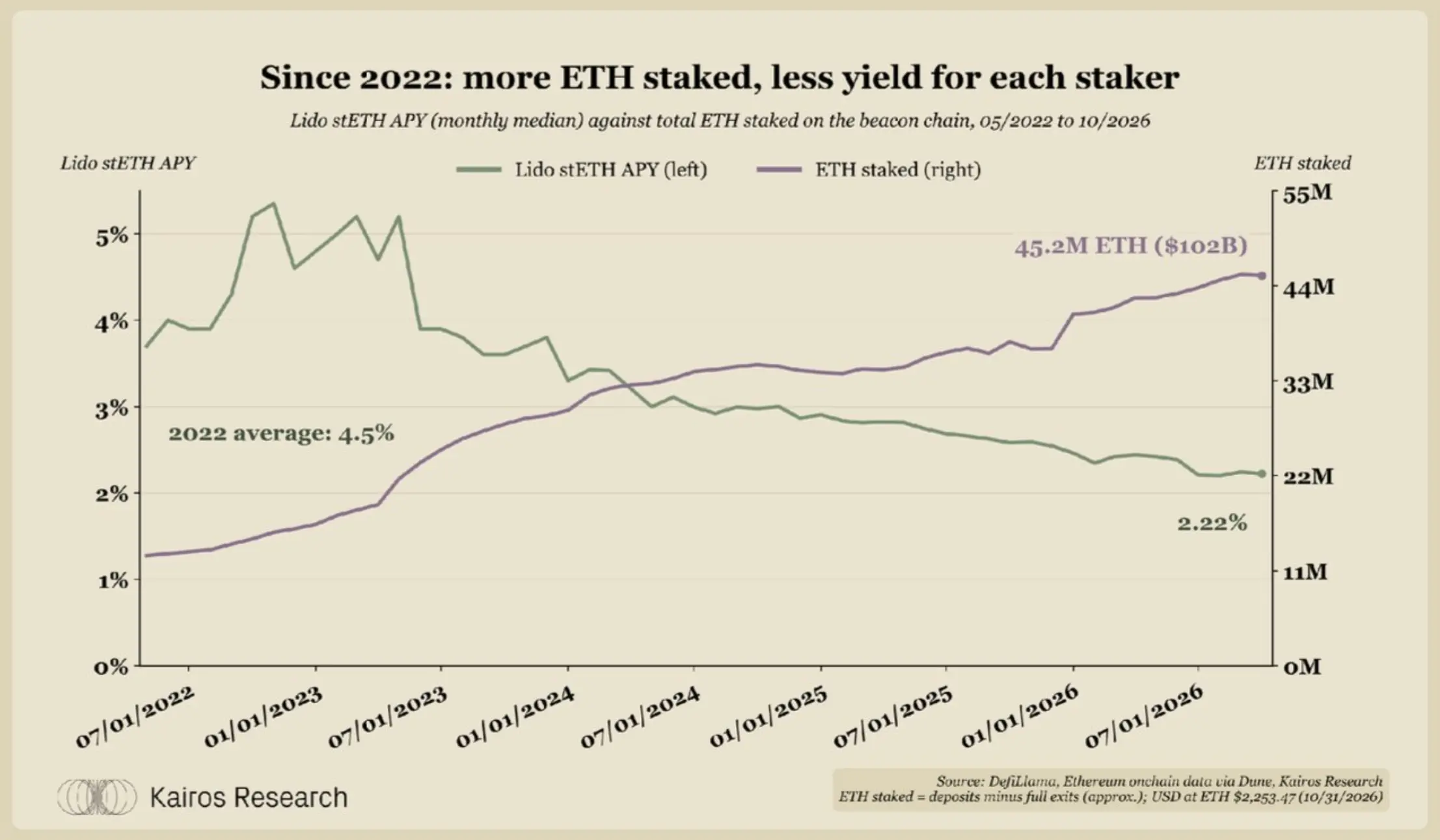
*ETH staking scale and changes in staking yield*
* Lido's yield has halved, from an average of 4.5% in 2022 to now 2.2%. Currently, the yields of all major liquid staking tokens are between 2.1% and 2.3%.
* Since 2022, the amount of staked ETH has grown approximately 3.5 times, from an average of 12.9 million that year to 45.2 million. The more ETH that participates in staking, the lower the network staking yield, so there is potential for further declines in yield.
Re-staking has not yet brought significant yields
-----------
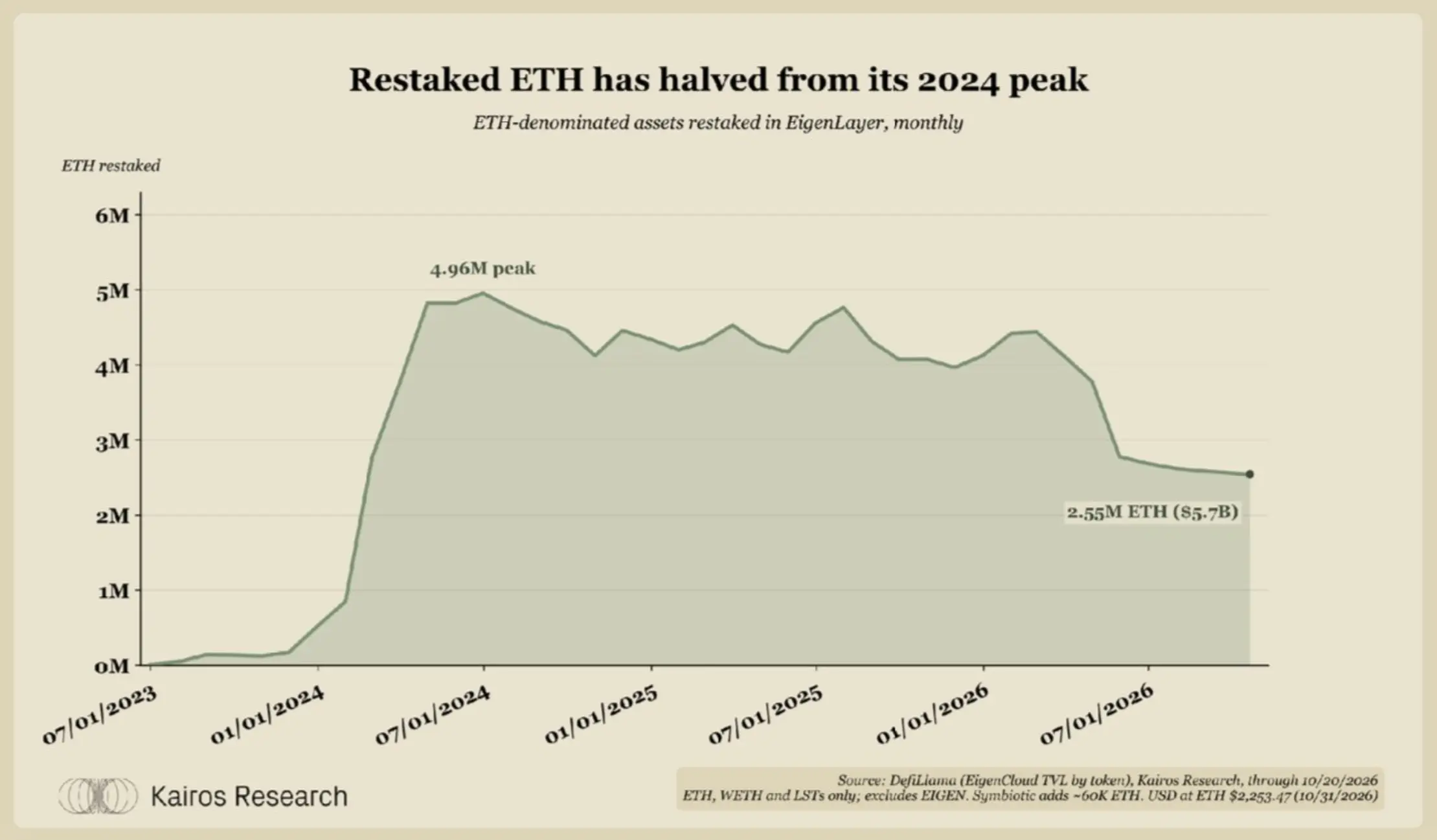
*ETH re-staking scale and yield situation*
* Currently, 2.6 million ETH are participating in re-staking, accounting for 2.1% of the total supply, almost all of which is located in EigenLayer. This number is down from about 5 million in mid-2024. Symbiotic holds about 60,000 ETH.
* The yield for liquid re-staking tokens is between 2.2% and 2.7%, while the yield for regular staking is 2.2%. Therefore, aside from points and EIGEN incentives, the additional yield gained from taking on extra penalties and liquidity risks is minimal.
* The additional yields that re-staking once provided largely came from EIGEN airdrops, point programs, and other token incentives, rather than fees paid for services using re-staked ETH. As these incentives gradually diminish, the yield premium of re-staking relative to regular staking has essentially disappeared, and the amount of re-staked ETH has decreased by about half from its peak in 2024.
### III. Besides staking, how else can ETH earn yields?
For ETH treasuries, the appropriate metric is whether a strategy can increase the quantity of ETH, not just its dollar value. The following strategies vary in liquidity, risk, and return, and may be suitable for different treasury allocations.
ETH yield comparison
--------
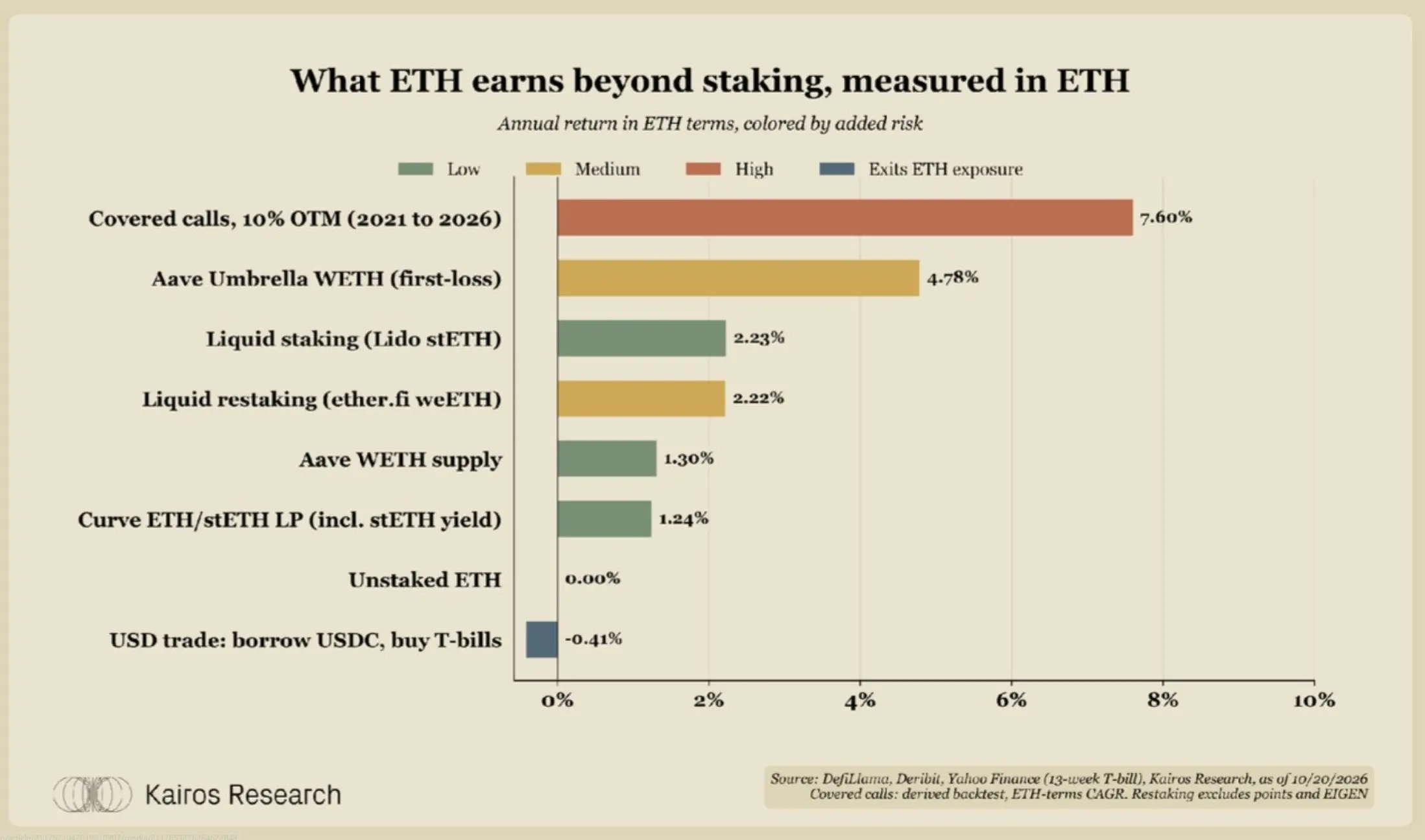
*Comparison of different ETH yield strategies*
* In ETH terms, the lending yield is 1.3%, and the yield for providing liquidity is 1.2%, both lower than the staking yield of 2.2%. Only the first loss protection and covered call options yield higher, at 4.8% and 7.6%, respectively. The latter figure is the annualized yield in ETH terms since 2021. However, these two strategies each come with different risks.
* Basis trading and U.S. Treasury trading generate dollar yields, which cause holders to lose ETH exposure. Borrowing USDC at the current rate of 4.50% and then purchasing U.S. Treasuries with a yield of 4.09% would result in a loss.
Lending ETH on Aave
--------------
*ETH lending yields on Aave*
* Currently, the yield for lending WETH on Aave is 1.3%, with an average yield of 1.7% in 2026, which is about 0.9 percentage points lower than staking the same amount of ETH.
* Aave Umbrella offers a yield of 4.8% for WETH, but the deposited assets may be forfeited to cover bad debts. Therefore, the additional yield is compensation for taking on first loss risk.
Covered call options
------
*Performance of ETH covered call option strategy*
* Currently, a call option with a term of 42 days and a strike price 10% above the spot price yields a premium equivalent to 3.2% of the amount of ETH held. The implied volatility of ETH is 51%, lower than the average level for each year since 2021, making the option premium relatively cheap.
* Since 2021, selling call options with a strike price 10% higher than the spot price every month has yielded an annualized return of 17.1% in USD; during the same period, holding ETH has yielded an annualized return of 8.8%. However, in a rising market, the former clearly underperforms: the return for 2024 is 9%, while the return for holding ETH is 53%.
### 4. Behind the Returns: What Risks Are Associated with Each Strategy?
Every step outside of staking increases risk in certain aspects. The appropriate combination depends on how much ETH the treasury may need to sell in the next 12 to 24 months and how much loss it can withstand.
* Liquid Staking: Decoupling risks and exit queue may make its advantages less attractive.
* First Loss Protection: Faces solvency and bad debt risks.
* Covered Call Options: Upside gains are limited, and some options trading platforms may introduce counterparty risk.
* Lending: Faces smart contract, liquidity, and bad debt risks.
* Re-staking: Forfeiture risks are linked to external services, and the exit liquidity for re-staked tokens is relatively weak.
* Basis Trading: Faces counterparty risk from exchanges. In the past year, 16% to 18% of hourly funding rates were negative.
Among all these risks, safety is currently the primary single concern.
Safety is a Real Cost
---------
*Number of Hacking Incidents and Losses in the Crypto Industry*
* As of 2026, there have been 328 hacking incidents, compared to 148 for the entire year of 2025; the amounts stolen were $8.78 billion and $2.72 billion, respectively. On October 29, 2026, Binance lost approximately $6.36 billion, becoming the largest recorded theft of crypto assets. The attackers had previously breached its hot wallet signature infrastructure.
* Excluding the Binance incident, losses from private key or key breaches and cross-chain bridge vulnerabilities were each about $700 million.
### 5. Holding ETH, but Paying Bills in USD
Most treasuries pay salaries and vendor fees in USD, so holding ETH is also a currency position. The potential outcome differences are vast: a strong year could provide the organization with ten years of operating funds, while a weak year could halve the operating funds.
Best, Worst, and Median Year Levels
--------------
*One-Year Holding Period Returns of ETH*
Since November 2018, the one-year return for holding ETH has ranged from -92% to +2,142%, with a median of +14%. 45% of one-year holding periods recorded losses, and 14% of holding periods lost more than half.
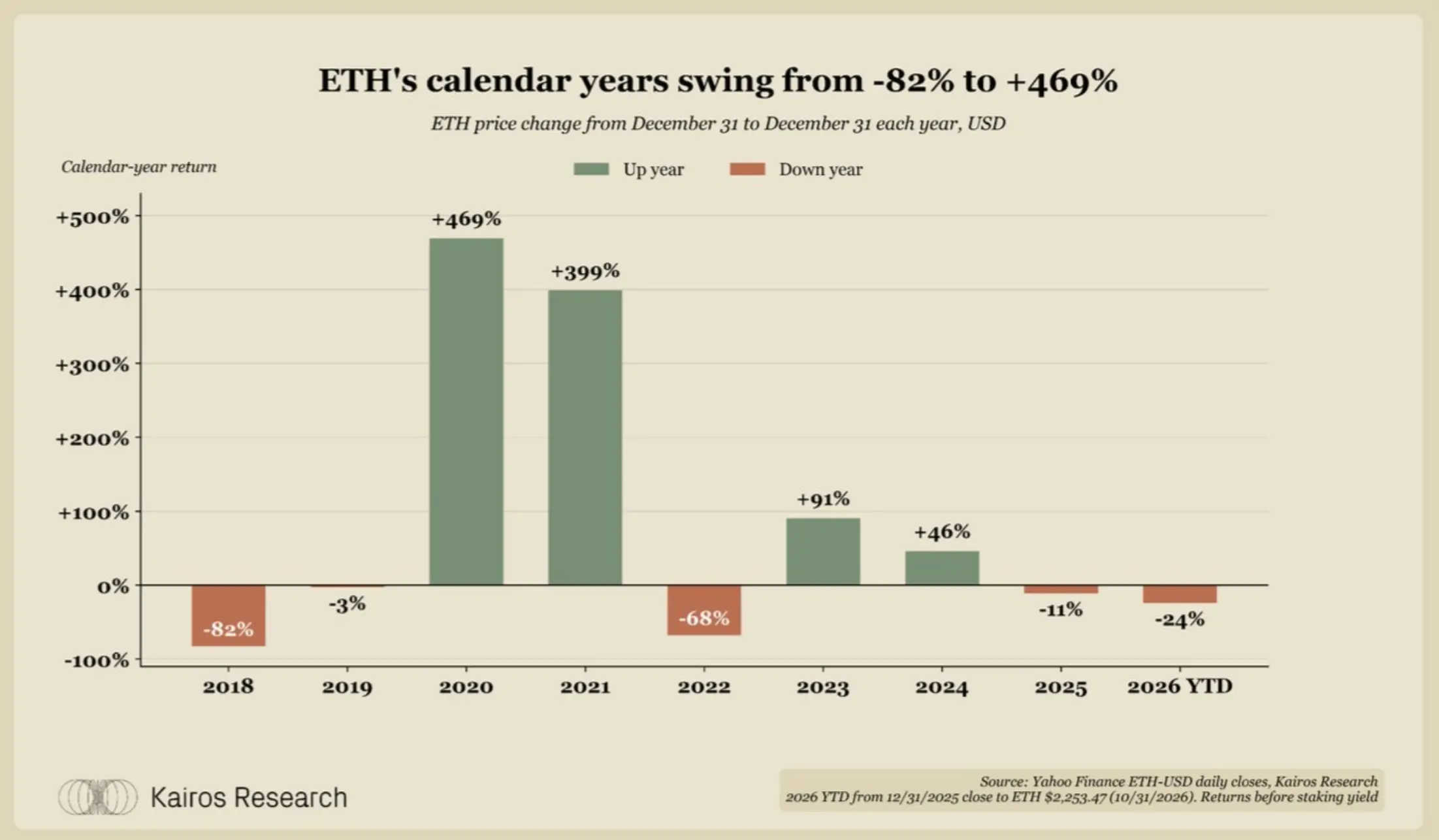
*Performance of Staked ETH in ETH Terms vs. USD Terms*
In the past year, staking ETH yielded a return of 2.4% in ETH terms; however, it lost 36.8% in USD terms. The ETH treasury needs a set of performance metrics measured in ETH.
Volatility
---
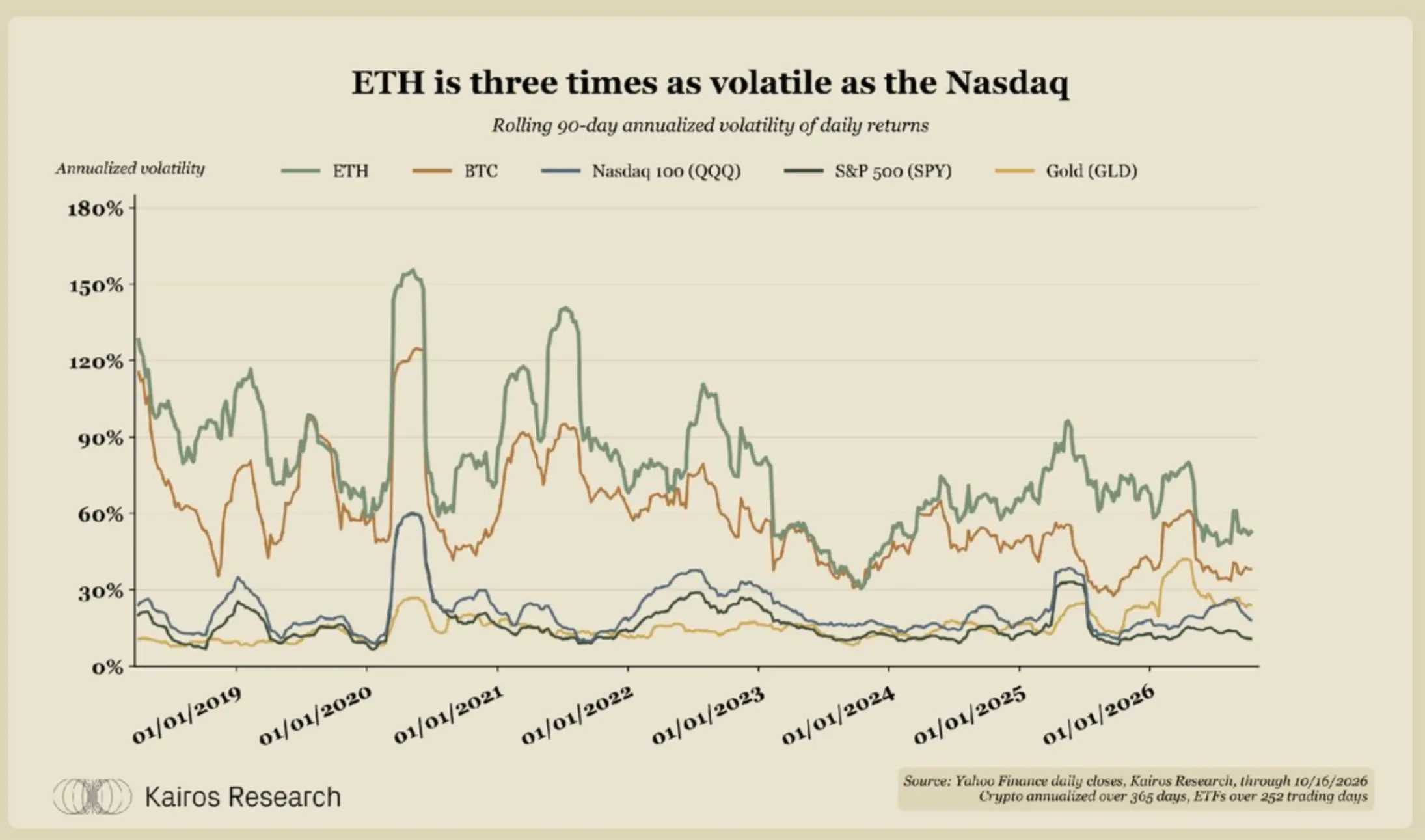
*Volatility Comparison of ETH with Other Major Assets*
* In the past year, ETH's volatility was 61%, which is 1.4 times that of Bitcoin, 3.1 times that of the Nasdaq 100 Index, 4.8 times that of the S&P 500 Index, and 2.1 times that of gold.
* Since 2018, the proportion of days when ETH's daily price change exceeded 5% has been 19%; for QQQ and SPY, this proportion is about 1%.
Is ETH Maturing?
------------
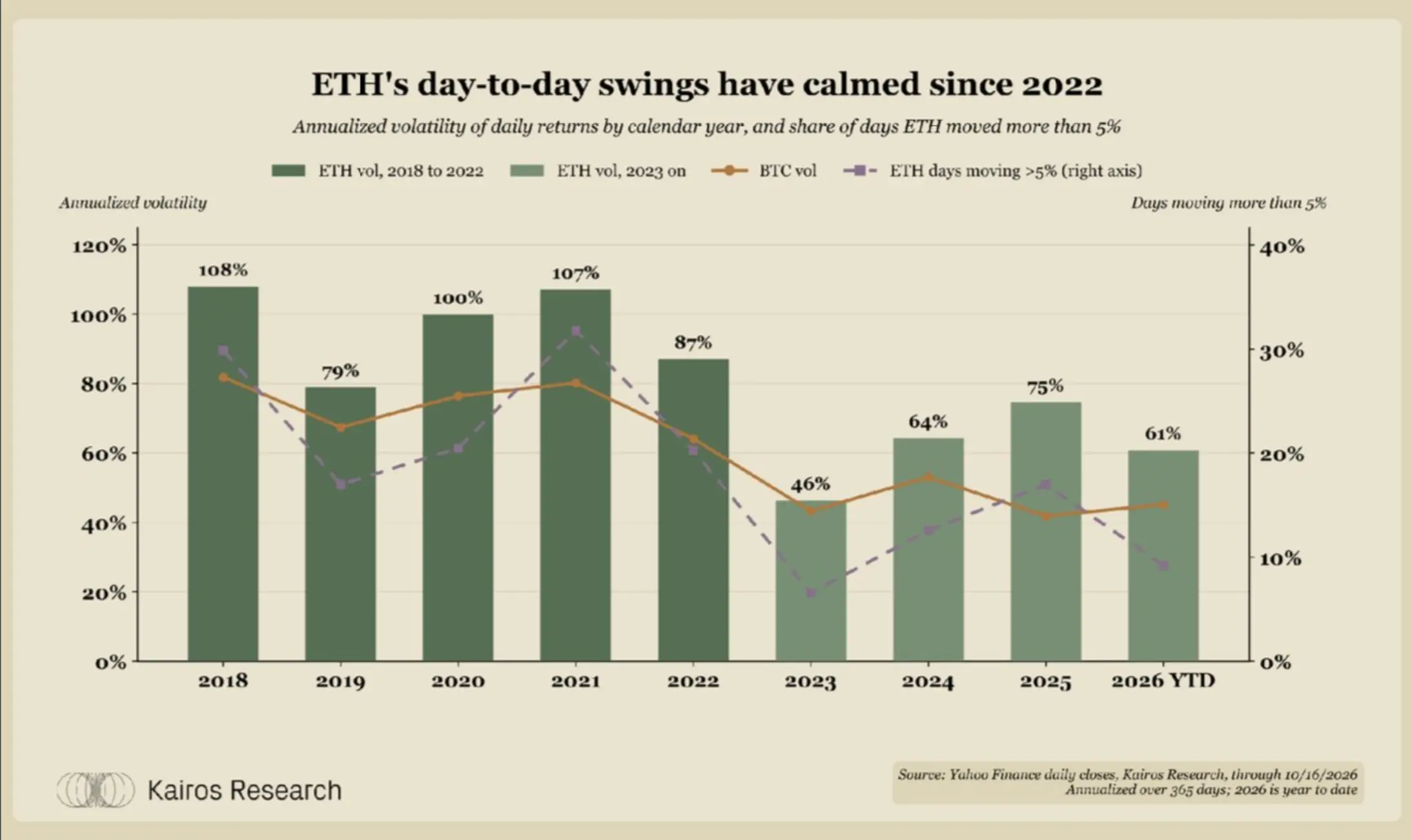
*Historical Changes in ETH Volatility*
* From 2018 to 2022, ETH's average annual volatility was about 96%; since 2023, it has decreased to about 62%. The proportion of days with price changes exceeding 5% has also dropped from 17% to 32% per year to 7% to 17% per year. As ETH matures and the holder base expands, its price volatility has eased.
* However, from the peak in August 2025 to the low on June 25, 2026, ETH still fell by 68%. In 2025, ETH's volatility was 1.8 times that of Bitcoin, marking the largest gap since 2018. Therefore, the treasury should still prepare for potential deep drawdowns in each cycle.
ETH vs. Other Major L1 Tokens: Drawdowns
------------------
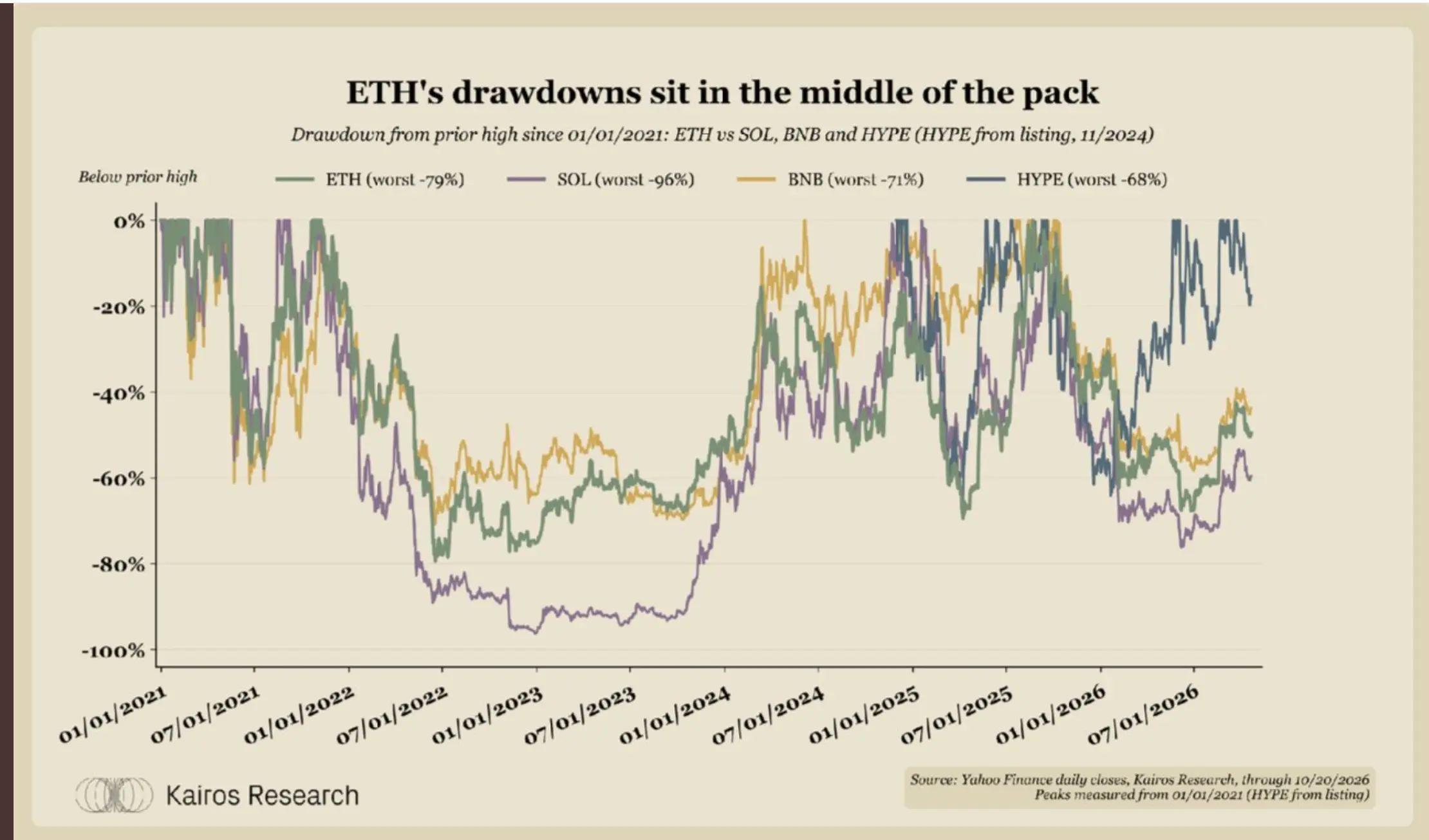
*Drawdown Comparison of ETH with Other Major L1 Tokens*
* Since 2021, ETH's maximum drawdown has been 79%, SOL has been 96%, and BNB has been 71%. The maximum drop for HYPE, which was listed in November 2024, was 68%.
* As of October 20, 2026, ETH has dropped 50% from its peak, SOL has dropped 60%, and BNB has dropped 44%. HYPE has dropped 18% from its peak in September 2026.
ETH vs. Other Major L1 Tokens: Volatility
-------------------
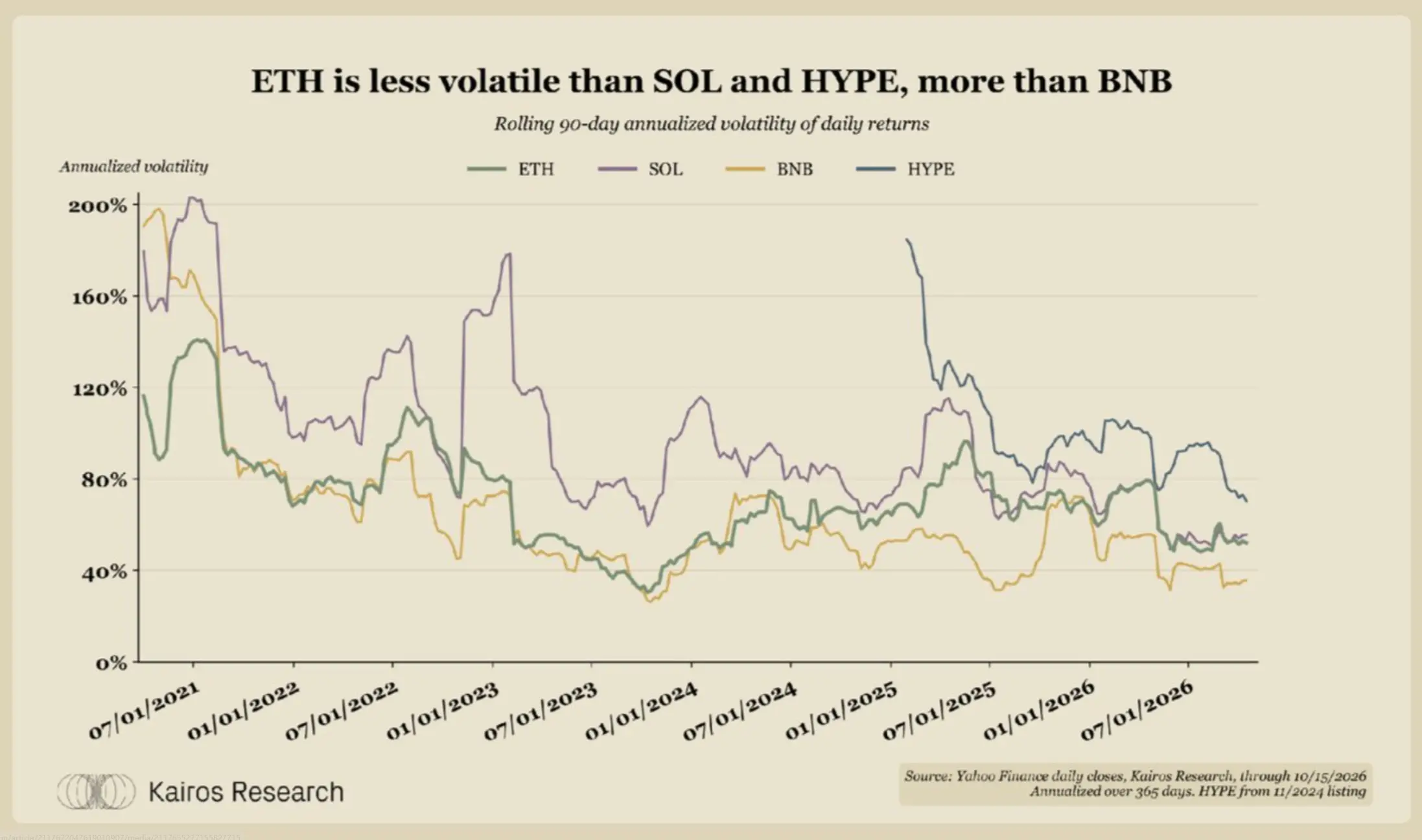
*Volatility Comparison of ETH with Other Major L1 Tokens*
* In the past year, ETH's volatility was 61%, SOL was 64%, BNB was 45%, and HYPE was 90%.
* Since 2025, ETH's volatility has been 69%, SOL has been 76%, BNB has been 49%, and HYPE has been 98%.
### 6. Can Stablecoin Yields Become a Better Option?
Through strategies such as lending, basis trading, reinsurance, and GPU collateralized loans, holding on-chain USD can yield higher returns than U.S. Treasury bonds. These yields serve as a benchmark for measuring any ETH strategy and reflect how much yield on-chain applications currently provide directly to users. As subsidies decrease and more funds enter, these yields are also declining.
On-Chain USD Yields
-------
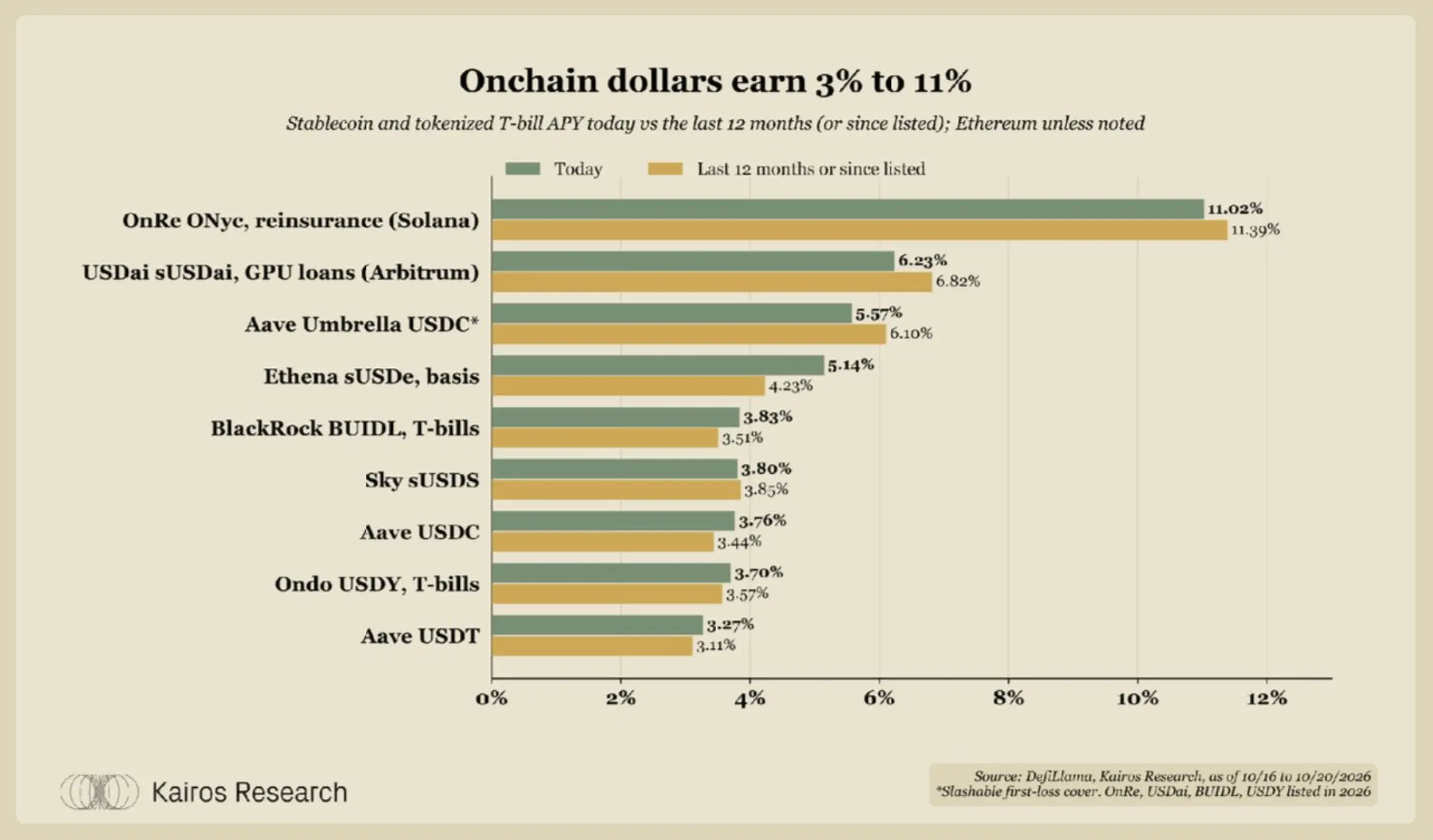
*Comparison of Different On-Chain USD Yield Strategies*
* On-chain USD yields range from 3.3% for Aave USDT to 11.0% for OnRe reinsurance on Solana. The tokenized U.S. Treasury yields from BlackRock and Ondo range from 3.7% to 3.8%. The GPU collateralized loan yield offered by USDai on Arbitrum is 6.2%.
* Aave's USDC yield is 3.8%, and USDT yield is 3.3%, about half of their average levels in 2024, which were 7.2% and 6.3%, respectively. The yield for sUSDe is 5.1%, but it has fluctuated between 0.1% and 5.7% over the past year, with a 7-day un-staking requirement.
Declining Basis Trading Yields
--------
*Changes in Basis Trading Yields and Funding Rates*
* With a large influx of funds into basis trading, the funding rate for Hyperliquid ETH has dropped from 22% in 2023 and 2024 to 5.9% in 2026, and the yield for sUSDe has also decreased from 17.5% to 4.2%. The periods of declining yields coincide with the launch of ETH futures ETFs in October 2023 and ETH spot ETFs in July 2024. These products provide new trading venues for basis traders.
* In the past year, 16% to 18% of hourly funding rates were negative. Currently, Deribit expiring futures can lock in annualized yields of 4.3% to 4.7%.
### 7. Why Do Institutions Hold ETH? Where Will Demand Come From?
The first to sixth sections use public market and on-chain data. The final section turns to the investment logic behind large ETH holders: what factors they believe will drive ETH demand and what the current data indicates. We surveyed treasury companies, brokers, service providers, and asset management institutions in the field and quoted their publicly expressed views.
Investment Logic of ETH Treasuries
-----------
Treasury companies believe that as assets move on-chain, ETH demand will also grow. Tom Lee, chairman of Bitmine, views Ethereum as the settlement layer for stablecoins and tokenized assets. The following data examines three aspects of this logic:
* Stablecoins: Will the growth in stablecoin supply on Ethereum translate into more transaction fees paid and ETH held?
* Tokenized Stocks and Real-World Assets: Which chains did issuers choose, and why?
* L2 as a Distribution Channel: Robinhood Chain uses ETH to pay Gas and settles on Ethereum.
Growth of Stablecoins and Ethereum's Share
------------
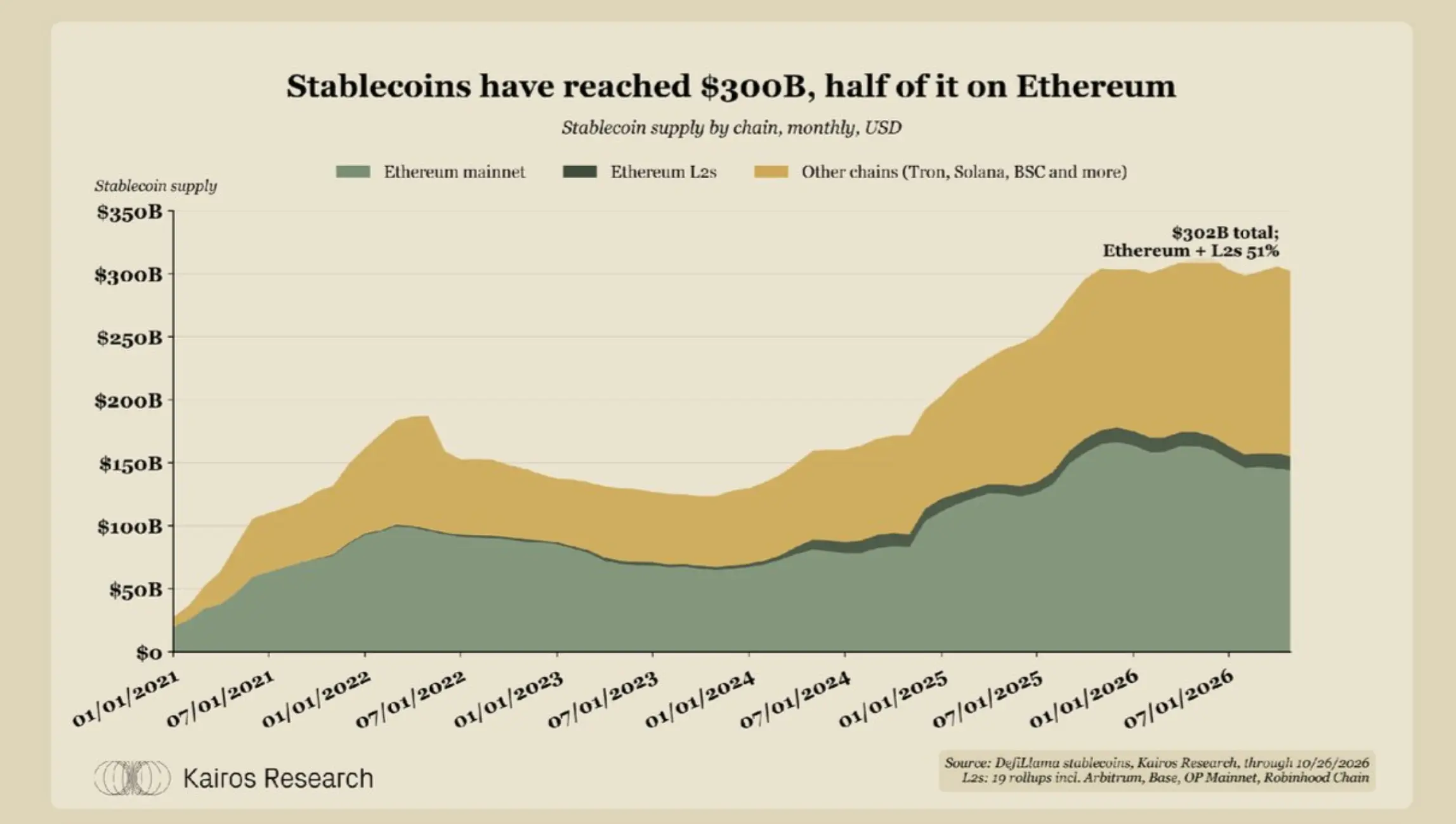
*Growth of Stablecoin Supply and Ethereum's Share*
* The stablecoin supply has grown from $27 billion in January 2021 to $302 billion today, with an increase of about $100 billion since January 2025.
* Ethereum and its L2s account for 51% of that share.
Tokenized Stocks
-----
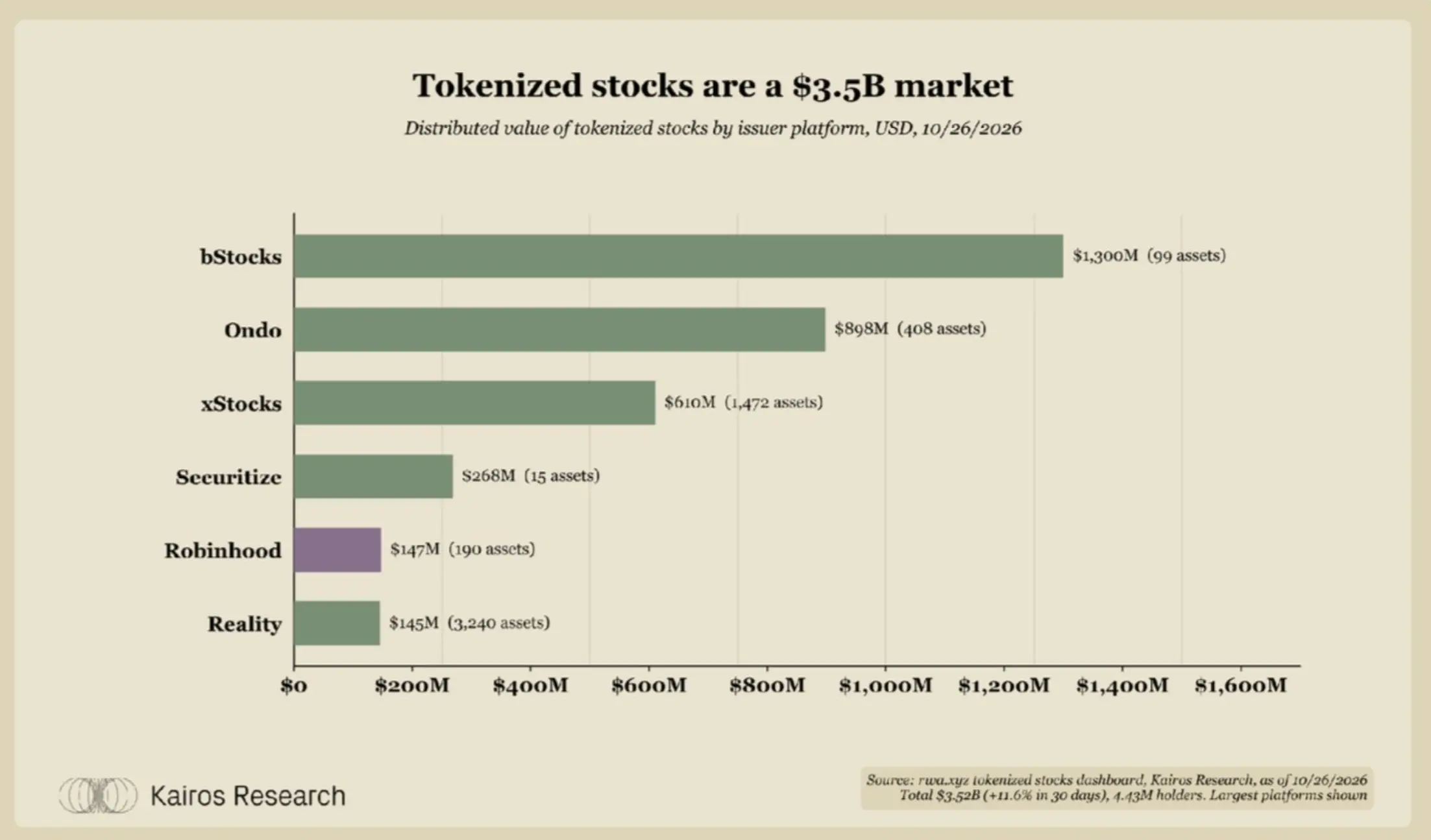
*Market Size and Issuance of Tokenized Stocks*
* As of October 26, 2026, the size of tokenized stocks reached $3.52 billion, growing by 11.6% in 30 days, with 4.43 million holders.
* bStocks, Ondo, and xStocks are leading on multiple chains; Robinhood has issued tokenized products covering 190 stocks, totaling $147 million.
ETH on Robinhood Chain
----------------------
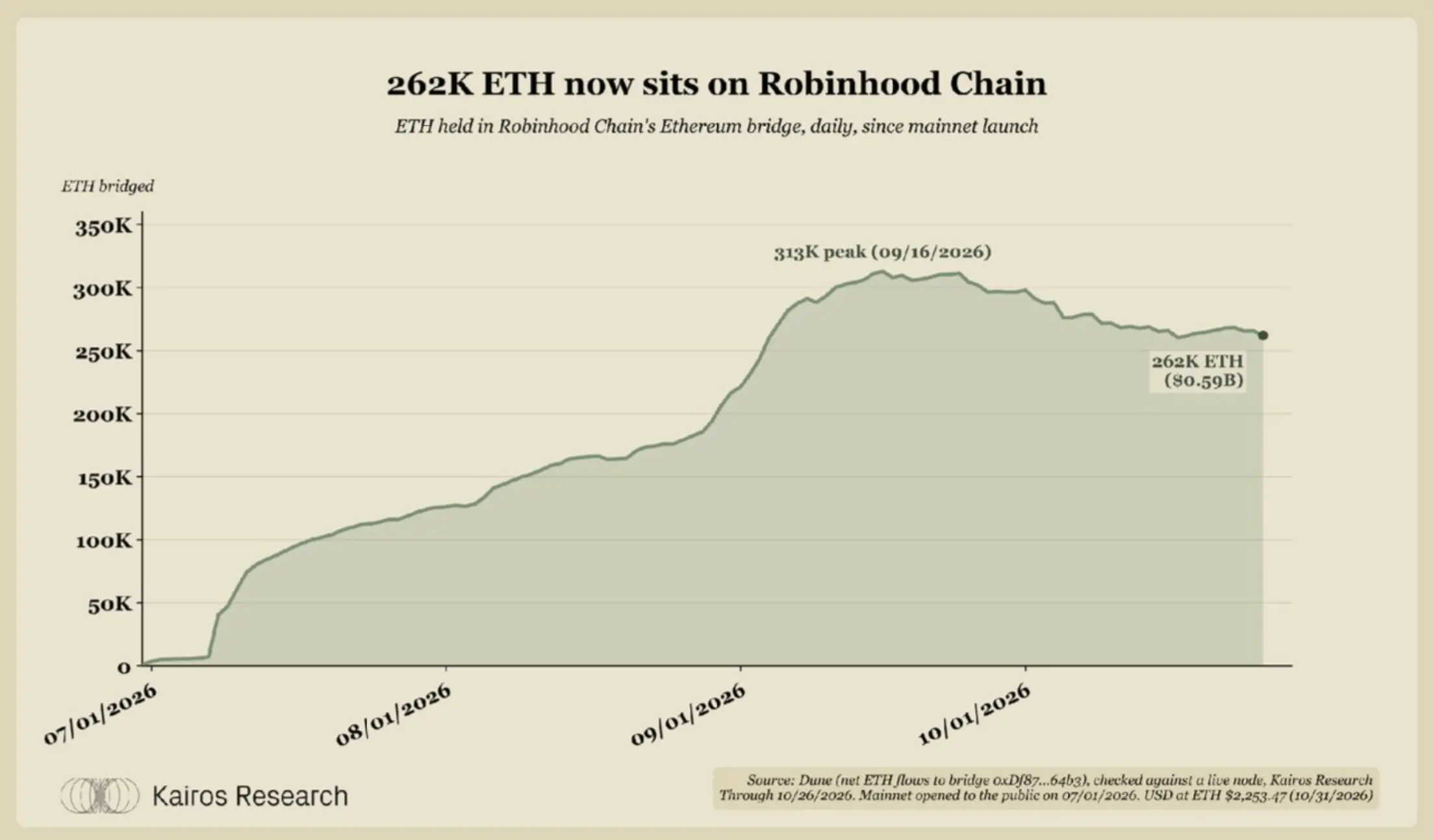
*Changes in ETH Holdings on Robinhood Chain*
* There are 262,000 ETH stored in the cross-chain bridge of Robinhood Chain, valued at approximately $590 million. This number was less than 1,000 before the public launch on July 1, 2026, and peaked at 313,000 on September 16.
* Robinhood Chain uses ETH as the Gas token, so every user trading on the chain needs to hold ETH. This is a direct example of demand being created for ETH.
Robinhood Chain Sequencer Revenue and Ethereum Costs
---------------------------
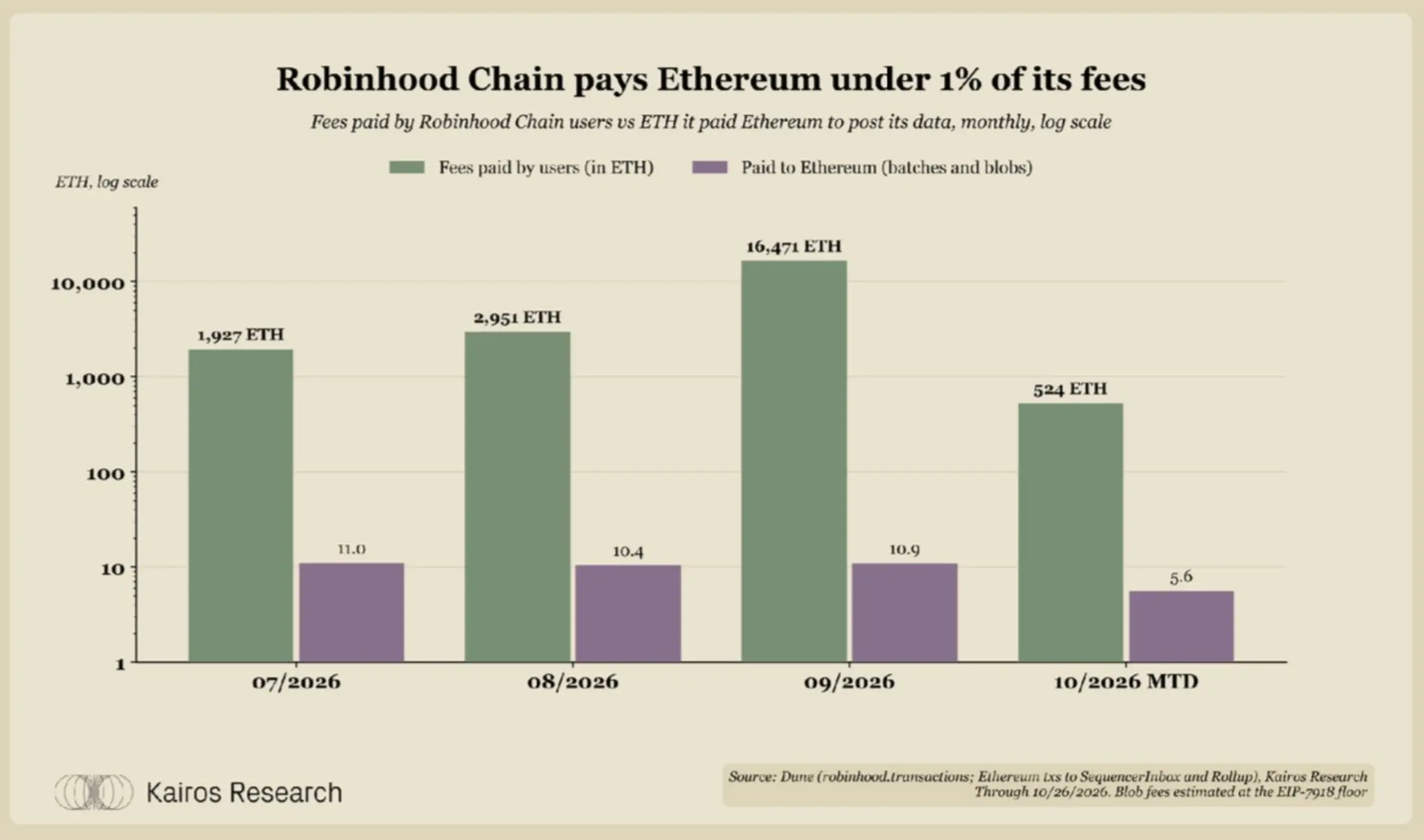
*Robinhood Chain Sequencer Revenue and Ethereum Settlement Costs*
* Since July, users have paid approximately 21,900 ETH in fees.
* Currently, the value obtained by Ethereum mainly comes from being used as Gas and holding ETH on the chain, rather than settlement fees. In the long term, Ethereum has the potential to gain a larger share of value from L2.
### 8. Demand for ETH is Growing, How Can Treasuries Make It More Effective?
The above data showcases a series of positive trends emerging in Ethereum and the broader crypto industry. So, what is the best way for market participants looking to bet on ETH to engage?
Most ETH treasuries primarily consider staking, but as yields decline, staking is no longer the complete answer. Since 2022, yields have halved to 2.2%. Re-staking has not filled this gap, and in ETH terms, the yields from lending and providing liquidity are lower than staking.
The only strategies that can clearly outperform this benchmark are first-loss protection and covered call options, but the former carries real risks, while the latter limits upside gains. As shown by the multiple occurrences of risk in various on-chain protocols over the past year, being on the front line of loss-bearing indeed carries risks. Service providers surveyed also agree with this. They all refer to staking yields as "a foundation, but not enough on its own."
They also pointed out that internal governance issues are hindering most ETH treasuries from using assets on-chain. Respondents cited smart contract risks, board approvals, and lack of clear standards as major obstacles. However, most indicated that compared to higher yields, reassuring boards or regulators is more conducive to driving asset deployment.
Some of the largest holders do not stake ETH at all, possibly due to ETF investment rules or because staking remains in a regulatory gray area in regions like South Korea. Given the increasing number of exploits and hacks in 2026 to date, it is entirely reasonable to remain cautious.
However, as the market matures, respondents and participants also see favorable trends. Joshua Lim, Co-Head of Global Markets at FalconX, and Kam Benbrik, Head of On-Chain Research at Bitwise, both emphasized the growth in activity and attention in the RWA space:
> "By 2027, people will ask less about how to tokenize assets and more about what can be done with assets after tokenization. Services traditionally provided by large brokers, such as financing and collateral management, may become more accessible on-chain. This has the opportunity to lower the barriers to entry, allowing a broader range of investors to use these services."
>
> *Kam Benbrik, Head of On-Chain Research at Bitwise*
>
> "Throughout the year, the growth of on-chain RWA tools in perpetual contracts and spot markets is a key trend. Looking ahead to 2027, we expect to further support our clients in accessing these markets."
>
> *Joshua Lim, Co-Head of Global Markets at FalconX*
The increase in innovation and product availability opens up broader investment opportunities for crypto market participants.
Charles d'Haussy, CEO of dYdX Foundation, stated: "With qualified custodians and traditional financial banks able to provide more RWAs, along with improved distribution channels, we can significantly increase our allocation to tokenized assets."
The regulatory clarity and on-chain security improvements needed to reassure boards still require time. Meanwhile, a significant question for 2027 is whether the investment logic behind holding ETH will be validated. Treasury companies bet that as assets enter the chain, the demand for ETH will also grow. And we have already seen:
* Stablecoins continue to grow across different market environments.
* One of the world's most popular brokers, Robinhood, launched on-chain stocks through Ethereum L2.
* Unique products like tokenized basis trading from OnRe, USDai, and Ethena demonstrate the market's demand for on-chain yield opportunities.