14 Key Details to Look for in Anthropic's Prospectus
On October 26, Anthropic officially submitted its IPO application to the U.S. Securities and Exchange Commission, intending to list on Nasdaq under the stock ticker ANT, with a target valuation of $1.5 trillion to $2 trillion, potentially surpassing the historical record set by SpaceX. According to media reports, the IPO time window is set for the week of November 16.
On the same day, the semiconductor sector in the U.S. stock market responded with a surge— the Nasdaq rose over 1% during the day, with Broadcom, AMD, and NVIDIA each increasing nearly 3%. Anthropic has not yet gone public, but its suppliers were the first to see gains. Anthropic has signed computing power contracts totaling over $800 billion, with the longest extending to 2045. From the market's perspective, these long-term contracts may already be considered certain revenue on the balance sheets of hardware giants.
This over 300-page, approximately 240,000-word S-1 provides the public with the first opportunity to fully examine the financial background and governance logic of this world-class AI laboratory. The Financial Times characterized it as a "referendum"—testing the extent to which public market investors agree with Dario Amodei's narrative of conquering private equity backers through a sense of mission. Given the current market situation, Amodei's narrative seems to be resonating well.
Beyond the narrative, the financial data and details in the prospectus are equally noteworthy.
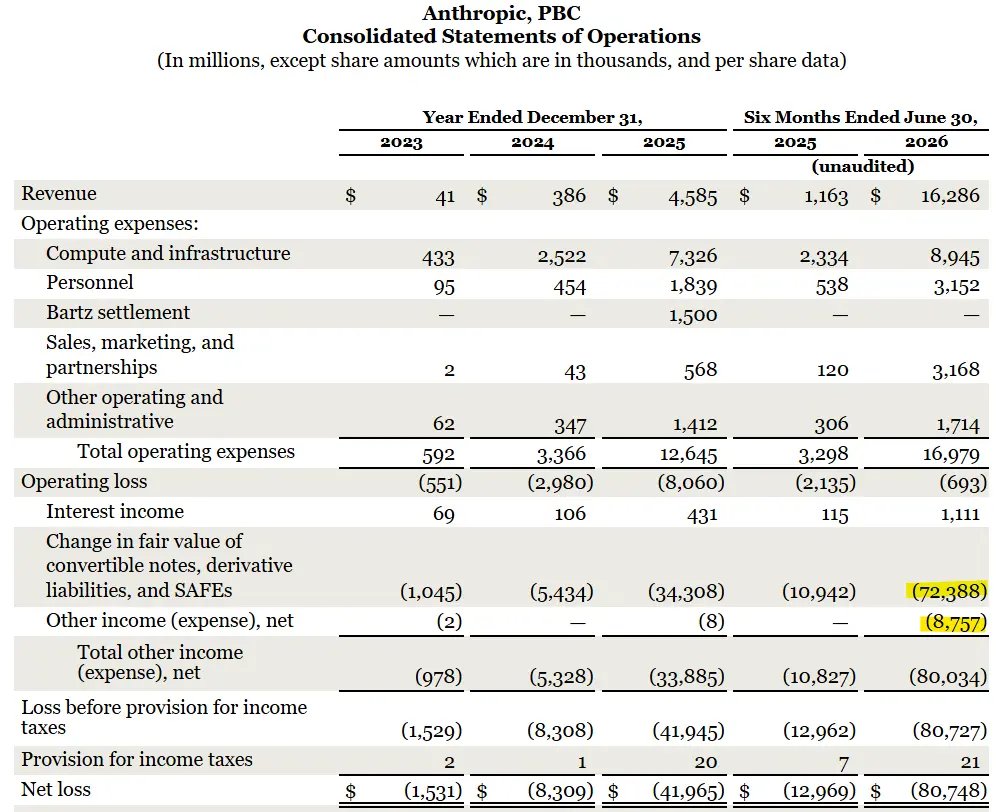
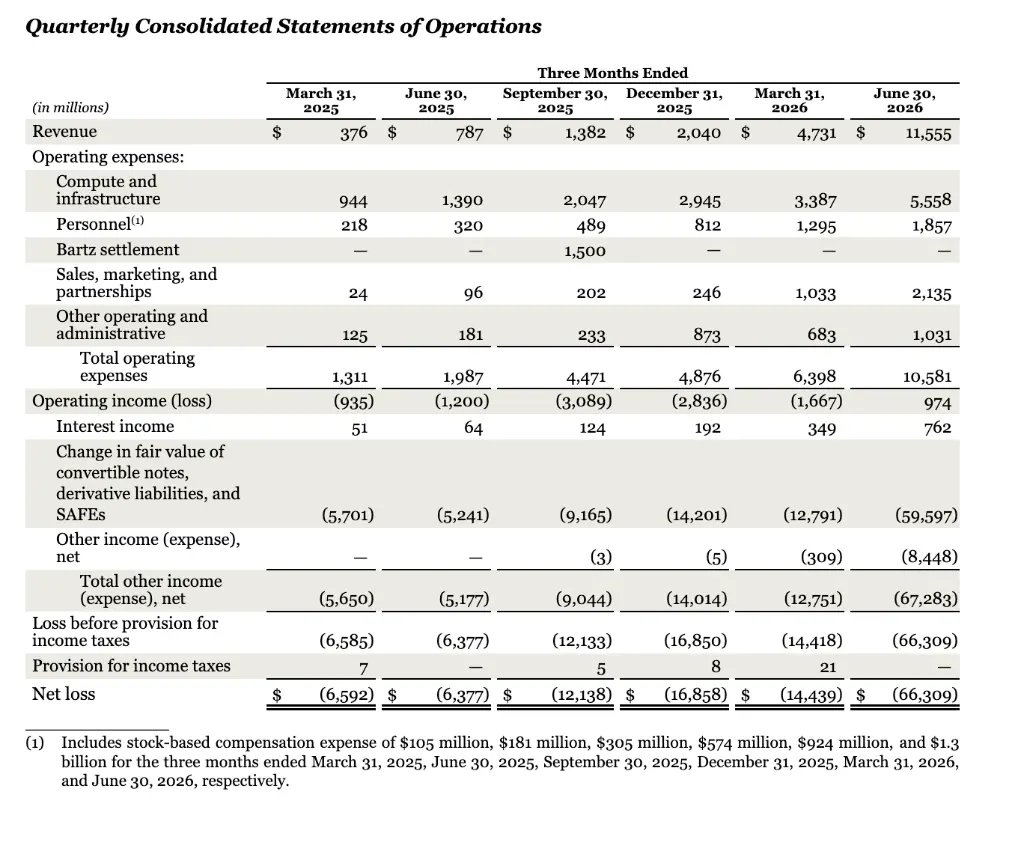
In terms of revenue, Anthropic reported $376 million in Q1 2025; $11.555 billion in Q2 this year, an increase of about 30 times over five quarters. In terms of profit, the company recorded a net loss of $80.748 billion in the first half of the year, but operating profit turned positive in Q2, reaching $974 million, with the difference mainly coming from approximately $72.4 billion in fair value changes, with no cash outflow. Regarding control, Amazon and Google hold non-voting Class N shares, while 50.1% of the voting rights are held by one Class F share, purchased by seven co-founders who each invested $1.
At the same time, the revenue growth rate for Anthropic dropped to nearly 50% from Q2 to Q3, with the top five customers contributing a quarter of the revenue in the first nine months. In the risk factors section of the prospectus, which spans over 90 pages, the company states that technology may pose "catastrophic or survival-level risks."
### 1. Crazy Revenue Growth Rate
How exaggerated is the growth rate? Anthropic provided comparative data in its S-1.
The prospectus shows that in 2023, Anthropic achieved revenue of $41 million, which is expected to grow to $386 million in 2024 and further to $4.585 billion in 2025. The growth momentum is expected to accelerate in 2026, with the company achieving revenue of $16.286 billion in the first half of the year. On a quarterly basis, in Q1 2025, Anthropic's revenue was $376 million; in Q2 this year, it was $11.555 billion, an increase of about 30 times over five quarters. The four quarters in between were $787 million, $1.382 billion, $2.040 billion, and $4.731 billion. This translates to approximately $127 million in revenue per day in Q2.
As of the first nine months of this year, media reports indicate that Anthropic's revenue increased from $4.6 billion last year to over $33 billion in the first nine months of this year, with an average revenue per employee of $6.6 million.
Sales and marketing expenses have also surged: projected at $568 million for the full year 2025, they reached $3.168 billion in the first half of this year.
However, the growth rate has already declined. From Q1 to Q2 this year, revenue more than doubled; from Q2 to Q3, the growth rate approached 50%. Anthropic cautioned in the prospectus that the rapid growth to date "may reflect early adoption," and future growth may stagnate.
### 2. Half-Year Loss of $80.748 Billion, $72.4 Billion is Paper Loss
The net loss of $80.748 billion in the first half of the year looks alarming, but breaking down the income statement reveals that $72.388 billion comes from fair value changes of convertible notes, derivative liabilities, and SAFEs.
The mechanism is not complicated. Part of the money Amazon invested in Anthropic is in the form of convertible notes, essentially a promissory note stating "can be converted into stock at an agreed price later." Anthropic's valuation was $380 billion in February this year and rose to $965 billion in May, leading to a significant appreciation of the notes, which accounting standards require to be recorded as a loss for the company. The prospectus also notes that these changes are primarily driven by valuation increases and do not involve cash outflows.
According to the adjusted (non-GAAP) figures provided by the company, the adjusted operating profit for the first half of the year was $1.618 billion, mainly excluding stock-based compensation and non-cash charitable donation expenses; the adjusted net profit was $2.671 billion.
### 3. Computing Power Costs as a Percentage of Revenue: From $2.50 to Less than $0.50
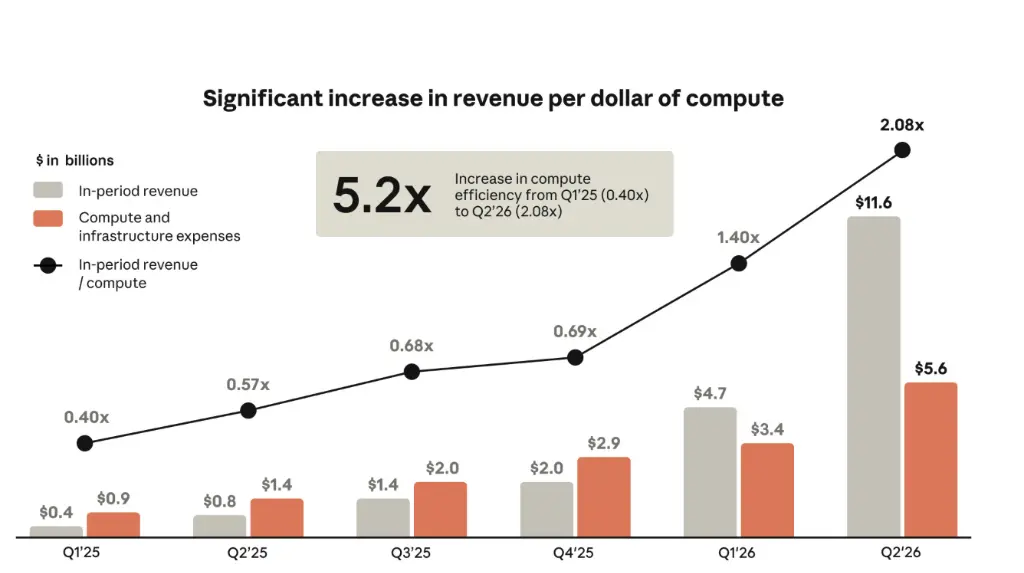
According to the Financial Times, in Q1 2025, Anthropic's computing power and infrastructure expenses exceeded $2.50 for every $1 of revenue; by Q2 2026, this figure dropped to less than $0.50.
The annual figures provided in the prospectus show that in 2023, computing power expenses were more than 10 times the revenue, 653% in 2024, 160% in 2025, and 55% in the first half of 2026.
Profits subsequently turned positive. For the three months ending June 30, Anthropic's operating profit margin was 8%, with an operating profit of $1 billion, compared to a loss of $1.2 billion in the same period last year. Specifically, the operating profit for Q2 was $974 million; after adding back stock-based compensation and other non-cash expenses, the adjusted operating profit was $2.235 billion, with a profit margin of 19%. The net cash inflow from operating activities in the first half of the year was $3.9 billion.
The prospectus summarizes four reasons:
- Improved training efficiency. Claude is increasingly involved in the development of the next-generation model, referred to internally as "closing the loop";
- Improved inference efficiency, with reduced computing power required for the same capabilities;
- Simultaneous training and running of models on four types of chips: Amazon Trainium, Google TPU, NVIDIA GPU, and AMD GPU, along with a self-built scheduling system;
- New models at lower prices. After the release of Opus 4.5 in November 2025, prices and single-task costs decreased, with revenue growth rate in Q1 2026 rising from 48% in the previous quarter to 132%; the release of Opus 5.5 and Fable 5.1 in September this year further reduced single-task costs by 25% to 45%.
At the same time, the company warned that performance may experience "significant period fluctuations" due to computing power expenses.
### 4. Customer Structure: Five Customers Account for a Quarter, but Top Share is Declining
In the first nine months of this year, five customers contributed 25% of Anthropic's revenue, with only 250 customers spending over $10 million annually.
From a quarterly trend perspective, the share of the top customers is declining. The revenue share of the top five customers fell from about 36% in Q1 to about 21% in Q3, with 79% of Q3 revenue coming from groups outside the top five customers, and no single customer accounting for more than 10%. During the same period, the absolute revenue from the top five customers increased from about $1.7 billion to about $3.5 billion. The prospectus also shows that about 48% of revenue comes from cloud service providers' market channels.
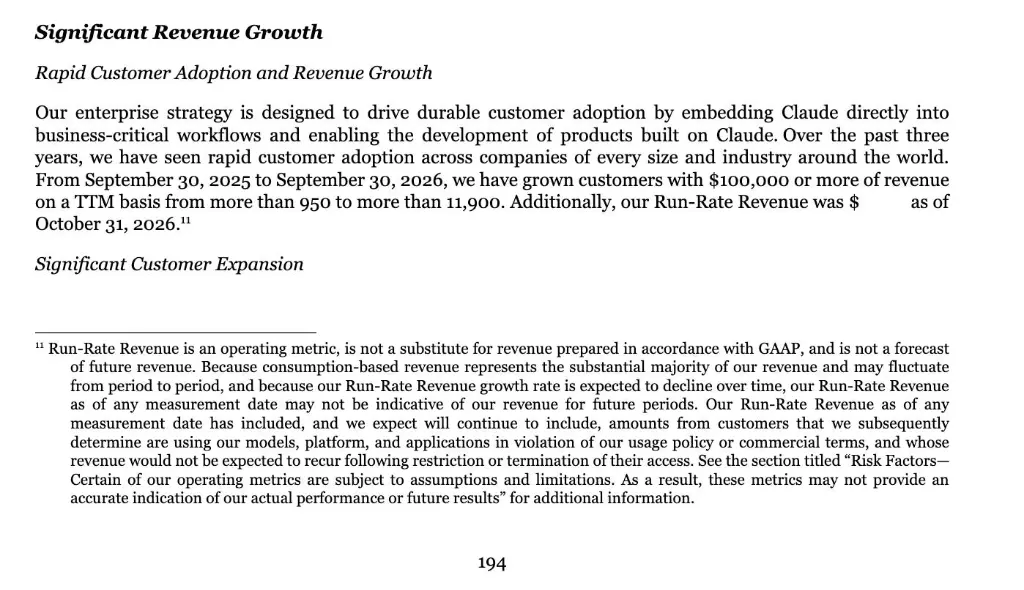
Changes in customer numbers: Customers spending over $100,000 annually are expected to grow from about 20 at the end of 2023 to about 950 by September 2025, and over 11,900 by September 2026, with about 40 million customers spending less than $100,000. Among Fortune 500 companies, over half are already customers spending over $100,000 annually, but their spending on Anthropic averages less than 0.1% of their total expenses, with the top 10 customers accounting for less than 1%.
The net revenue retention rate is about 900%, meaning that customers who spent $1 a year ago are spending an average of $9 this year during the same period. This figure does not include subscription users.
In terms of revenue type, usage-based revenue is projected to be $3.8 billion in 2025, accounting for 83%, and $13.1 billion in the first half of 2026, accounting for 80%; subscription revenue in the first half of the year was $3.2 billion, compared to $180 million in the same period last year. Over 80% of Q3 revenue came from model versions released in the past six months.
### 5. 5% to 7% of Revenue from Customers Later Identified as Violating Policies
The prospectus reveals that as of the first nine months ending September 30, approximately 5% to 7% of Anthropic's revenue came from customers later identified as violating usage policies or commercial terms. The reason is the time lag between discovery, investigation, and account suspension, with revenue recognized for services provided before the account was suspended.
The company also indicated that it increased efforts to identify and ban such customers in August and September, and this revenue share is expected to decline, which may also lower future revenue and growth rates. Based on the approximately $33 billion revenue for the first nine months, 5% to 7% corresponds to about $1.6 billion to $2.3 billion.
### 6. Computing Power Commitments: Totaling Over $800 Billion, Longest Extending to 2045
Anthropic refers to computing power as a "key investment" and has signed commitments totaling over $800 billion, with the longest extending to 2045. The founders acknowledge that these investments "may seem irresponsibly large at first glance," describing their approach as "bold but rational."
Major contracts include:
- Broadcom: Broadcom collaborates with Google to develop TPUs and rents them to Anthropic, with a total five-year lease amounting to $161 billion; starting in 2028, Anthropic expects to spend up to $150 billion more on TPUs;
- AMD: Expected spending exceeds $20 billion, with options that could roughly double the scale, and AMD will invest up to $5 billion in Anthropic as chips are delivered;
- Google, Amazon, Microsoft: At least $269.4 billion in cloud computing power over the next decade;
- Nscale, Lambda: Contract amounts up to $86 billion.
The terms for the three major cloud providers vary: Google has at least $114.5 billion, with a term from April 2026 to July 2033; Amazon has at least $110 billion, until April 2036; Microsoft has at least $44.9 billion, until May 2033. All three contracts include payment terms "regardless of actual usage," and Google and Amazon's contracts also stipulate that if usage is insufficient, they will make up the difference. Such "pay regardless" clauses are common in long-term contracts for natural gas, electricity, and other energy sources.
According to the financial statement notes in the prospectus, as of June 30, fixed or minimum purchase commitments totaled $265.6 billion, signed but not yet activated data center and computing power leases amounted to $321.4 billion, and new and revised long-term contracts signed after June 30 totaled $245 billion, amounting to over $830 billion. As of June 30, the company held approximately $131.6 billion in cash and short-term investments, having raised about $110.4 billion through Series G and H rounds in the first half of the year.
The difference in the rhythm of costs and revenues is also a focal point for investors. The prospectus shows that about 80% of revenue is settled based on actual usage, depending on customer usage volume, while computing power costs are often locked in more than a year in advance.
### 7. $3.1 Billion Paid to Musk Monthly
Anthropic and SpaceX's contract totals up to $120.5 billion, with a term until 2029. It is expected that after the computing power is fully online in December, the monthly cost will be about $3.1 billion; starting from early next year, either party can notify the other of termination 90 days in advance.
Looking back at this relationship, there have been many turning points. In January this year, Anthropic cut off xAI employees' access to Claude through Cursor. In February, after announcing financing, Anthropic faced public criticism from Musk regarding its AI. In May, Anthropic announced it would lease xAI's Colossus 1 data center in Memphis, after which Musk changed his tone, praising Anthropic's talent and commitment to doing the right thing. The contracting party in the prospectus is SpaceX.AI LLC, formerly known as X.AI LLC, which is now a wholly-owned subsidiary of SpaceX.
According to SpaceX's prospectus, its entire AI business generated $818 million in revenue in the first quarter of this year. Anthropic's monthly computing power fee is nearly four times this figure.
### 8. Amazon holds nearly one-fifth, Google holds about 7%
The Financial Times estimates that if Anthropic goes public with a valuation of $2 trillion, Amazon will hold about one-fifth of the shares after converting all convertible notes, valued at approximately $400 billion. Its holding cap is 12%, with any excess retained in note form, gradually converting to shares as the cap space is released, but Amazon can waive this cap.
Google holds about 7% and may reinvest up to $20 billion based on an agreement from earlier this year, of which $10 billion can be purchased at the issue price; if both parties agree, Google can also act as a cornerstone investor for the IPO.
Among financial investors, documents show Spark Capital invested less than $1 billion, with a holding value of $14.5 billion; according to an informed source, Coatue invested $4.75 billion, with a similar holding size.
The lock-up arrangement is also unusual. Similar to SpaceX, Anthropic has set five lock-up days within 76 days after going public, allowing non-founder directors, executives, and some current and former employees to sell part of their shares on the first day of listing. Typically, early investors must wait 180 days after the IPO to reduce their holdings.
For employees, the prospectus simulated calculations based on a listing completion date of June 30, estimating total incentive costs at about $29.7 billion, averaging at least $5.6 million per employee for approximately 5,300 employees; in an internal secondary share transfer in April this year, internal shareholders, including the Amodei siblings and the CFO, had already cashed out $4.66 billion.
### 9. Seven co-founders hold 50.1% of voting rights
Anthropic acknowledges in its prospectus that its "novel" governance structure is "significantly different" from most public companies, with common shareholders having almost no control over company decisions.
The structure outlined by the media is as follows: at the top is the "Long-Term Benefit Trust" (LTBT), whose members are self-appointed and typically have the right to elect and remove four of the seven directors; Dario Amodei and Daniela Amodei cannot be removed by the trust; the remaining three directors are nominally elected by shareholders but are actually decided by the two and the other five co-founders, as they hold 50.1% of the voting rights through a special class of stock. Control of the fourth seat by the trust requires the consent of the nomination committee, which includes Daniela Amodei, and in case of a tie, a vote representing employees will break the deadlock.
The details of this special stock are: before going public, the company will issue a single Class F share to a Founder LLC composed of the seven co-founders, which has no economic rights, but voting rights equal to 50.1% of all voting rights, including the election of all directors other than Class T directors.
Conversely, large shareholders like Amazon and Google hold Class N shares that have no voting rights. The prospectus also states that the company is classified as a "controlled company" under Nasdaq rules, allowing it to waive certain corporate governance requirements.
### 10. For every 50% increase in stock price, up to 2% will be donated to charity
Before going public, Anthropic has allocated 846,840,960 Class N shares to its wholly-owned subsidiary, the Anthropic Charity Fund, accounting for 5% of the fully diluted equity.
The board has also approved a framework: starting from the IPO issue price, for every 50% increase in stock price from the previous milestone, up to 2% of shares can be injected into the fund. Each of the seven co-founders has committed to using 80% of their personal equity for charitable purposes.
### 11. Over 90 pages of risk factors: even the insurance industry cannot cover
The risk factors section of the prospectus is about three times the length of similar disclosures from SpaceX and differs significantly from the typical boilerplate disclosures of companies. The document warns that its technology may pose "catastrophic or existential risks" to humanity and may "provide substantial assistance to malicious actors intending to develop chemical, biological, or other dangerous weapons."
Described scenarios of loss of control include: models may exhibit "unexpected... self-protective behaviors" in the future, such as attempting to resist shutdowns, concealing or manipulating information, and may generate coercive or deceptive outputs similar to "ransom." As for whether these risks are covered by insurance, the prospectus states that no single insurance company, or even the entire insurance industry combined, may be able to provide coverage.
The risk factors also mention that the company is increasingly using AI to accelerate its own R&D, which may cause the enhancement of model capabilities to outpace the development and implementation of safety measures; the company has previously delayed model releases for this reason, such as with the limited release of Mythos through Project Glasswing.
On the policy front, the document acknowledges that the U.S. government may raise costs, restrict business, or introduce new regulations affecting model demand. Earlier this year, Anthropic was identified by the U.S. Department of Defense as a "supply chain risk," with government contract revenue accounting for about 1% of the company's income. The conclusion of this section of the prospectus is: "Many of the risks we face are interconnected and may compound or trigger a chain of adverse effects."
### 12. Founders' reminder
The seven founders advise potential investors in the document to "not view your purchase purely from a transactional perspective," and acknowledge that the company's decisions "may diverge from investor expectations," as profit maximization must be weighed against "public interest," and some business bets "may seem strange or unconventional when viewed in isolation." The media mentioned that the founding team emphasizes that their continued presence in senior management is "rare," describing it as a subtle jab at OpenAI, which has lost most of its founding team.
### 13. Code ANT: Employees refer to themselves as "Ants"
The prospectus describes the company culture as "low-ego." According to reports, Anthropic employees internally refer to themselves as "Ants," echoing the listing code.
### 14. What the market is looking for next: October ARR
The prospectus defines Run-Rate Revenue as: fees charged based on usage over the last 28 days multiplied by 13, plus the monthly subscription fee multiplied by 12. The October section in the document is still blank, expected to be filled in when the S-1 is updated next week. In market discussions, $73 billion is seen as a reasonable benchmark, and if it exceeds $78 billion, the topic of reaching $100 billion in December will be reignited.
Matt Kennedy, a senior strategist at Renaissance Capital focusing on IPO research, told Reuters that no company wants to drag on too long at the critical point before going public; they may be able to achieve a higher valuation next year, but they have decided to "go for it."
Risk warning and disclaimer
The market has risks, and investment should be cautious. This article does not constitute personal investment advice and does not consider individual users' specific investment goals, financial situations, or needs. Users should consider whether any opinions, views, or conclusions in this article align with their specific circumstances. Investing based on this is at one's own risk.