The chess game of payment giant MoR: Why did Stripe still need to step in after acquiring Lemon Squeezy?
When Stripe acquired Lemon Squeezy in July 2024, Patrick Collison stated the goal was to "scale Merchant of Record sales."

On January 28, 2026, Lemon Squeezy co-founder JR Farr publicly wrote that the team was involved in building Stripe Managed Payments and hoped to facilitate the migration for existing Lemon Squeezy users.
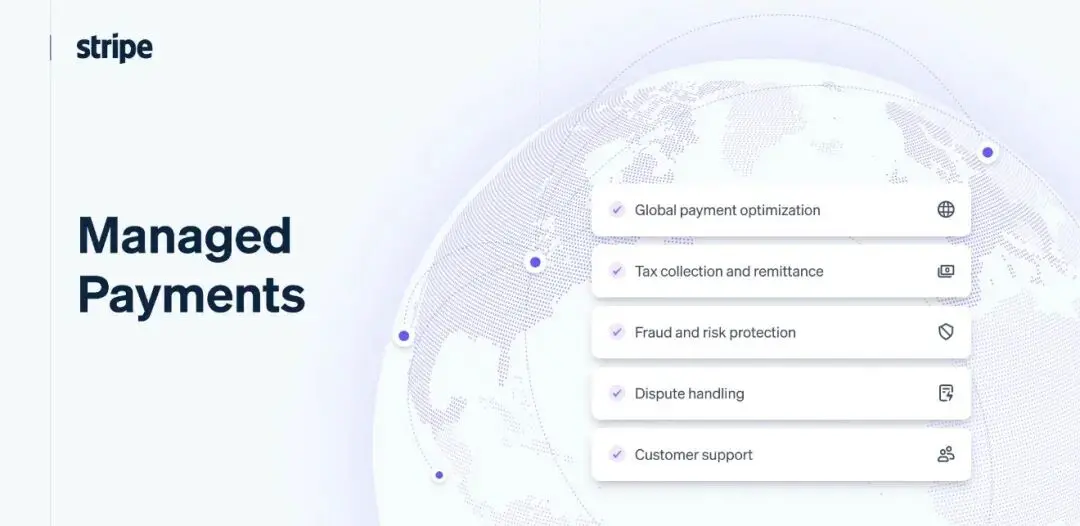
Starting April 6 of the same year, the legal seller entity for Managed Payments changed from LemonSqueezy LLC to Sold through Link, LLC.
Stripe's official explanation is that this is a change of the same underlying MoR service entity, which does not affect transactions and pricing.
At this point, things are clear.
Stripe's acquisition of Lemon Squeezy is not primarily about operating two unrelated MoRs long-term, but rather about bringing in the team, product experience, and operational capabilities, and then making MoR a native capability on its platform.
The Lemon Squeezy brand remains, but the underlying structure is consolidating towards Managed Payments.
Why did Stripe choose to push itself from payment infrastructure to "global commercialization infrastructure" through acquisition?
### Two Entry Points, Different Purposes
Lemon Squeezy and Stripe Managed Payments currently coexist, but they serve different customer entry points.
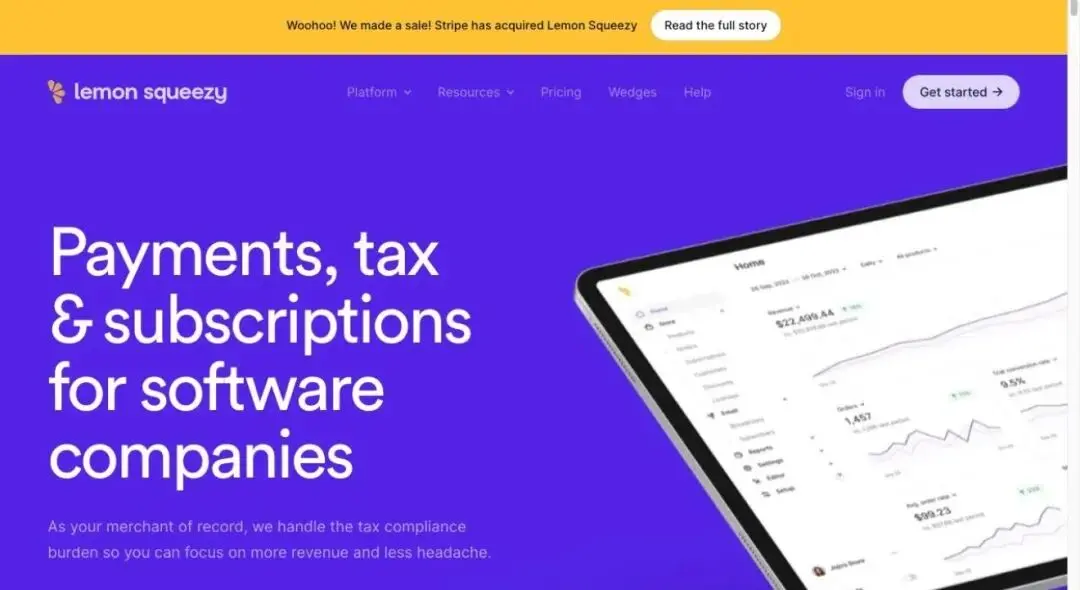
Lemon Squeezy starts from the sales tools for developers.
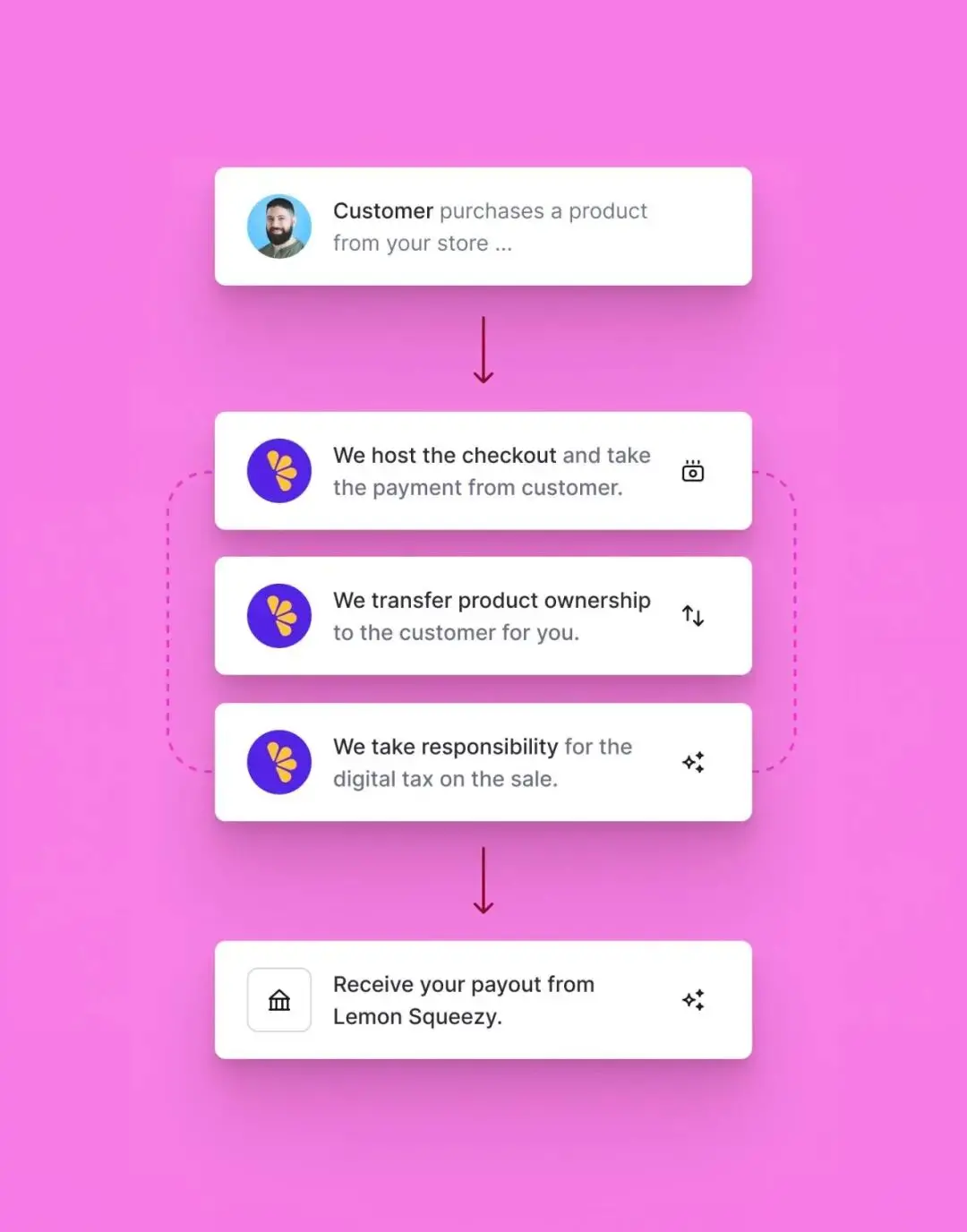
A small team of three created an AI video tool, lacking a tax team or dedicated payment engineers. What they need is a solution that can be quickly launched: create products, set prices, manage subscriptions, issue licenses, handle taxes, and collect payments. Payments are just one part of this sales system. This type of customer has a higher demand for "out-of-the-box" solutions than familiarity with the underlying payment system, allowing Lemon Squeezy to reach independent developers and small teams that have not deeply used Stripe.
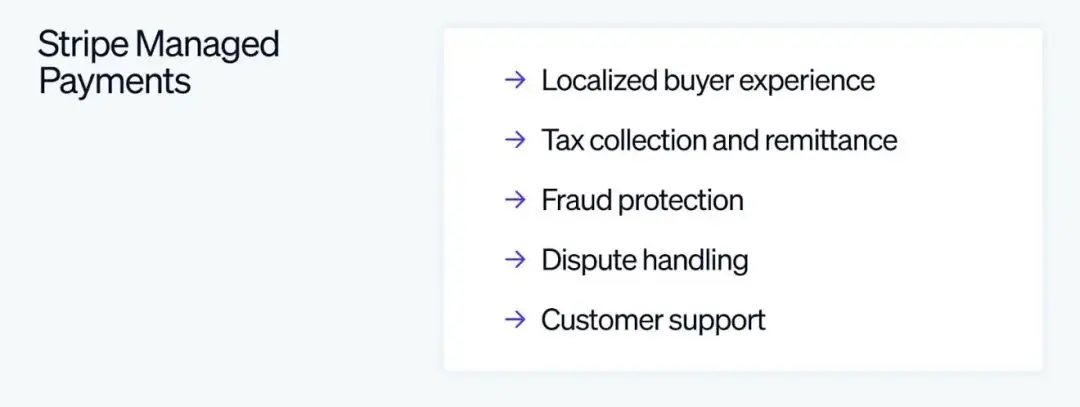
Stripe Managed Payments takes a different route. It targets businesses that are already using Stripe Payments, Checkout, or Billing. These businesses do not need to buy a new software sales platform; they simply want to delegate indirect taxes, fraud, dispute handling, and transaction-level customer service to MoR for certain markets and transactions. Stripe allows enabling on a transaction, market, or product basis, rather than forcing all sales to be converted to MoR. Domestic U.S. businesses continue to bear seller responsibilities, while certain digital product transactions in Europe enable Managed Payments—this hybrid model has significantly lower switching costs for businesses that are already deeply embedded in the Stripe ecosystem.
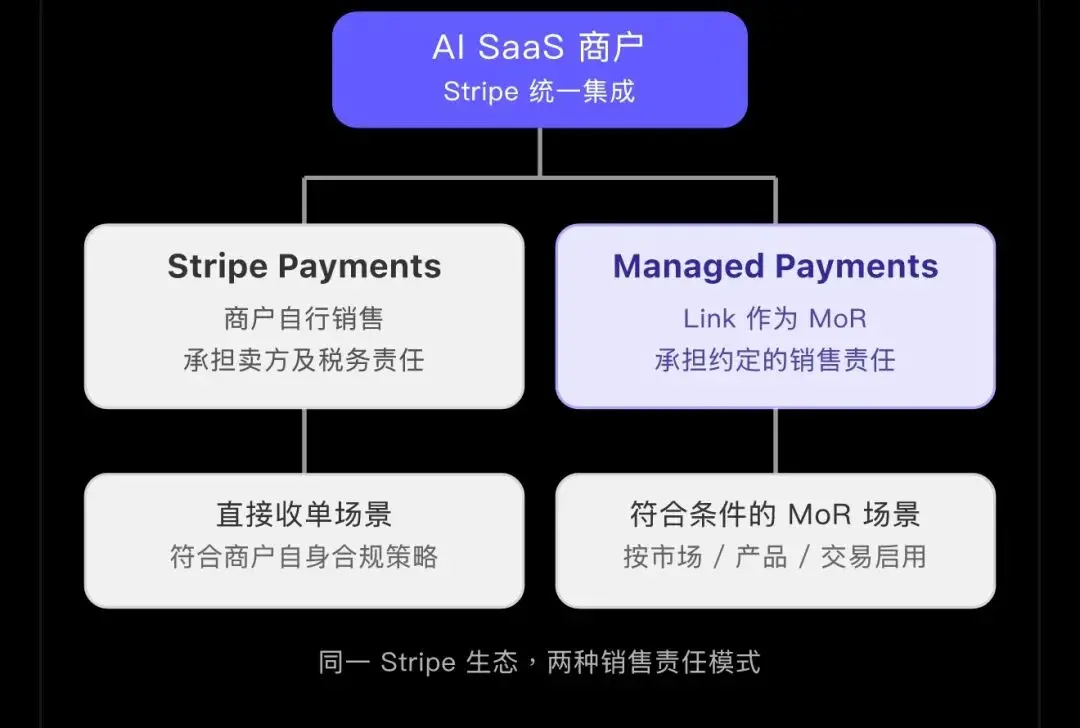
The former addresses customer acquisition, while the latter addresses upgrades within the ecosystem.
This is the current observable arrangement.
However, based on the migration direction disclosed by Lemon Squeezy, in the long term, the underlying capabilities will continue to integrate into the Stripe platform, rather than maintaining two independent MoR infrastructures permanently. Whether the brand continues to exist independently is another matter.
Why is it Sold through Link, rather than directly having Stripe as the legal seller?
This is currently the most easily overlooked detail and the one worth further observation.
In Managed Payments transactions, consumers see "Sold through Link."

Checkout, receipts, order management, subscription management, and after-sales support are all conducted through Link.
The card statement descriptor is LINK.COM* [merchant-defined description]. Link is not just a wallet that accelerates checkout; in these transactions, it also serves as the interface for consumers to interact with MoR.
Why not directly use Stripe Payments as the legal seller? One practical effect is the separation of risk and brand.
Sold through Link, LLC is the legal entity providing MoR services, while other Stripe fees are collected by the local Stripe entity, and the billing is separate.
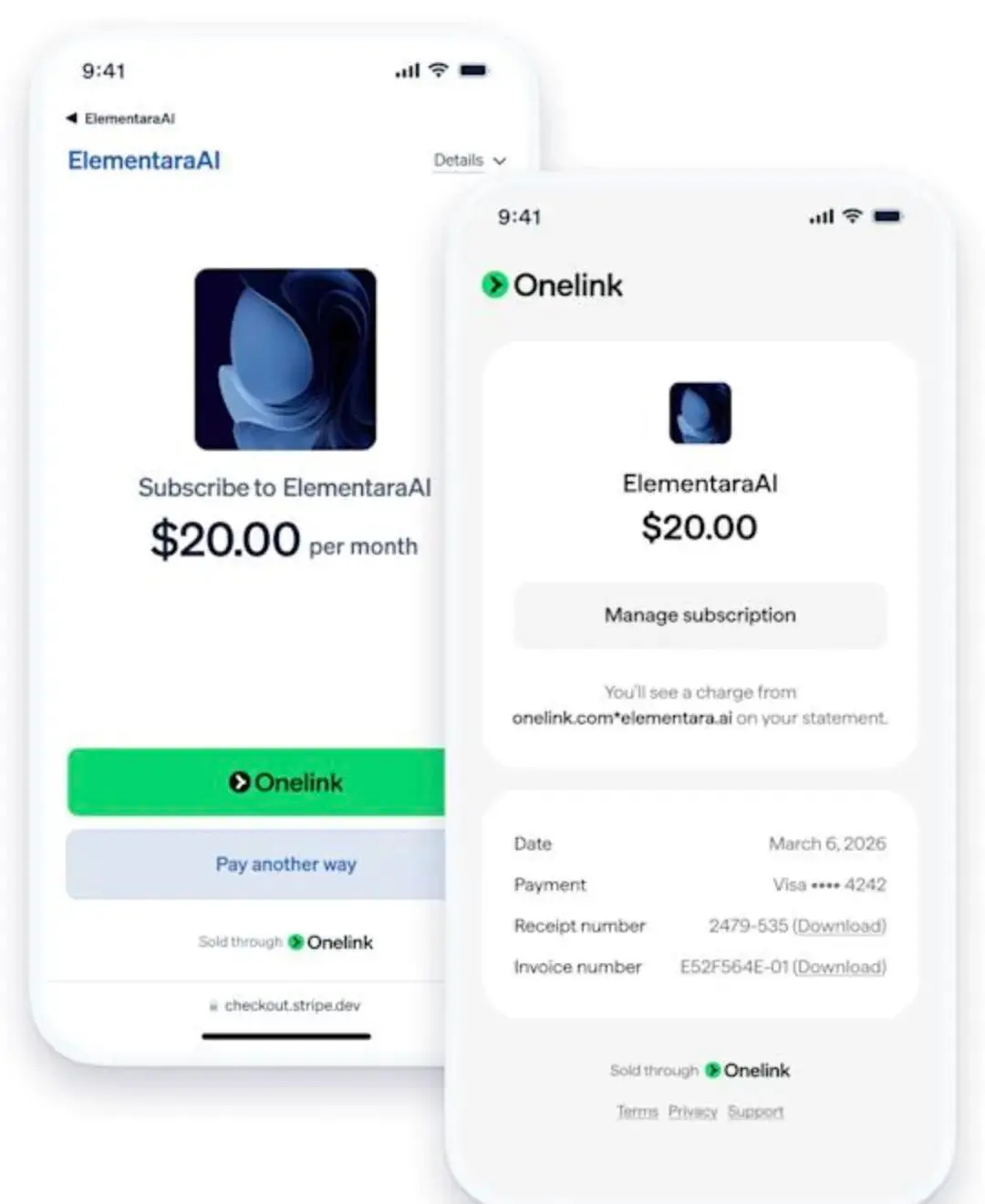
For merchants, the legal seller is an entity under the Link system, not their own company;
For consumers, the billing shows Link, not an unfamiliar merchant name.
This reduces the probability of disputes over "not recognizing this charge" and centralizes transaction-level customer service to Link support.
### But the boundaries of responsibility must be clear.
MoR handles card organization dispute resolution, which does not automatically mean that merchants are completely exempt from economic responsibility. Principal, fees, fraud losses, and recovery arrangements still depend on specific terms.
In some jurisdictions, Stripe still needs to retain and pay taxes during refunds, and the merchant account balance will decrease accordingly.
For issues with the product, contractual liabilities, and certain refund decisions, merchants may still be involved. These details have a greater impact on actual costs than simply looking at "who is the legal seller."
Strategically, Link gains a cross-merchant consumer interaction entry point here.
If more and more digital product subscriptions, refunds, and customer service go through Link in the future, Stripe will simultaneously hold both the merchant-side payment relationships and the consumer-side account relationships. This is an observable product design direction; whether Link will further develop into a stronger consumer relationship platform is still speculative.
A specific figure: $10 million annual revenue AI SaaS
### Beyond Strategic Analysis, Merchants Really Care About Money.
Let's look at a simplified example.
Assume an American AI SaaS company with an annual revenue of $10 million, primarily selling subscriptions, with an average order value of $100, 60% from the U.S. and 40% from overseas. We will only compare payment processing + MoR related costs, not considering the gross margin differences of the subscription products themselves, nor calculating the labor costs of an internal tax team (this part varies greatly and can only be qualitatively assessed).
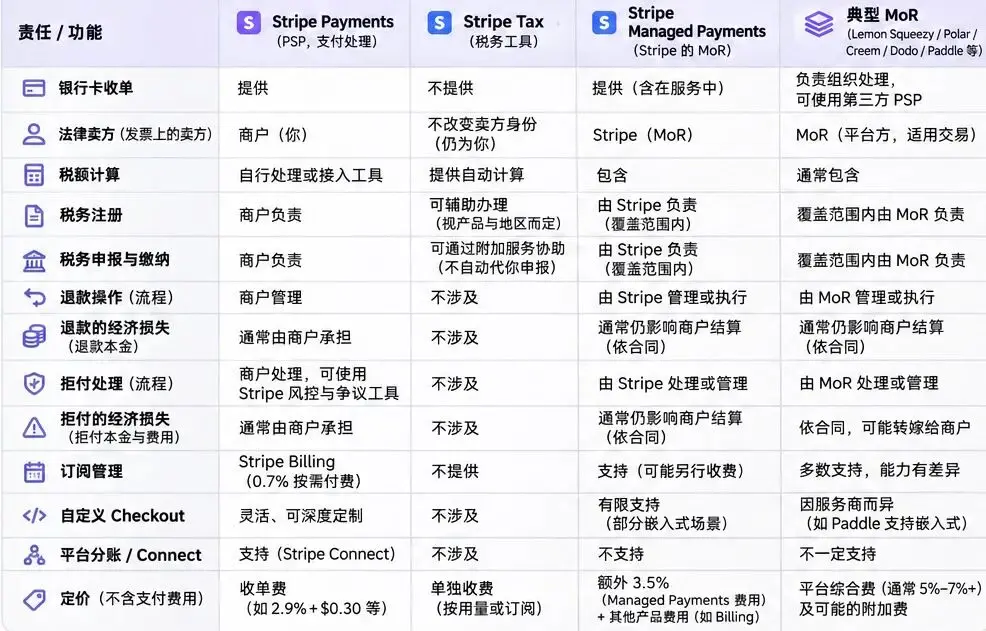
Pure Stripe Payments (acting as seller): U.S. cards about 2.9% + $0.30, international cards add another 1.5%, possibly another 1% for currency conversion. The business needs to handle indirect tax compliance (registration, reporting, tax payment) and disputes and customer service on its own. The rates are the lowest, but the compliance and operational costs are borne by the business. For companies with annual revenues in the tens of millions and a significant overseas proportion, the fixed costs of tax compliance are often not trivial.
Lemon Squeezy: Base 5% + $0.50, subscriptions may add another 0.5%, international transactions may add 1.5%, etc. MoR handles taxes, disputes, and some customer service. The rates are significantly higher than pure payments, but it trades off by outsourcing global indirect tax and transaction operation responsibilities. This is highly attractive for small teams, while for companies with established payment and finance teams, the additional rates need to be offset by the compliance cost savings.
Stripe Managed Payments: Standard Stripe payment fee + 3.5%. The effective rate for domestic U.S. card transactions is about 6.4% + $0.30 (specifics depend on whether tax is included). It allows for mixed usage—only enabling for certain overseas markets while continuing to use regular Stripe domestically. This way, businesses do not have to migrate their entire payment structure, only paying an additional 3.5% where MoR is needed. For companies already deeply using Stripe, this is the lowest switching cost MoR option.
Roughly calculated, if 40% of overseas revenue goes through Managed Payments while domestic continues with regular Stripe, the overall rate will be more controllable than going entirely through Lemon Squeezy or Paddle, while still outsourcing high compliance cost markets. However, 3.5% is not pure profit; tax reporting, dispute handling, and customer service all have costs. For merchants, the real calculation is whether the additional rates can cover the tax compliance, chargeback losses, and customer service labor they would otherwise have to bear. If the overseas revenue proportion is high, tax registration is complex, and the dispute rate is not low, the comprehensive cost of MoR may be lower; if primarily domestic U.S., with a low dispute rate and an existing tax team, pure payments are often more cost-effective.
This calculation does not have a single answer, but at least indicates that the value of Managed Payments lies not in being "cheaper than Lemon Squeezy," but in allowing businesses already using Stripe to enable MoR as needed and by market, without having to switch platforms.
### What Does It Mean for Other MoRs
For Paddle, competition is no longer just about feature comparisons. Stripe can now allow existing customers to directly open MoR within their familiar payment systems, reducing the technical switching costs. Paddle's advantage still lies in more mature software sales tools and depth in specific markets, but customers who think, "I’m already using Stripe and don’t want to adopt a new system," will be partially drawn away by Managed Payments.
For players like Polar, Creem, and Dodo, who are more focused on developer experience, differentiation will continue to concentrate on access policies, risk tolerance, support for specific categories, price transparency, and response speed. Stripe's product access and checkout customization have clear limitations; not all digital products and countries can use Managed Payments.
Stripe itself is not leading in all dimensions. MoR is not a universal exemption card; the boundaries of responsibility and recourse clauses need to be examined one by one.
For AI companies going overseas, the real watershed is not "who is the MoR," but rather: who will bear the tax, dispute, and customer service responsibilities behind this transaction, to what extent, and how to calculate the money when problems arise.
### Long-Term Direction
Over the past decade, Stripe has made it sufficiently simple for global businesses to "collect money."
Now, what it wants to do is make "selling things to the whole world" equally simple.
Acquiring Lemon Squeezy is not just about adding another MoR company, but about thoroughly understanding "how to help developers sell software," and then embedding that back into its payment backbone. Sold through Link takes this relationship a step further—legal sellers, billing descriptions, subscription management, and transaction customer service are all starting to appear on the consumer side.
When the tax, dispute, and customer service responsibilities of a transaction are no longer entirely on the merchant, the revenue logic of payment companies will extend from "processing fees" to "sales liability fees." This is not as simple as a 3.5% increase in rates. It means that the role of the legal seller is beginning to be repriced.
Who qualifies to stand in the middle of the transaction, bearing more and also earning more, will determine who truly controls the infrastructure of digital commerce in the next phase.