Binance caught fire, and the exchange's battle for deposits has begun
*Author: Gu Yu, ChainCatcher*
On October 30, Binance was hacked for approximately $6.3 billion. In the following days, the busiest departments in the crypto industry, besides the security teams, were the marketing teams.
At 14:00 Beijing time on November 1, Binance began to gradually restore withdrawals. By 20:36 that evening, the first batch of 15 networks and corresponding assets was fully restored, covering Bitcoin, Ethereum, Solana, Tron, Arbitrum, and others.
In the early stages of recovery, there was a noticeable peak in withdrawals: Binance disclosed that in the first nine and a half hours of restoring withdrawals, it processed $4.649 billion in withdrawals and $1.01 billion in deposits, with a net outflow of approximately $3.64 billion. By November 3, the cumulative net withdrawals rose to $4.72 billion—Binance stated this accounted for about 3% of the platform's assets.
For reference, as of November 3, Binance's reserve was $128 billion, while the second place, OKX, was about $28.6 billion.
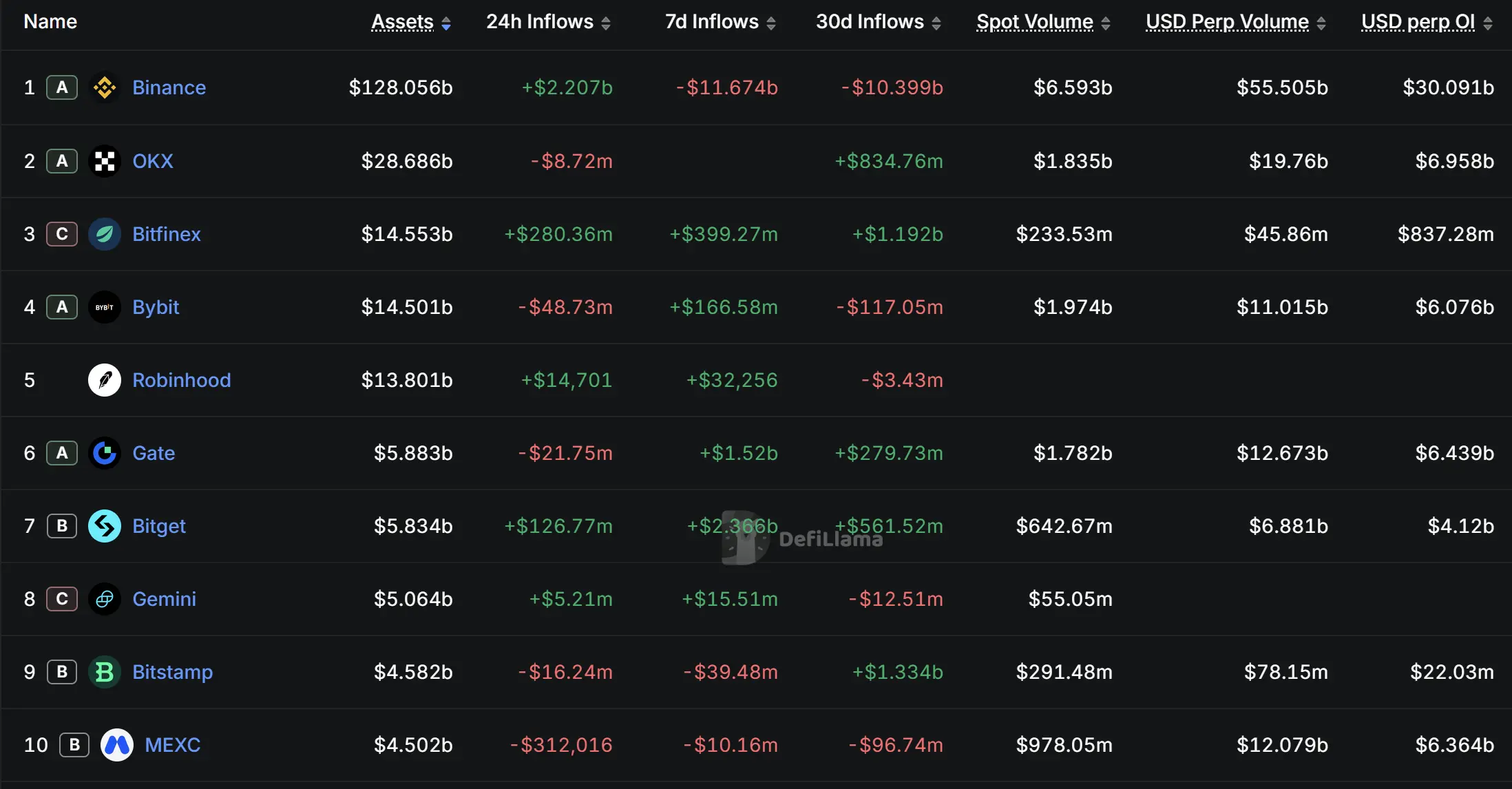
Binance's funds were flowing out, and competitors were also withdrawing. Since the day Binance restored withdrawals, Bitget, OKX, and Gate have successively launched new rounds of stablecoin financial products, with annualized rates increasing from 4% all the way to 12%. The time windows for these activities overlapped significantly, and the design of the thresholds pointed to the same goal—bringing users' funds from Binance.
### 1. Binance: Filling Back While Raising Interest Rates
Binance's activities came the earliest and resembled a defensive move.
Starting from 19:30 on November 2, it launched a user feedback campaign that would last until 07:59 on November 22, consisting of three parts: increased interest rates for stablecoin financial products, spot trading fee rebate vouchers, and a trading prize pool totaling 20 million USDC.
The financial product section offered tiered interest rates based on holdings. The base annualized rate for USDT and USDC was about 3%, with an additional 8% for the first 1,000 USDT, resulting in a combined annualized rate of 11%; for USDC, the additional rates varied by user level, with ordinary users receiving an extra 7% to 7.5% for the first 10,000 to 30,000 USDC, and VIP 1 to VIP 3 receiving an additional 8% for the first 200,000 USDC, while VIP 4 to VIP 9 received an additional 8.5% for the first 300,000 USDC—resulting in a maximum combined annualized rate of 11.5%.
Additionally, RWUSD offered an extra 6.39% for the first 50,000 coins, totaling about 10%; BFUSD provided an extra 5% for the first 50,000 coins, resulting in an approximate annualized rate of 10.11% after combining with the base yield of about 5.11%. Users who completed identity verification could receive a 100 USDC spot trading fee rebate voucher; the prize pool would be divided based on trading volume, with a maximum limit of 4,000 USDC per person, and VIP 3 and above would not participate.
### 2. Bitget: 12%, No Deadline Set
Bitget's numbers were the most straightforward.
Its USDC flexible product offered an annualized rate of 12% for the first 300,000 coins, with the excess (from 300,000 to 10 million coins) dropping to 3.5%—this is currently the highest rate among all flexible stablecoin products.
On the USDT side, it followed a net deposit logic: a regular rate of about 4%, with an additional 4.5% for users with net deposits of no less than 1 million USDT, resulting in a combined rate of 8.5%, with a limit of 3 million USDT. There were also USDGO tiers (first 100,000 at 9%, 100,000 to 1 million at 8%, 1 million to 10 million at 5%) and PoolX staking for BTC and ETH, yielding 2.88% and 3.77%, respectively.
What’s more noteworthy is the lack of a deadline. Other platforms set end dates for their activities, but Bitget's Greater China head, Xie Jiayin, stated on X that **"we will match our competitors for as long as they do"**—not setting a clear deadline essentially turns this into a competition for market share.
However, the launch of the activity did not go smoothly. Many users on X reported that the purchase channel showed sold out as soon as it opened, with many stating they could not successfully purchase and questioning whether the limits advertised by the platform were merely promotional figures.
In addition to regular stablecoin financial products, Bitget also plans to announce a new Pre-IPO subscription plan tonight, leveraging the high yields of quality new assets to attract more funds and become a platform VIP to obtain higher subscription limits.
One context is that Bitget itself experienced a theft two months ago. In September of this year, some of its wallets were attacked, resulting in a loss of approximately $387.5 million, after which withdrawals were restored in batches. This time, it is the one offering the highest annualized rate for flexible stablecoins.
### OKX and Gate Also Take Action
As long-time competitors with a history of "grudges," OKX also launched a new flash profit activity today, setting up two prize pools but without a fixed annualized rate.
The first is a "flash profit" BTC/ETH subscription activity, running from November 3 at 15:00 to November 8 at 15:00, with hourly interest calculations and the ability to redeem at any time. Subscribers will share a 1 million USDT prize pool (410,000 for BTC and 590,000 for ETH) in addition to the base financial product yield; the minimum investment is 0.001 BTC or 0.01 ETH, with ordinary users capped at 1 BTC or 100 ETH, while higher-level users can go up to 50 BTC or 3,000 ETH.
The second is a USDC holding reward, running from November 2 to December 3 at 07:59. No subscription is required; users holding no less than 10,000 USDC and with a cumulative trading volume of no less than $1,000 during the activity period can share a total of 400,000 USDC based on their daily qualified holding ratio, with a maximum of 100,000 USDC counted per account.
This segment is clearly aimed at trading VIPs, with the official pitch being "no subscription, earn by holding," but actual earnings depend on the scale of participating funds, with no fixed annualized rate. However, many OKX VIP users obtain their VIP status based on their holding amounts, and the stringent criteria have raised questions among many users.
Gate's financial activity launched on November 2, covering flexible and fixed terms for idle funds, with a maximum combined annualized rate of 9%. The yields are a combination of "approximately 3% base yield + limited-time interest increase." For flexible products, users with a cumulative net deposit of 10,000 USDT during the activity period will enjoy 4% for the first 50,000 coins; those with net deposits of 50,000 will enjoy 5% for the first 50,000 coins, with funds still available for trading, and interest rewards automatically credited the next day, continuing until December 2 at 07:00.
For fixed terms, VIP 2 to VIP 14 users with net deposits of 100,000 USDT can subscribe to the first 100,000 coins of a 7-day fixed term at 9%; those with net deposits of 1 million can subscribe to the first 1 million coins of a 30-day fixed term at 6%, continuing until December 2 at 16:00.
### Conclusion
From the withdrawal surge following Binance's hack to the intensive launch of stablecoin financial activities by various exchanges, this competition is no longer just a battle of yields but a struggle for user funds and market trust.
An annualized rate of 12% and tens of thousands of dollars in additional earnings seem enticing, but for crypto users who have just experienced security incidents, yield may no longer be the most important consideration. Bitget recently suffered a theft of hundreds of millions, and Binance is now facing a large-scale net outflow; security records, asset transparency, and withdrawal capabilities are becoming important indicators for users when choosing exchanges.
The amount of assets held by various exchanges may fluctuate to some extent, but user trust and security architecture require years of accumulation to form competitive barriers.