From Binance Alpha to Payward: RootData has become a more trusted data layer for tokenized assets among institutions
Author: momo, ChainCatcher
Recently, Payward, the parent company of Kraken, has reached a deep data cooperation with the tokenized asset data platform RootData. This partnership will integrate RootData's financing, token economics, and other tokenized asset data to provide data support for information disclosure, tokenized stocks, institutional services, and business expansion.
Against the backdrop of the ongoing RWA and tokenization wave, tokenized asset data is a crucial focus of this data collaboration. Payward's business has already covered areas such as tokenized stocks, derivatives, stablecoin payments, and institutional settlement, while RootData covers tokenized data for underlying assets like stocks, ETFs, and gold, as well as cross-market quotes and rankings, providing strong support for Payward's business expansion.
This cooperation is not just about data integration; it also reflects the collective shift of trading platforms towards comprehensive financial platforms that cover both Crypto and TradFi, highlighting the upgraded demand for systematic and structured data infrastructure.
### The changing data needs in the transition to comprehensive financial platforms
Payward serves as the underlying financial infrastructure for Kraken and its expanding family of businesses, encompassing four main pillars: trading, banking, asset management, and B2B services. Its brands are showing growth in areas such as tokenized stocks, derivatives, stablecoin payments, and institutional settlement.
The expansion of the business landscape also means that the information the platform needs to process has become more complex.
In relatively simple trading scenarios, the platform's data needs mainly focus on market quotes, project introductions, and basic information. However, as the business gradually extends to institutional services, asset management, and tokenized assets, relying solely on price and basic information is no longer sufficient to cover all research and decision-making needs. Information such as which institutions have invested in a project, its financing history, how tokens are allocated and released, and the core ecological relationships can all become important references for understanding related assets.
At the same time, the use of data is no longer limited to user-facing displays.
Information disclosure primarily addresses the question of whether users can easily access information, while institutional services and business expansion further involve project screening, background research, risk assessment, and client communication. Thus, data begins to transform from a content resource into a general capability that can serve multiple business lines.
For a comprehensive financial platform like Payward, introducing external structured data capabilities is expected to reduce the costs of redundant information collection and organization across different businesses, allowing data to play a role in more business processes.
### Upgrading information infrastructure alongside the tokenization wave
As the RWA and tokenization wave continues to advance, the market's demand for tokenized asset data is shifting from basic information queries to more comprehensive and systematic data support.
Tokenization primarily changes the expression, circulation, and settlement methods of assets, but just because assets can be moved onto the blockchain does not mean that market participants can efficiently understand the related assets. As business scales expand and institutional participation increases, the market's requirements for information standardization, verifiability, and continuous tracking capabilities will also rise.
On-chain data can present transaction, holding, and circulation records, but it cannot independently cover all asset information. Off-chain information such as project background, financing history, team and institutional relationships, and token economics still requires long-term accumulation, cross-validation, and structured processing to be efficiently utilized by different products and businesses.
In this cooperation, RootData not only provides Payward with data services related to financing and token economics but also supports multi-dimensional data formed around tokenized assets.
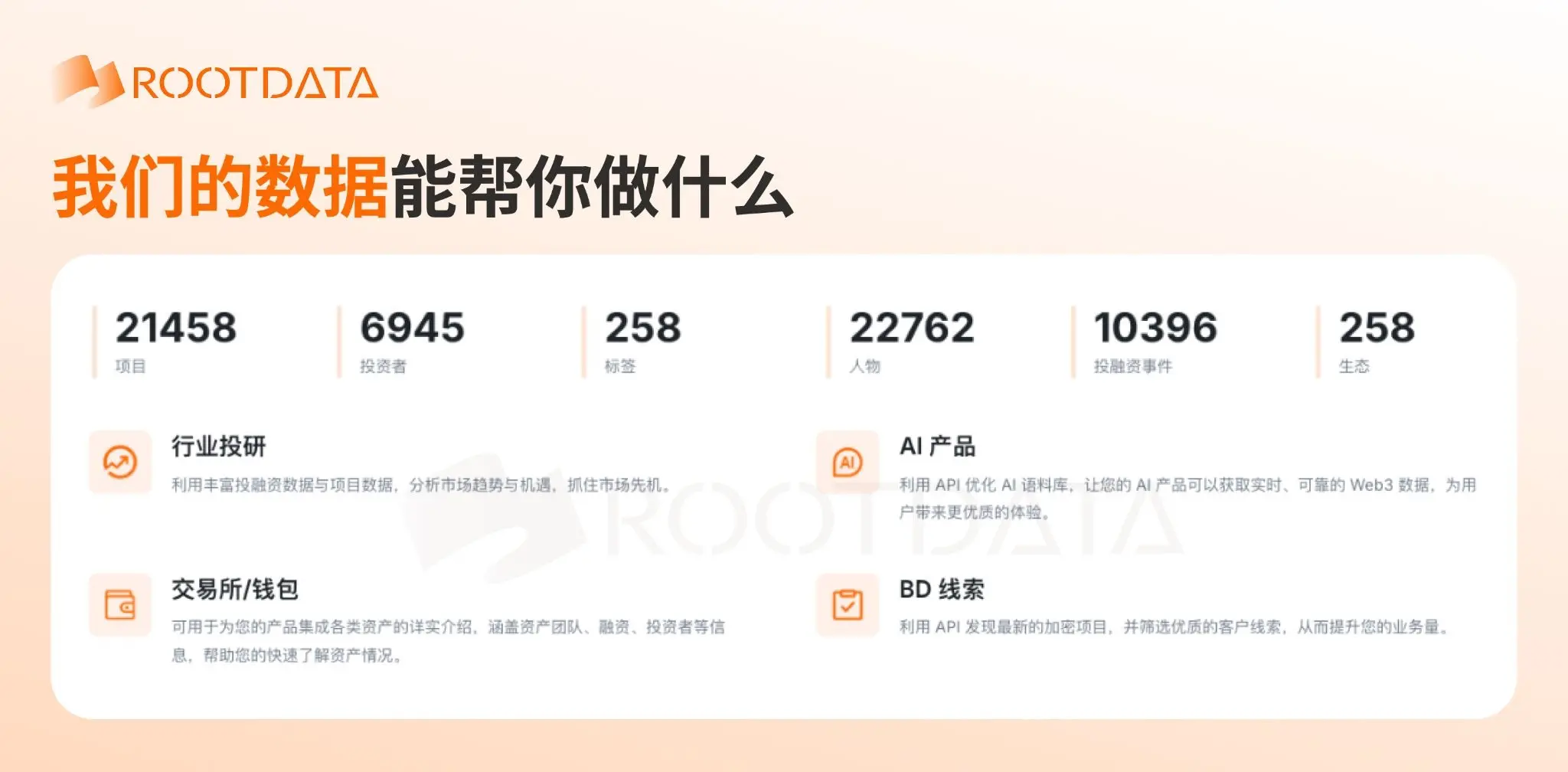
As of the time of publication, RootData has recorded 21,458 projects, 6,945 investors, 22,762 industry figures, and 10,396 financing events, establishing 258 tags and 258 ecological classifications to provide a foundation for data services related to financing backgrounds, team relationships, and project research. Among these, token economics and token unlocking data have covered over 2,000 projects, supporting the platform in viewing token allocation, release rhythms, and related unlocking information, further supplementing the information dimensions of project fundamentals and token supply.
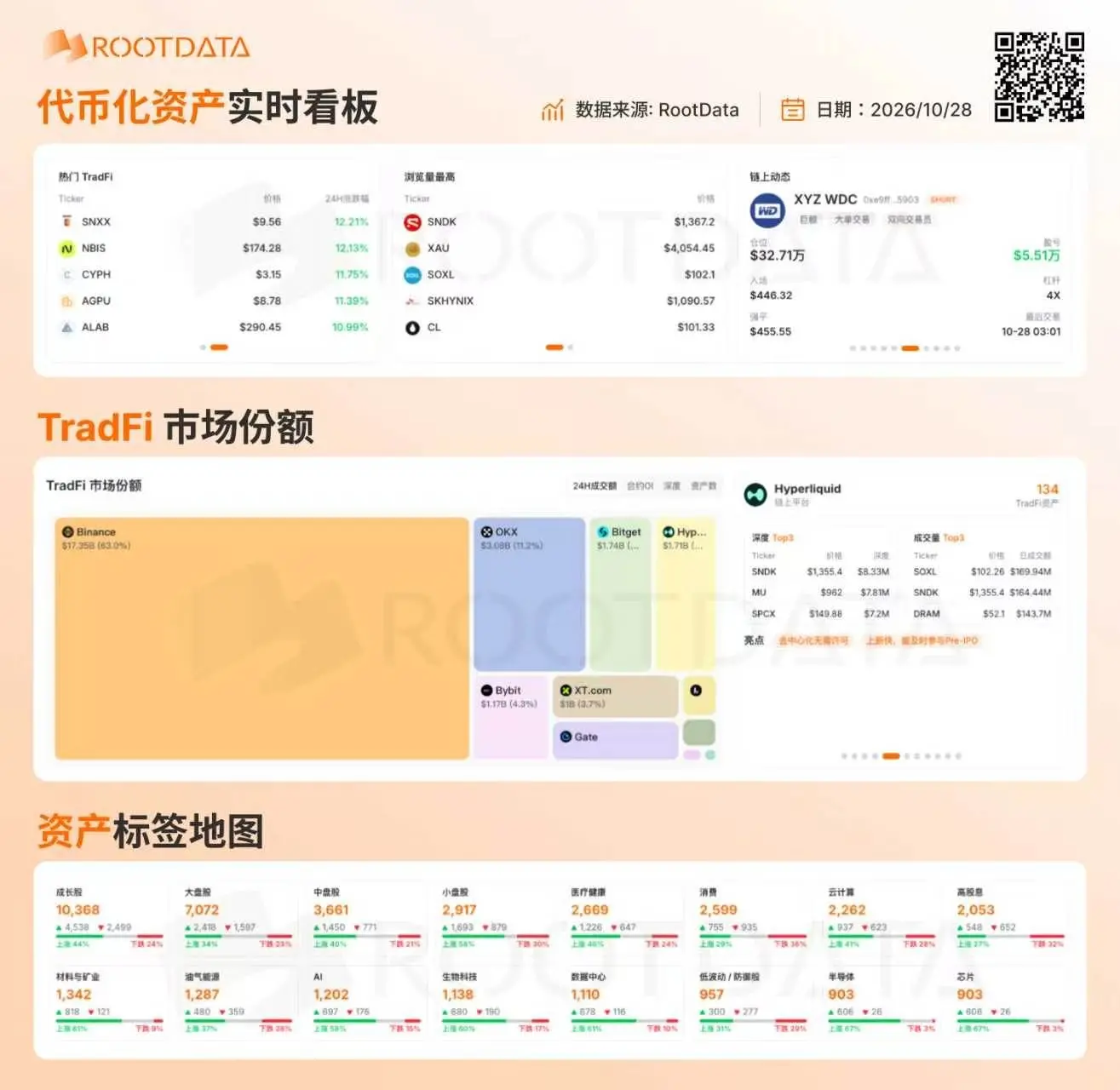
In terms of tokenized asset data, RootData has covered over 8,000 stocks/ETF underlying assets with effective market binding through sections such as the tokenized asset dashboard, perpetual stock contracts, and stock spot rankings, forming over 21,000 displayable records of stock derivatives, tokenized, and spot assets.
For example, the RootData tokenized asset dashboard has integrated data on popular TradFi assets, asset views, on-chain dynamics, market shares, asset tag board maps, and single asset details. For tokenized stocks, RootData can provide prices, issuance volumes, and AUM for different issuers and on-chain versions, and combine this with financial report data such as revenue, net profit, gross margin, and free cash flow to help users synchronize and reference the fundamentals of the underlying companies.
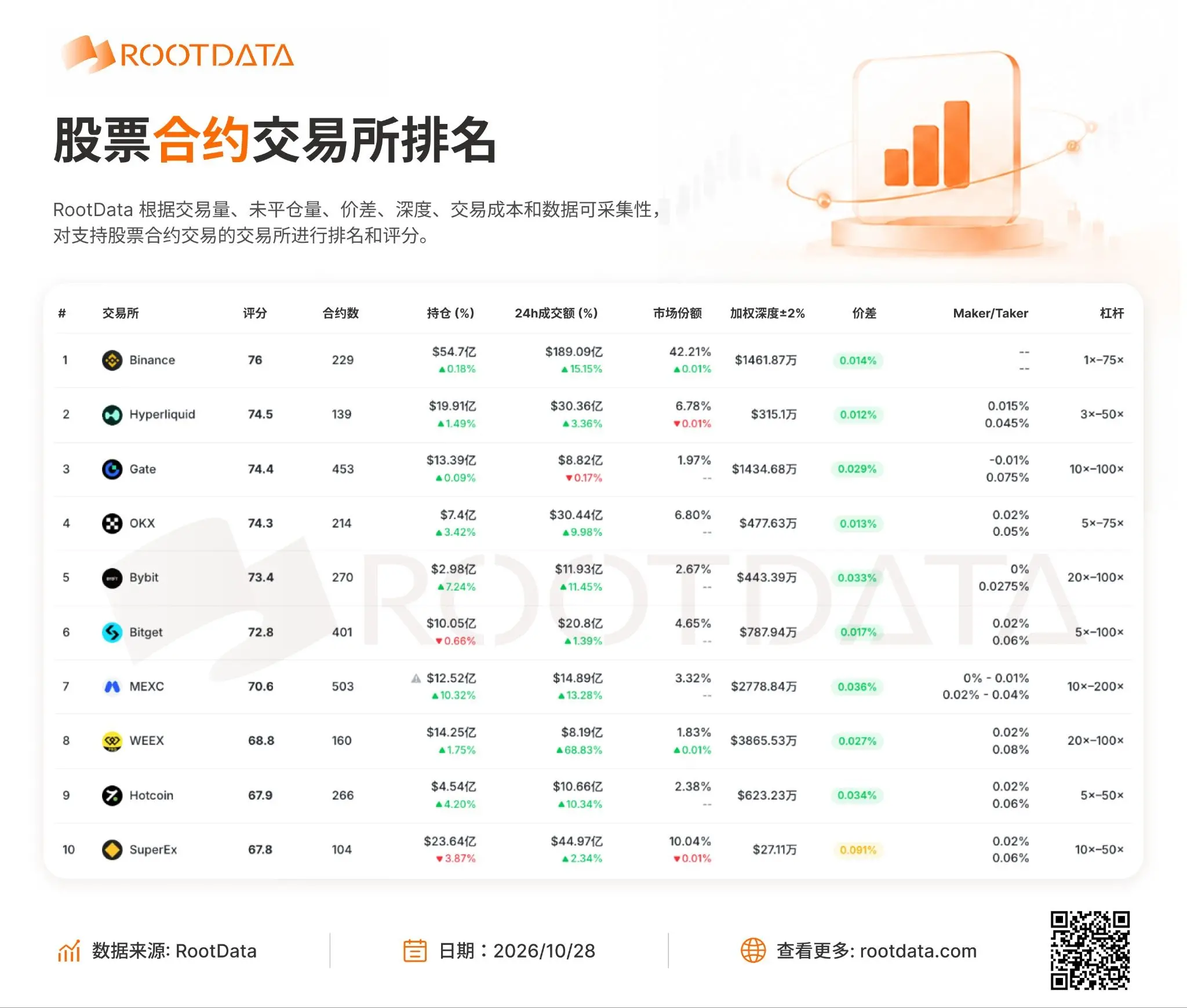
Additionally, RootData compares prices, spreads, liquidity, 24-hour trading volumes, OI, funding rates, leverage, and fees for stock derivatives and stock spots across different exchanges using real-time data.
Through systematic data integration, this information can not only serve front-end information disclosure but is also expected to play a role in institutional services, project research, and business expansion scenarios, helping the platform present and understand tokenized assets more comprehensively.
This also means that, in the development of tokenized business, data infrastructure needs to be upgraded in sync with asset and trading infrastructure. Competition between platforms will not only be reflected in asset types, liquidity, and trading experiences but will gradually extend to information organization, information disclosure, and data calling capabilities.
### RootData opens tokenized data, potentially extending tokenization competition to the data layer
For RootData, this cooperation further expands its data service boundaries in leading platforms and diverse business scenarios.
Previously, Binance Alpha deeply integrated RootData's team information, allowing users to more conveniently understand the core members of projects and their industry influence before trading, enhancing the platform's information transparency. Meanwhile, RootData's data capabilities continue to enter various scenarios such as wallets, trading platforms, security institutions, and investment research tools.
The collaboration with Payward further covers information disclosure, tokenized stocks, institutional services, and business expansion, extending its data services to comprehensive financial infrastructure.
Currently, RootData's API has over 260 clients, covering well-known platforms such as Ethereum Foundation, Binance Wallet, OKX Wallet, CertiK, Coinglass, and Coinone.
These collaborations indicate that RootData's data is no longer just a project database for a single platform but plays a role in providing standardized data across multiple leading platforms. Through APIs and other forms, its data capabilities are embedded in different products and business processes, becoming a foundational data infrastructure for multiple scenarios.
From Binance Alpha to Payward, RootData's collaboration scenarios are extending from user-facing project displays to tokenized finance and institutional services. Data is no longer just helping users understand projects but is playing a foundational support role in the business operations of more platforms.
As the RWA and tokenization business continues to develop, standardized and structured data will become an important foundation for information disclosure and business collaboration. This cooperation is expected to further promote RootData's data capabilities into more tokenized and institutional service scenarios, aiding the industry in accelerating the expansion of emerging finance such as tokenization and pushing tokenization competition from assets and traffic further towards data and information infrastructure construction.